
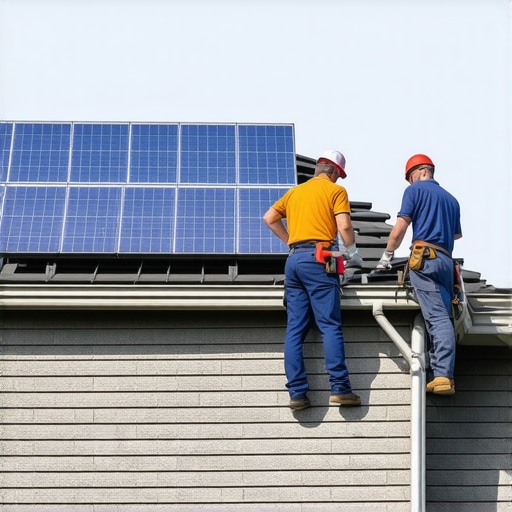
The Solar Infiltration: Why Your Roof Might Be a Ticking Time Bomb
I’ve spent 25 years on the deck, and if there’s one thing I’ve learned, it’s that a roof wants to be left alone. Every time a roofing company punches a hole in those shingles to install a solar hook, they aren’t just adding a bracket; they’re performing surgery without an anesthetic. I remember a forensic call-out in the high desert where the homeowner’s living room ceiling looked like a topography map of the Atlantic. Walking on that roof felt like walking on a sponge; I knew exactly what I’d find underneath. The solar crew had missed the rafters on half the mounts, leaving a dozen ‘shiners’—those missed nails and bolts—to act as perfect conduits for water. They didn’t see the leaks for two years because the insulation was soaking it up like a thirsty camel. By the time it hit the drywall, the plywood was a blackened, moldy mess of oatmeal. This is the reality when you prioritize ‘green energy’ over basic physics.
The Desert Physics of Failure
In the Southwest, we don’t just deal with rain; we deal with a brutal thermal cycle that makes materials scream. When you bolt a piece of heavy aluminum solar hardware to a roof, you’re introducing a material with a completely different expansion coefficient than asphalt or wood. During a 115°F afternoon, that metal hook is scorching. It expands, pushing against the sealant and the fasteners. When the sun drops and the desert air cools by forty degrees in an hour, it shrinks. This ‘thermal tug-of-war’ is a constant vibration. If your roofing companies didn’t use a high-temp underlayment, that heat transfer will bake the bitumen right out of the felt until it’s as brittle as a cracker. You start seeing underlayment tears that no one will notice until the first monsoon hits.
“A roof is only as good as its flashing.” – Old Roofer’s Adage
The mechanism of failure is rarely a catastrophic hole. It’s a slow, quiet process called capillary action. Water hits the base of a solar hook and, instead of running off, it gets pulled sideways into the microscopic gaps between the bracket and the shingle. Once it’s under there, it finds the lag bolt. If that bolt isn’t seated in the dead center of a rafter, or if the ‘pro’ just used a glob of cheap silicone, the water follows the threads of the bolt straight into the roof deck. That’s how you get roof decking decay while your solar app tells you everything is sunny.
Question 1: Are You Hitting the Meat or Creating ‘Shiners’?
The biggest sin in solar installation is the ‘shiner.’ This happens when a tech sends a lag bolt through the deck but misses the rafter. In a 2,500-square-foot roof, you might have eighty penetrations. If even 5% are shiners, you have four direct paths for water to enter your attic. You need to ask your roofing companies how they verify rafter hits. Do they use a hammer-tap method (which is prone to error) or do they use modern tools like heat cameras to locate the thermal mass of the rafters before they drill? If they don’t have a precise way to hit the meat of the wood, they’re just playing Russian roulette with your structural integrity.
Question 2: What Is the High-Temp Rating of Your Underlayment?
Standard #15 or #30 felt is a joke under solar panels. In the desert, the space between the panel and the roof acts like an oven, trapping heat and creating attic heat spikes that can reach 160°F. You need a synthetic underlayment or a modified bitumen sheet that is rated for at least 250°F. If they are installing solar on an existing roof, they need to check for fastener failure in the older materials. Solar is a 25-year commitment; if your underlayment only has five years of life left, you’re paying for the solar removal and re-installation twice. That’s a ‘trunk slammer’ special that will drain your bank account faster than a leak drains into your attic.
Question 3: Mechanical Flashing or ‘The Goop Method’?
If a contractor tells you they ‘seal’ the hooks with a proprietary sealant and no metal flashing, show them the door. Sealant is a secondary line of defense, not the primary. In the Southwest UV, even the best ‘lifetime’ caulk will dry out and crack within seven years. You want to see a dead-level, metal-on-metal flashing system that slides under the course of shingles above the penetration. This ensures that gravity is doing the work, not a chemical bond that is fighting the sun. Without proper flashing, you’ll eventually see nail pop leaks and bracket lifting that ruins the whole ‘square’ of shingles.
Question 4: How Do We Manage the Structural Load and Vibration?
A solar array is essentially a giant sail. When high winds whip through the valley, those panels want to lift. This creates ‘uplift pressure’ on the hooks. If the roofing company hasn’t accounted for the spacing of the mounts based on your specific wind zone, the constant vibration can loosen the fasteners. You need to ask about solar brackets and their specific pull-out ratings. This isn’t just about keeping the panels on the roof; it’s about making sure the hooks don’t wiggle and widen the holes in your rafters, which is a leading cause of long-term structural rot.
“Roofing systems shall be designed and installed in accordance with this code and the manufacturer’s installation instructions.” – International Residential Code (IRC) R903.1
The Bitter Truth About Warranties
Don’t fall for the ‘Lifetime Warranty’ on the panels. That warranty rarely covers the roof penetrations if the leak was caused by ‘improper installation’—and guess who gets to decide if it was improper? The solar company will blame the roofer, and the roofer will blame the solar company. You’re the one left holding the bucket. Before you sign, ensure there is a clear, written agreement between the roofing companies and the solar installers regarding the ‘watertightness’ of every single penetration. If you see signs of decking rot, it’s already too late for a simple fix. You’re looking at a full-scale surgery. Solar is great, but don’t let the promise of a lower electric bill blind you to the fact that your roof’s primary job is to keep the outside *out*. If you compromise the skin for the sake of the sun, you haven’t saved a dime.