
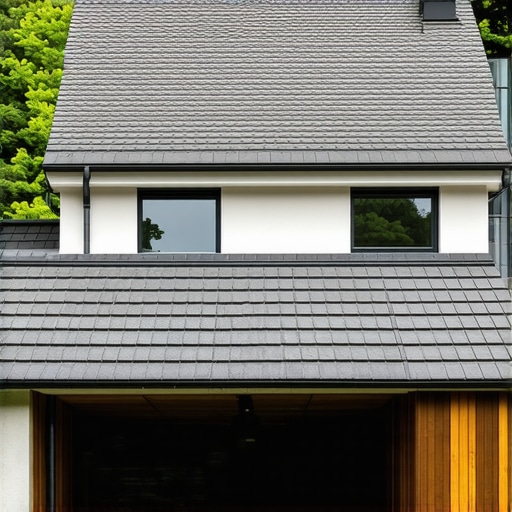
The High Price of Aesthetic Vanity and the New Solution
I have spent three decades watching homeowners in the Northeast fall in love with the look of heavy, natural slate only to watch their bank accounts bleed out when the structural reality sets in. Real slate is a beast. It is beautiful, sure, but it weighs enough to crush a standard ranch-style frame if the rafters aren’t beefed up. When a local roofer tells you that you can have that 100-year look without the 100-year structural nightmare, you usually smell a scam. But 2026 has brought something different to the job site: high-performance recycled slate tiles. My old foreman used to say, ‘Water is patient. It will wait for you to make a mistake.’ And he was right. Most synthetic materials of the past decade were just glorified plastic that curled like a cheap sandwich in the sun. But the chemistry in these newer recycled composites is finally catching up to the physics of the roof deck. We are seeing materials that handle the freeze-thaw cycles of a Pennsylvania winter without shattering into a thousand gray shards.
“Roofing assemblies shall be designed and installed in accordance with this code and the manufacturer’s installation instructions.” – International Residential Code (IRC), Section R903.1
The problem with traditional asphalt is that it is essentially a paper or fiberglass mat soaked in oil. Once the UV rays cook that oil out, the shingles get brittle and start shedding granules like a dog with the mange. You end up with decking rot because the water starts find its way through the micro-cracks. Recycled slate, particularly the 2026 iterations, uses a blend of post-industrial polymers and actual stone dust. This creates a tile that isn’t just a covering; it’s an armor plate. When we talk about these tiles, we aren’t talking about thin imitation stuff. We are talking about deep-profile, compression-molded units that have the heft to resist wind uplift but are light enough that you don’t need a structural engineer on speed dial.
1. Structural Weight and the Physics of the Load
The first benefit is purely about gravity. A square—that’s 100 square feet in trade talk—of natural slate can weigh anywhere from 800 to 1,500 pounds. That is a massive load for a house designed for 300-pound asphalt shingles. If you put real slate on a house without reinforcement, you’ll start seeing the ridge line sag like an old horse’s back. Recycled slate tiles come in at about a third of that weight. This means you get the aesthetic depth—those thick, chiseled edges that cast long shadows—without having to rip open your drywall to sister the rafters. Local roofing companies are jumping on this because it shortens the job cycle. We can get the old trash off and the new recycled tiles on without waiting for a structural permit. If you have noticed sagging lines on your current roof, adding heavy natural stone would be a death sentence for the building.
2. Impact Resistance and the ‘Hail Alley’ Factor
In our neck of the woods, spring storms don’t just bring rain; they bring ice stones. Natural slate is hard, but it is also brittle. Hit it with a hammer, and it rings; hit it with a big piece of hail, and it cracks. Once a slate tile cracks, the capillary action takes over. Water gets sucked behind the tile, travels sideways, and finds the one nail pop you didn’t see. The recycled slate of 2026 carries a Class 4 impact rating. This isn’t just marketing fluff. It means you can literally stomp on these tiles and they won’t snap. The polymers provide a level of flex. During a thermal shock event—where the roof goes from 140 degrees in the sun to 60 degrees in a sudden downpour—the material expands and contracts without internal stress fractures. This is why roofing companies love 2026 recycled slate; it reduces the number of ‘nuisance’ call-backs after every thunderstorm.
“The primary purpose of a roof is to shed water, but its secondary purpose is to protect the structure from the kinetic energy of the environment.” – NRCA Manual excerpt
3. Thermal Performance and Attic Climate Control
Most people think a roof is just a lid. They don’t understand the thermodynamics. In the winter, your attic is a battleground. Warm air leaks from your living space—what we call an attic bypass—and hits the cold underside of the roof deck. If your roofing material is too conductive, you get condensation. That condensation turns into the smell of wet earth and eventually grows mold. Recycled slate tiles act as a better insulator than thin asphalt. Because they are thicker, they create a more significant thermal break. When paired with proper airflow management, these tiles help keep the roof deck temperature uniform. This is the secret to preventing ice dams. An ice dam happens when the bottom of the snow layer melts, runs down to the cold eave, and freezes. If your roof material helps maintain a consistent temperature, you don’t get that melt-freeze cycle. You avoid the horror of water backing up under the tiles and rotting out your soffits.
4. Longevity Without the ‘Trunk Slammer’ Risk
The fourth benefit is the sheer lifespan compared to the cost. A ‘trunk slammer’ contractor will offer you a ‘Lifetime Warranty’ on a cheap asphalt shingle, but that warranty is usually pro-rated and doesn’t cover labor after a few years. It’s a paper shield. Recycled slate tiles are built to last 50-plus years because they don’t have the organic components that rot. There is no wood fiber or asphalt oil to break down. They are inert. When we install these, we use stainless steel fasteners because the tiles will actually outlast standard galvanized nails. If you use cheap nails, you’ll get a ‘shiner’—a missed or poorly driven nail—that rusts out and causes a leak while the tile is still perfectly good. We often see homeowners needing valley leak repairs because the previous installer used cheap flashing with high-end tiles. With recycled slate, the goal is a system where every component matches that 50-year horizon. You aren’t just buying a roof; you’re buying the end of your roofing problems for the next two decades.
The Forensic Reality: Why Quality Matters
I recently did an inspection on a Tudor-style home where the owner had ‘saved money’ by going with a mid-grade asphalt that mimicked slate. Five years in, the shingles were ‘cupping’—the edges were curling up toward the sun. This created a perfect wind-catch. During a minor windstorm, the shingles started flapping, breaking the sealant bond. Once that bond is gone, the roof is toast. You can’t just glue it back down and expect it to hold. When we tore it off, the plywood underneath looked like it had been through a car wash. The recycled slate tiles avoid this because of their weight and interlocking designs. They don’t rely on a thin strip of adhesive; they rely on mechanical fastening and gravity. If you’re looking at your roof and seeing ridge decay or bald spots where the granules used to be, you are already on borrowed time. The cost of a full replacement is high, but the cost of replacing your rafters, insulation, and ceiling drywall because you waited is triple. Don’t be the homeowner who waits for the dining room table to get wet before taking the roof seriously. Recycled slate isn’t just about looking rich; it’s about being smart enough to only do this job once.