
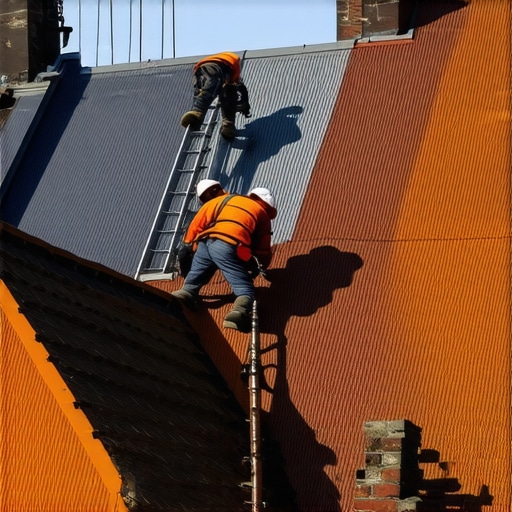
The Spongy Death of a Commercial Flat Roof
Walking on that roof felt like walking on a sponge. I knew exactly what I’d find underneath. This was a 400-square job in the heart of the humid Southeast, where the air stays thick enough to drink and the UV rays chew through standard modified bitumen like a chainsaw through warm butter. My boots sank three inches into the saturated insulation with every step. The owner thought a simple patch would fix the leaks in the breakroom, but he didn’t realize the capillary action had already pulled a hundred gallons of moisture sideways under his laps. This is why local roofers are abandoning the old ‘tear-off and replace’ playbook. The economics of labor and the sheer physics of tropical humidity are driving a massive shift toward 2026 hybrid coatings.
“A roof system must be designed to manage moisture both from the exterior and the interior environment, particularly in high-humidity zones where vapor drive is constant.” – General Principles of the NRCA
The Molecular Muscle: Why Hybrids Outperform Acrylics
For years, roofing companies relied on pure acrylics or pure silicones. Acrylics are cheap but they turn into brittle crackers after five years of thermal shock. Silicones handle ponding water well but they attract dirt like a magnet and have zero tensile strength—if a maintenance tech drops a tool, he’s poked a hole in your roof. Enter the 2026 hybrid coatings. These systems, often a blend of high-solids silicone and urethane, offer the UV resistance of silicone with the physical ‘muscle’ of a urethane. When you apply these, you aren’t just painting; you are initiating a cross-linking chemical reaction that creates a monolithic membrane. We aren’t worried about hybrid seams failing because, technically, there are no seams. It’s one continuous sheet of high-performance rubber bonded directly to the substrate.
The Physics of Failure: Capillary Action and Surface Tension
Most leaks aren’t from giant holes. They come from microscopic gaps where surface tension pulls water uphill. In the Southeast, wind-driven rain can push moisture into the smallest underlayment tears. When a roofer installs a standard shingle or mod-bit system, they are creating thousands of potential failure points—nails, laps, and transitions. If a guy leaves a shiner (a nail that missed the joist), that metal shank becomes a thermal bridge. Cold morning air hits that warm nail, condensation forms, and drip-drip-drip, you’ve got rot. Hybrid coatings eliminate this by encapsulating every fastener and transition in a liquid-applied shield that cures into a 40-mil thick skin. It’s the difference between wearing a chainmail suit and a rubber diving suit during a hurricane.
The Material Comparison: Cost vs. Longevity
Let’s talk turkey. A full tear-off in 2026 is a logistical nightmare. You have crane permits, dumpster fees, and the risk of leaving the deck exposed to a sudden 3 PM downpour. If you’ve got decking rot, you have no choice—you have to tear it out. But for a roof that’s just ‘aged out,’ roofing companies are pushing hybrids because they cost about 40% less per square than a full replacement. You bypass the landfill and you get a reflective surface that drops attic temperatures by thirty degrees. In the 140°F heat of a Florida summer, that’s not just a comfort issue; it’s the difference between your HVAC units lasting fifteen years or burning out in seven. I’ve seen units struggle to keep up because the roof was a giant black heat-sink, radiating infrared energy into the plenum 24/7.
“Roofing materials shall be compatible with each other and the substrate to which they are applied to prevent premature deterioration.” – International Residential Code (IRC) R902
The Trap: The ‘Lifetime Warranty’ Shell Game
Don’t get suckered by the marketing gloss. Most ‘Lifetime Warranties’ are written by lawyers to ensure the manufacturer never pays a dime. They exclude ponding water, ‘acts of God’ (which apparently includes rain in some states), and lack of maintenance. A 2026 hybrid coating is only as good as the prep work. If a local roofer doesn’t perform a pull test to check adhesion, they are just ‘painting over the problem.’ I’ve seen coatings peel off in sheets because the contractor didn’t wash the grease off the old roof. You want an NDL (No Dollar Limit) warranty that covers both labor and material. That forces the manufacturer to send an inspector to the site to make sure the cricket is installed correctly and the drains are clear before they sign off. If you ignore the details, you’ll eventually deal with structural failure, which costs triple to fix.
How to Pick a Contractor Who Isn’t a ‘Trunk Slammer’
The barrier to entry for liquid-applied coatings is low, which means every guy with a pressure washer and a bucket thinks he’s a coating expert. You need to ask about their equipment. Are they using airless sprayers that can handle high-solids material, or are they thinning it out with solvents to make it spray easier? Thinning the product kills the molecular bond. Check their understanding of high winds and uplift ratings. A real pro will look at your flashings, your scuppers, and your penetrations before they even talk about the coating. They’ll look for signs of acrylic seals that have failed previously. If they don’t mention a moisture scan to find hidden wet insulation, walk away. You can’t coat over wet wood; you’re just sealing in the rot.