
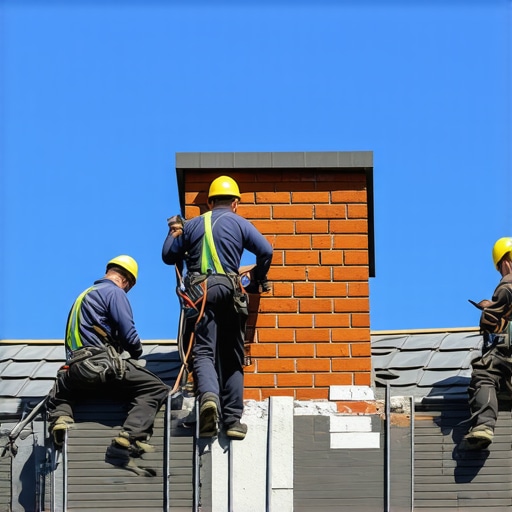
The Anatomy of a Phantom Drip: Why Your Fireplace is Leaking
You’re sitting in your living room in the middle of a November Nor’easter when you hear it—the rhythmic plink-plink-plink against the firebox. Most homeowners think they have a chimney cap problem. They buy a new one, yet the water keeps coming. As a forensic roofer who has spent three decades on steep-slope structures, I can tell you that the chimney is the most misunderstood component of the entire roofing system. It is a vertical protrusion that acts as a dam against every gallon of water running down your roof deck. If the integration between the masonry and the shingles isn’t perfect, the physics of water will find the path of least resistance every single time.
My old foreman used to say, ‘Water is patient. It will wait for you to make a mistake.’ He didn’t mean a big mistake like forgetting a shingle; he meant the tiny, invisible errors. A 1/16th inch gap in a solder joint or a slightly bent piece of step flashing is enough to allow capillary action to draw moisture uphill and behind your interior drywall. By the time you see a brown stain on the ceiling, the plywood underneath has likely been wet for months. This is why 2026 roofing companies are moving away from the ‘caulk and crawl’ methods of the past and toward forensic-level diagnostics.
The Physics of Failure: Capillary Action and Differential Expansion
To understand how 2026 roofing companies solve these issues, you have to understand the ‘Mechanism of Failure.’ A chimney and a roof are two different structures with two different densities. They expand and contract at different rates as the sun hits them. This ‘differential expansion’ is the primary reason why simple beads of caulk fail within three years. When the masonry heats up to 140°F and the wood framing stays at 80°F, the bond between them literally tears itself apart. Water then uses capillary action—the ability of a liquid to flow in narrow spaces without the assistance of external forces—to ‘wick’ its way between the flashing and the brick.
“A roof is only as good as its flashing.” – Old Roofer’s Adage
In the cold climate zones of the North, we also deal with the ‘sponge effect’ of old brick. Bricks are porous. During a heavy freeze-thaw cycle, moisture enters the brick face, freezes, and creates micro-fissures. Modern roofing professionals now use heat cameras to see where the thermal envelope is leaking. If warm air from your house is escaping into the attic and hitting the cold masonry of the chimney, it creates condensation. That ‘leak’ you see might not even be rain; it could be ‘attic rain’ caused by poor air sealing.
The 2026 Strategy: From ‘Band-Aids’ to Precision Surgery
When you hire local roofers today, the conversation shouldn’t start with a ladder; it should start with data. High-end roofing companies now use thermal imaging and LiDAR to map the exact contours of the chimney-to-roof transition. One of the most common points of failure we find during these autopsies is the ‘Shiner.’ A shiner is a nail that was driven into the wrong spot—usually too close to the valley or right through the flashing. Over time, the metal expands, the nail pops, and you have a direct conduit for water to travel into the rafters. This often leads to fascia board decay that can compromise the entire eaves of the home.
The solution isn’t more goop. It’s a two-part flashing system. First, we install step-flashing: individual L-shaped pieces of metal that weave into every course of shingles. Then, we install counter-flashing: a second layer of metal that is actually reglet-cut into the brick mortar joints. This creates a mechanical shed that doesn’t rely on sealants. However, for those tricky transitions where metal can’t quite bridge the gap, many companies now prefer bio-sealants which maintain flexibility across a much wider temperature range than old-school petroleum products.
The Role of the ‘Cricket’ in Water Diversion
If your chimney is wider than 30 inches, the International Residential Code (IRC) requires a cricket. Think of a cricket as a mini-roof built behind the chimney to divert water to the sides. Without it, water pools in a ‘dead valley’ behind the masonry. This standing water eventually rots the decking, leading to underlayment rot. I’ve seen chimneys where the ‘local roofers’ just piled on more roofing cement instead of building a proper wood-framed cricket. That’s not roofing; that’s a temporary stay of execution for your ceiling.
“The building envelope must be viewed as a single, integrated system where every penetration is a potential vulnerability.” – NRCA Manual
For historic homes or those wanting the best longevity, modern contractors are returning to traditional materials but with 2026 precision. We are seeing a massive resurgence in lead flashing or heavy-gauge copper for chimney work. These materials are ‘dead soft,’ meaning they can be hammered to fit the exact profile of the brick, providing a seal that lasts 50 years rather than five. If you see chimney flashing rust, it is a sign that the original contractor used cheap galvanized steel. That rust is a cancer; once it starts, the metal becomes porous and must be replaced entirely.
Don’t Wait for the Ceiling to Fall
The cost of a proper chimney repair is usually measured in the hundreds or low thousands. The cost of replacing a rotted structural header and remediating black mold because you ignored a ‘minor’ leak is measured in the tens of thousands. When you evaluate roofing companies, ask them about their flashing methodology. If they don’t mention reglet cuts, step-flashing, or crickets, they aren’t fixing your leak; they’re just hiding it for a while. A real pro looks for the ‘why’ behind the water, not just the ‘where.’ Check your chimney every autumn, look for those tell-tale rust streaks, and keep your attic dry. In this trade, the only thing more expensive than doing it right is doing it twice.