
The Anatomy of a Slow-Motion Disaster
It starts with a sound you can only hear when the house is silent—a rhythmic, metallic tink-tink-tink. Most homeowners ignore it, thinking it is just the house settling or the wind rattling a loose downspout. But to a forensic roofer, that sound is the death knell of a roofing system. I have spent twenty-five years climbing ladders and tearing back layers of deception, and if there is one thing I have learned, it is that water has no ego. My old foreman used to say, ‘Water is patient. It will wait for you to make a mistake.’ By 2026, we are going to see a massive wave of failures from the ‘supply chain’ roofs installed a few years back, specifically at the most vulnerable point: the chimney flashing.
The Physics of the Failure: Why 2026?
We are currently looking at a systemic failure timeline. During the building boom of the early 2020s, many roofing companies were forced to use whatever materials they could get their hands on. Cheap, thin-gauge galvanized steel often replaced the heavy-duty copper or lead-coated materials that a chimney deserves. By 2026, the sacrificial zinc coating on that inferior steel will have oxidized into oblivion. When that happens, the raw steel underneath meets the humid, acidic air of the Northeast, and the chemistry of decay begins. This isn’t just a cosmetic issue; it is a structural pathology. When metal rusts, it expands. As it expands, it pulls away from the masonry, breaking the reglet seal and creating a ‘capillary highway’ for water to bypass your shingles entirely and soak into the headers. Walk into your attic on a humid day; if you smell that metallic, earthy scent of wet rust and damp plywood, the autopsy of your roof has already begun.
“Flashings shall be installed in a manner that prevents moisture from entering the wall or roof through joints in copings, through moisture-permeable materials and at intersections with dissimilar materials.” — International Residential Code (IRC), Section R903.2
Sign 1: The ‘Tea Stain’ and Galvanic Corrosion
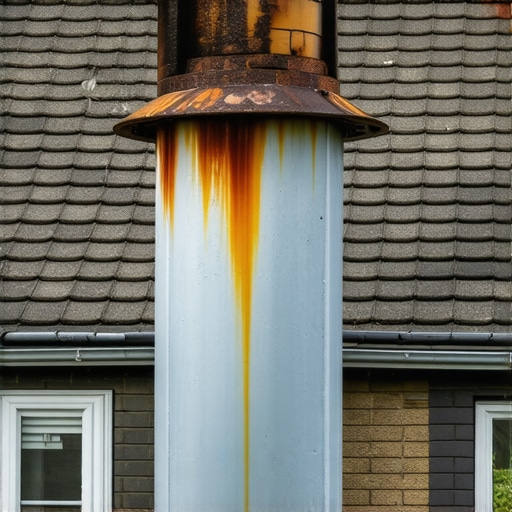
The first sign isn’t a hole; it is a discoloration. Local roofers often see this on white or light-colored shingles—a brownish, orange streak that looks like a tea stain bleeding down from the base of the chimney. This is the byproduct of galvanic corrosion. When you have two dissimilar metals, or even just steel reacting with the minerals in your chimney’s mortar, the water running off the metal carries iron oxide particles. These particles don’t just sit on the surface; they act as an abrasive, eating away the granules of your shingles. If you see these streaks, the ‘zinc shield’ is gone. You are looking at raw, naked iron. In the freeze-thaw cycles of a cold climate, that rust acts like a sponge, holding moisture against the wood deck long after the rain stops. By the time the stain is visible from the street, the plywood underneath is likely reaching the ‘oatmeal stage’—a term we use when the plys delaminate and turn into a soft, pulpy mess that won’t hold a nail.
Sign 2: The Buckling ‘Dead Valley’ and Hidden Crickets
Look at the high side of your chimney. If your chimney is wider than 30 inches, the code requires a ‘cricket’—a small peaked structure designed to divert water around the masonry. Many roofing companies skip this or build it out of scrap wood and cheap flashing. By 2026, the rust in these hidden ‘dead valleys’ becomes a terminal illness. Mechanism zooming: imagine water rushing down a roof slope at twenty miles per hour during a summer thunderstorm. It hits the back of the chimney and stops dead. Without a properly flashed cricket, the water pools. Rust starts at the seams. Because the area is perpetually shaded and damp, the metal thins until it is paper-thin. You might notice the shingles behind the chimney starting to lift or buckle. That is not a shingle problem; it is the rust underneath forcing the metal upward as it oxidizes and expands. It creates a dam, forcing water backward—up and under the shingles in a process called hydrostatic pressure.
“The chimney is the most common point of water infiltration on a residential roof. A roof is only as good as its flashing.” — National Roofing Contractors Association (NRCA)
Sign 3: The Sealant Separation (The Band-Aid Failure)
The third sign is the most dangerous because it looks like a ‘fix.’ If you see gobs of silver roof cement or clear silicone smeared around the top of your metal flashing, you are looking at a ‘trunk slammer’ special. In our trade, we call these ‘shiners’ or ‘Band-Aids.’ Rust doesn’t just eat through the middle of the metal; it attacks the bond between the metal and the brick. Metal and masonry have different thermal expansion coefficients. In the 140°F heat of a summer afternoon, the metal expands. At night, it shrinks. Rust makes the metal brittle, so instead of flexing, it cracks. If your local roofers simply applied caulk to rusted flashing, that caulk will pull away within eighteen months. Look for a gap between the metal and the brick. Even a gap the width of a credit card is enough for capillary action to ‘wick’ water upward, over the top of the flashing, and down the interior face of the chimney. This is how you end up with water dripping out of your fireplace mantel while the roof looks ‘fine’ from the driveway.
The Surgeon’s Approach: Why Replacement is the Only Cure
You cannot ‘fix’ rusted flashing with a tube of goop. Once the iron oxide has compromised the integrity of the steel, the only solution is a surgical tear-off. This involves removing the surrounding shingles (at least two courses), grinding out the mortar joints of the chimney to install a true counter-flashing, and replacing the rusted metal with a heavy-gauge alternative—ideally copper or a high-quality Kynar-coated aluminum. A real pro will install a ‘kick-out’ flashing at the bottom to ensure water is ejected into the gutter rather than being allowed to run down the fascia board. If a contractor quotes you a price that seems too good to be true, they are probably planning to leave the old rusted flashing in place and just ‘pin’ new metal over it. That is like putting a clean bandage over a gangrenous wound. It will look good for a month, and then the whole system will collapse. Don’t let 2026 be the year you have to replace your living room ceiling because you tried to save a few hundred bucks on a chimney repair.