
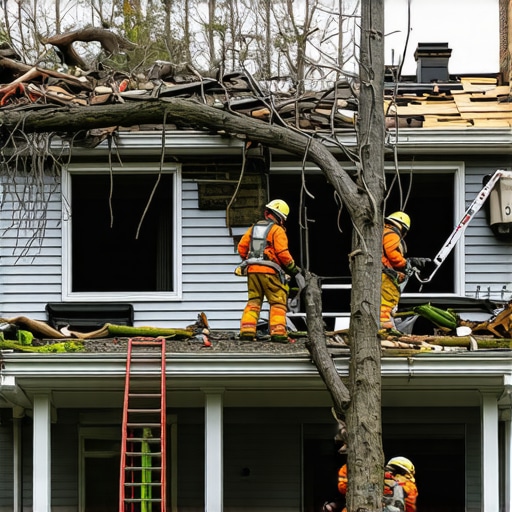
The 2:00 AM Wake-Up Call You Never Wanted
The sound isn’t just a thud. When a 500-pound oak limb decides to part ways with its trunk and meet your roof, it’s a visceral, bone-shaking crack that resonates through the framing. Most homeowners rush outside with a flashlight, see the leaves hanging over the gutter, and think, ‘I’ll call someone in the morning.’ That’s the first mistake. By the time you’ve had your coffee, the secondary damage—the kind the insurance adjuster will try to call ‘pre-existing’—has already started its slow crawl through your insulation.
Walking on that roof felt like walking on a sponge. I knew exactly what I’d find underneath. Last year, I did a forensic teardown in Miami after a tropical squall dropped a mahogany branch across a ridge. From the ground, it looked like a few mangled shingles. But once I got the harness on and felt the deck deflect under my boots, the truth came out. The impact hadn’t just broken the asphalt; it had sheared the nails right out of the rafters, leaving a gap where wind-driven rain was literally being pumped into the attic through a shiner—one of those missed nails that now acted as a straw for every drop of water hitting the deck.
The Physics of the Strike: It’s Not Just Weight
When we talk about emergency repairs, we have to talk about kinetic energy. A fallen limb doesn’t just sit there; it punches. This is what I call the ‘Hammer Effect.’ The initial impact creates a localized compression of the asphalt shingles, often pulverizing the fiberglass mat inside. Even if the shingle looks ‘okay,’ the waterproofing integrity is gone. You’re now looking at capillary action. Water doesn’t just fall into a hole; it finds the tightest spaces between the damaged shingle and the underlayment and moves sideways, defying gravity to find a seam in the plywood.
“A roof is only as good as its flashing.” – Old Roofer’s Adage
In the Southeast, where the humidity is a constant 90%, that water doesn’t dry. It sits on the decking, soaking into the edges of the 4×8 sheets. If you don’t get a pro out there fast, you’re looking at hidden decking plywood decay within weeks. The wood fibers swell, the glue fails, and suddenly your structural ‘diaphragm’ is as strong as a wet cereal box.
The Forensic Autopsy: Anatomy of a Puncture
Let’s look at the actual anatomy of a limb strike. First, you have the Point of Impact. This is where the structural rafters take the brunt. If the limb hit near a valley or a cricket, you’re in deep trouble. These are the high-volume water highways of your roof. A puncture here is like a hole in a dam. You need to identify if you have a weakened roof spine, which happens when the ridge board is cracked by the weight.
Second, there is the Shear Zone. This is where the limb slid down the roof. It’s not just about the hole; it’s about the thousands of ceramic granules that were scraped off. Those granules are the only thing protecting your shingles from UV radiation. Without them, the sun in places like Houston or Orlando will bake the exposed bitumen until it cracks like a dry riverbed. Most local roofers will just slap a ‘California patch’ over the hole and call it a day, but a real veteran knows you have to check the felt or the synthetic shingle felt pad for tears that aren’t visible from the surface.
The ‘Band-Aid’ vs. The Surgery
When the storm is still howling, you can’t do a full repair. You need a triage plan. This is where immediate leak storm patches come into play. But don’t just throw a blue tarp up with some bricks. Tarps should be ‘sandwiched’ with 2×4 furring strips and nailed into the rafters, not just the sheathing. If you nail into just the plywood, the first 40mph gust will rip that tarp off, taking the remaining shingles with it.
“Water is the most patient architect; it will find every crack you didn’t know existed.” – Structural Engineering Axiom
Once the sun comes out, the ‘surgery’ begins. This isn’t a DIY job. You need roofing companies that understand forensic evidence. They need to pull back the shingles at least two feet in every direction from the impact site. Why? Because water travels. If you only fix the hole, you’re ignoring the damp insulation that’s currently growing a colony of black mold. You’ll eventually see unforeseen wood rot appearing on your rafters three years from now, and your insurance won’t cover it because you didn’t mitigate the damage properly on day one.
Hiring the Right Local Roofers for Storm Damage
Beware the ‘truck slammers’ who appear after a heavy branch falls. They’ll offer a cheap price to ‘swap a few squares’ of shingles. A square is 100 square feet, and they’ll try to convince you that’s all it takes. But did they check the flashing? Did they check the drip edge? When a limb falls, it often bends the metal drip edge, creating a ‘back-pitch’ where water can actually run uphill behind your fascia boards.
You need to find local roofers who specialize in storm damage. Ask them about ‘secondary water resistance’ (SWR). In high-wind zones, this is the difference between a dry house and a total loss. They should be looking for hairline fractures in the decking and checking for ‘uplift’ issues where the impact might have loosened the hurricane clips in your attic. If they don’t go into the attic with a high-lumen spotlight, they aren’t doing their job. They need to look for daylight peeking through or the tell-tale ‘weeping’ of rusted nails.
The Long-Term Cost of Neglect
The cost of an emergency repair is always lower than the cost of a full structural restoration. If you ignore a limb strike, you aren’t just risking a leak; you’re risking the ‘spine’ of your home. Over time, that damp plywood will delaminate. The rafters will start to ‘bow’ under the constant weight of the roof load. Eventually, you’ll see the shingles start to ‘dip,’ a sign of structural failure that requires a full tear-off and re-decking—a $20,000 problem that started with a $500 branch. Don’t wait for the ceiling to sag. Get a forensic inspection, document every fractured fiber of that wood, and make sure the roofing work is done to code, not just to a price point.