
The Forensic Reality of Flat Roofing
Walking on that roof felt like walking on a sponge. I knew exactly what I’d find underneath. It was a humid afternoon in a coastal city, and the building manager was convinced he just had a minor leak near a vent. But the moment my boots hit that membrane, the physics told a different story. You see, water is patient, and on a flat roof, it has all the time in the world to find your mistakes. I’ve spent 25 years watching ‘budget’ roofing companies slap down a few squares of material only to have the entire system fail because they didn’t understand hydrostatic pressure. Most local roofers can nail a shingle, but a flat roof? That’s not roofing; that’s fluid dynamics. If your roof isn’t shedding water, it’s just a swimming pool waiting for an invitation to your living room. In this climate, the salt air and relentless humidity turn every tiny ‘shiner’ or missed seal into a gateway for structural rot.
“A roof is only as good as its flashing.” – Old Roofer’s Adage
1. The Seam: Where Molecular Failure Begins
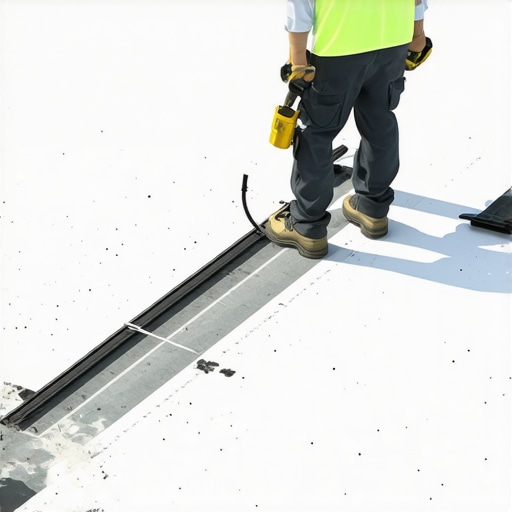
The first thing I look at during a forensic inspection isn’t the middle of the field; it’s the seams. On a TPO or PVC roof, those seams are supposed to be heat-welded into a single monolithic sheet. When a crew is rushing, they don’t get the temperature right on the robot or the hand-welder. This creates what we call a ‘cold weld.’ It looks fine to the naked eye, but under the heat of a 140°F afternoon, the materials expand at different rates. Capillary action then takes over. Water doesn’t just fall into a hole; it gets sucked into micro-fissures through surface tension. Once it hits the polyester scrim—the reinforcement layer inside the membrane—it acts like a wick. It pulls moisture feet away from the actual leak, saturating the insulation. This is why you need PVC seam welding done by someone who actually knows how to calibrate their equipment for the ambient humidity. If those seams aren’t fused at a molecular level, you’re just waiting for the next tropical depression to turn your ceiling into a waterfall.
2. The ‘Birdbath’ and the Physics of Ponding Water
The second critical point is drainage. ‘Flat’ is a lie; no roof should be truly flat. We look for a 1/4-inch per foot slope. When that slope is missing, you get ‘birdbaths’—areas of standing water that sit for more than 48 hours. Most people think the weight is the problem. It’s not. The problem is the magnifying glass effect. Standing water focuses UV radiation directly onto the membrane, cooking the plasticizers out of it. The membrane becomes brittle, cracks, and then the hydrostatic pressure of the water sitting on top of those cracks pushes the moisture through. This is why you must identify ponding water before it leads to structural deflection. If I see a roof with deep ponding, I know the ‘crickets’—the small angled diversions we build—were either omitted or sized incorrectly. Proper flat roof drainage requires a forensic understanding of how water moves across a plane. Without it, your roof is basically a petri dish for algae and membrane decay. I’ve seen standing water on flats eat through a multi-layer bitumen system in less than five years because the installer didn’t understand the basic geometry of a scupper.
“The most expensive roof is the one you have to pay for twice.” – Forensic Roofing Axiom
3. Penetrations: The Scupper and the Flashing Nightmare
The third point, and the one that causes 90% of my service calls, is the penetrations. Vents, HVAC curbs, and drains are the ‘weak links’ in the chain. I often find that roofing companies used a standard caulk or cheap mastic to seal these areas instead of proper flashing. In a tropical climate, the thermal expansion is violent. The metal of a vent pipe heats up and expands significantly faster than the roofing membrane. This ‘differential movement’ shears the seal. A professional doesn’t rely on goop in a tube; we use pitch pockets or pre-fabricated boots that allow for movement. If you’re seeing decking rot behind gutters or around drains, it’s because the transition from the horizontal field to the vertical penetration failed. We also look for ‘bridging,’ where the membrane isn’t tucked tightly into the corner of a curb, creating a void that pops under the first heavy footstep. This is why a flat roof seam safety check is non-negotiable every six months. You’re looking for the ‘smile’—that tiny gap at the edge of a flashing that says the adhesive has given up the ghost.
The Band-Aid vs. The Surgery
When I find these issues, owners always ask for a quick fix. ‘Can’t we just coat it?’ they ask. Sure, you can put a coating on a wet roof, but you’re just gift-wrapping a disaster. If the insulation underneath is saturated—which I check with an infrared camera or a moisture probe—no amount of ‘cool roof’ coating will save you. You’re just trapping the moisture, which will turn to steam under the sun and blow huge blisters in your new coating. The ‘surgery’ involves cutting out the wet sections, replacing the polyiso board, and properly welding a new patch. It’s expensive, but it’s cheaper than replacing the entire deck because you let the rot spread. Don’t let a ‘trunk slammer’ tell you a bucket of silver paint is a roof restoration. Real roofing is about managing the transition of water from the sky to the ground without letting it take a detour through your rafters.