
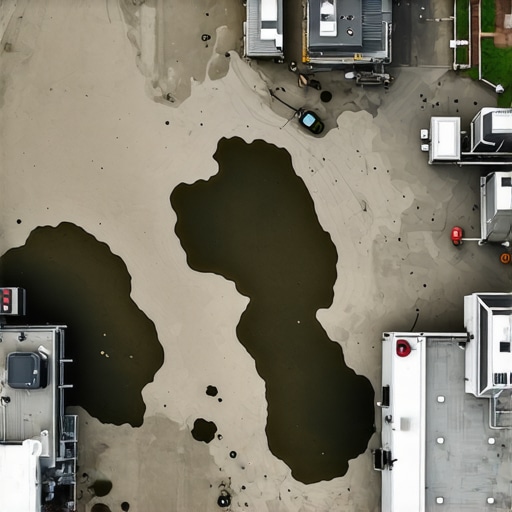
The Mirror in the Sky: Why Your Flat Roof is Actually a Lake
I’ve spent twenty-five years walking industrial roof decks, and if there’s one thing I’ve learned, it’s that most facility managers don’t see a roof; they see a headache they hope goes away. You walk out onto a TPO or EPDM surface forty-eight hours after a rainstorm, and you see it—a shimmering, still pool of water reflecting the sun right back at you. Most local roofers will tell you it’s ‘just a little dip.’ I’m here to tell you that dip is a structural cancer. My old foreman used to say, ‘Water is patient. It will wait for you to make a mistake, and then it will sit on that mistake until it rots its way through to the machinery below.’ When water stands for more than forty-eight hours, we call it ponding. It’s not just wet; it’s a heavy, high-pressure weight that’s actively trying to find a shiner in your decking or a weak lap-seam in your membrane.
“Standing water (ponding) shall not be allowed on the roof membrane. The roof system shall be designed to provide positive drainage.” – International Building Code (IBC) Section 1503.4
In the high-heat environments of the Southwest, ponding water isn’t just a weight issue; it’s a magnifying glass. That water acts as a lens, concentrating UV radiation on the membrane. While the rest of your roof is handling the heat, the areas under these ‘birdbaths’ are literally cooking. The plasticizers in your membrane begin to migrate out, leaving the material brittle. Eventually, you’ll see shingle lifting on the transitions or perimeter, but on a flat roof, the failure is much more insidious. It starts with microscopic cracks that undergo capillary action—where the water is literally sucked upward into the insulation board through the tiniest pinhole. If you’ve ever wondered why your energy bills are spiking, it’s likely because your ‘dry’ insulation is now a wet sponge, destroying your R-value and causing attic leaks that you can’t see from the warehouse floor.
The Physics of Failure: Why ‘Dead Level’ is a Death Sentence
The term ‘flat roof’ is a misnomer that keeps roofing companies in business for all the wrong reasons. No roof should be flat. To identify ponding before it causes a collapse, you have to look for the ‘Silt Ring.’ Even when the sun eventually evaporates the water, it leaves behind a dark circle of dirt, pollen, and environmental pollutants. This residue is a heat sink. It absorbs more thermal energy than the surrounding clean membrane, leading to thermal expansion stress. When that area expands at a different rate than the dry area, the seams pull apart. This is why commercial PVC seam welding is so critical; if those seams aren’t fused, they stand no chance against the hydrostatic pressure of five hundred pounds of water sitting on a single square (100 sq. ft.) of roofing.
The Forensic Investigation: Spotting the ‘Hidden’ Pond
Sometimes, the ponding isn’t obvious. You have to look for the structural ‘deflection.’ If you’re inside the building and you see the steel bar joists bowing even slightly, or if the roofing deck feels ‘spongy’ under your boots, you’re looking at a structural compromise. Water weight causes the deck to sag, which creates a deeper hole, which collects more water. It’s a feedback loop of destruction. I once inspected a warehouse where the owner thought he had a minor leak near a curb for an HVAC unit. When we cut a core sample, the plywood had turned to oatmeal because the ponding water had been slowly seeping through a failed flashing for three years. The signs of hidden decking decay were all there, but they were ignored because the ‘pond’ would dry up in the summer heat.
“A roof is only as good as its flashing and its ability to shed water, not store it.” – Old Roofer’s Adage
To truly identify the risk, you need to check your scuppers and drains. If they are the highest point in the ‘lake,’ they were installed improperly. A drain is useless if it’s sitting on a ‘high spot.’ This happens when local roofers don’t account for the thickness of the insulation sumps. You should also check for algae growth. In humid climates, ponding water becomes a petri dish. If you see green or black slime, you have a permanent moisture problem that is eating your membrane’s surface. You can try to scrub it off, but that’s like putting a band-aid on a gunshot wound. You need to address the pitch. This often requires the installation of a cricket—a tapered structure designed to divert water around obstacles like chimneys or large HVAC units—to ensure that water moves toward the drainage system rather than sitting around the base of a curb.
The Fix: Surgery vs. The Band-Aid
When I see a ponding issue, the ‘trunk slammers’ will tell you to just throw some more coating on it. That’s a lie. More coating just adds more weight and doesn’t fix the gravity problem. The ‘Surgery’ involves installing tapered insulation. This is a system where the rigid foam boards are manufactured with a built-in slope, usually 1/8″ or 1/4″ per foot. We rip the old, wet mess off, fix the hidden decking warps, and lay down a system that forces the water to obey the laws of physics. If you’re hiring roofing companies, you need to verify their insurance and ask for a drainage plan, not just a shingle count. If they aren’t talking about slope, they aren’t solving your problem. You should also look into venting large warehouse flat seams to ensure that any residual moisture trapped during the install has a way to escape before it rots the new deck from the inside out.
The Bottom Line on Standing Water
Identifying ponding is about more than just seeing a puddle. It’s about recognizing the smell of stagnant water, the sight of silt rings, and the feel of a sagging deck. If your roof is ‘holding’ water, it is failing. Don’t wait for the water to hit your server room or your production line. Get a forensic inspection that looks at the structural load and the drainage geometry. A roof should be a shield, not a swimming pool. The cost of a proper tapered system is a fraction of the cost of a structural collapse. Take it from someone who has seen the ‘oatmeal’—water never stops moving until you force it off the building.