
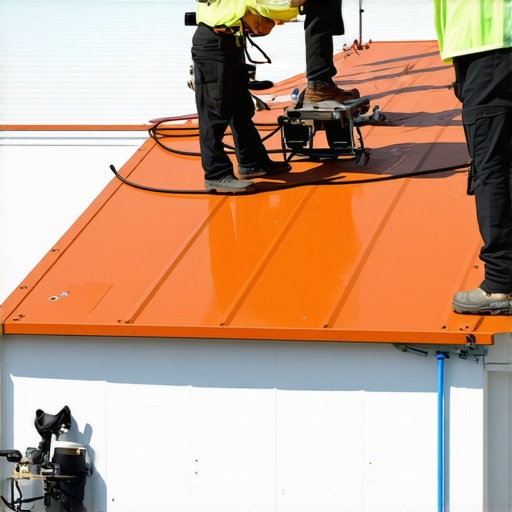
My old foreman used to say, ‘Water is patient. It will wait for you to make a mistake.’ He said that while we were standing on a frozen warehouse deck in a January gale, watching a crew try to glue EPDM seams in twenty-degree weather. Predictably, those seams failed by spring. Glue is a prayer; welding is a fact. In the world of commercial roofing, specifically in these northern corridors where ice dams and thermal bridging turn flat roofs into swimming pools, the way you join two pieces of membrane determines if you’re building a shelter or a liability. When we talk about PVC (Polyvinyl Chloride) seam welding, we aren’t just talking about sticking plastic together. We’re talking about a molecular change that turns individual rolls into a monolithic shield. For roofing companies that actually know their physics, this isn’t optional.
1. The Power of Molecular Fusion
Most roofing systems rely on adhesives or tapes. In a cold climate, adhesive is the weak link. It dries out, it becomes brittle, and it eventually delaminates when the building expands and contracts. PVC welding uses a hot-air gun—usually a Leister or similar walk-behind unit—to heat the overlapping edges to roughly 1100°F. At that temperature, the polymers liquify and intermingle. As they cool, they don’t just bond; they become a single, continuous piece of material. If you try to pull a properly welded seam apart, the membrane itself will tear before the weld breaks. This creates a surface that is virtually impervious to the hydrostatic pressure of standing water. When local roofers encounter signs of underlayment failure, it’s often because the moisture bypassed a glued lap. Welding eliminates that entry point.
“The most common cause of roof membrane failure is the lack of proper workmanship at the seams and flashing.” – NRCA (National Roofing Contractors Association) Guidelines
2. Chemical and Grease Resistance in Urban Environments
Go stand on the roof of any restaurant or manufacturing plant. The smell of grease traps and chemical exhaust is thick enough to chew on. This atmospheric gunk eats through standard asphalt and EPDM like acid through paper. PVC is naturally resistant to animal fats and industrial chemicals. When you weld these seams, you aren’t leaving any exposed adhesive for these chemicals to soften. The weld remains as tough as the field of the roof. Many roofing companies prefer PVC flashing for this exact reason—it handles the high-stress areas around kitchen vents and exhaust stacks without turning into a gummy mess.
3. Superior Performance Against Wind Uplift
Wind doesn’t just blow across a roof; it creates a vacuum that tries to suck the membrane off the deck. In a hurricane or a high-plains windstorm, a glued seam is a point of failure where the wind can get a ‘toehold.’ Once a single lap pops, the rest of the roof follows like a zipper. Because a welded PVC seam is actually stronger than the membrane itself, it distributes the load across the entire system. This is why we focus so heavily on how roofing companies handle high winds through mechanical fastening and heat welding. If you have a ‘shiner’ (a fastener that missed the purlin) and a weak glued seam nearby, you’re looking at a total loss. With PVC welding, the system acts as a unit.
4. Lifecycle Cost and Installation Speed
While the setup for a hot-air welder takes time, the actual speed of a robotic welder is impressive. It’s consistent. It doesn’t get tired. It doesn’t get ‘sloppy’ with the glue brush at 4:00 PM on a Friday. This consistency leads to fewer callbacks. As a forensic investigator, I can tell you that the most expensive roof is the one you have to fix twice. By investing in the equipment and training for PVC welding, roofing companies reduce the long-term maintenance costs for the building owner. You avoid the ‘fishmouths’—those small gaps in the lap where the membrane puckers—which are the primary culprits in roof decking decay.
“A roof is only as good as its flashing.” – Old Roofer’s Adage
The Physics of the Hot Air Weld
To understand why this works, you have to ‘zoom’ into the heat. As the nozzle passes between the sheets, the top and bottom layers reach their glass transition temperature simultaneously. A weighted roller immediately follows the heat, pressing the molten layers together. You’ll see a tiny ‘bleed’ of melted PVC at the edge—that’s your proof of a good weld. If you don’t see that bleed, the tech moved too fast. If it’s charred black, they moved too slow. It’s a craft. It’s why we check airflow in the attic and on the deck; if the roof can’t breathe and the membrane isn’t sealed, condensation will rot your structure from the inside out. Don’t let a ‘trunk slammer’ convince you that ‘tape is just as good.’ In the commercial game, if you aren’t welding, you’re just waiting for a leak. While some companies prefer TPO over PVC for cost reasons, the chemical stability of PVC during the welding process remains the gold standard for many forensic veterans like myself. Check your seams, probe your laps, and don’t settle for adhesives where a weld belongs.