
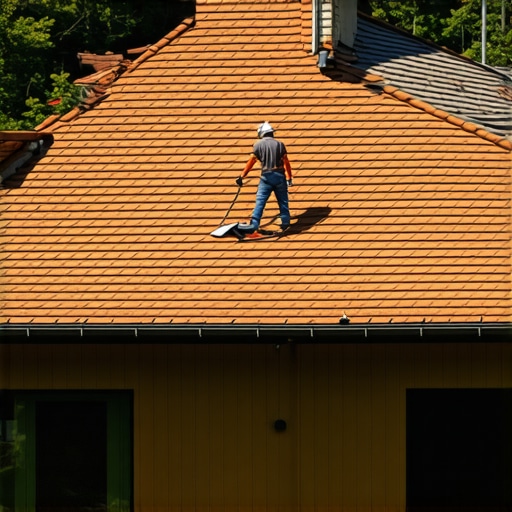
The Flat Roof Reality Check: Why 2026 Has Flipped the Script
Look, I’ve spent three decades smelling hot asphalt and burning my fingertips on heat-welders. If you think PVC is still the undisputed king of flat roofing, you’re living in 2010. By 2026, the game changed. I’ve seen enough failed membranes to know when a material is coasting on its reputation, and for a long time, that was TPO. But the 2026 formulations have flipped the hierarchy. My old foreman used to say, ‘Water is patient. It will wait for you to make a mistake.’ And for years, the mistake was choosing the wrong thermoplastic for the wrong climate. In the Southwest, where the sun behaves like a 1.3-million-mile-wide blowtorch, we aren’t just looking for a roof; we’re looking for a heat shield that won’t turn into a potato chip after five summers.
The Molecular Meltdown: Why PVC is Losing Ground
To understand why local roofers are pivoting to TPO, you have to understand the physics of failure. PVC (Polyvinyl Chloride) relies on plasticizers—oily chemical additives—to stay flexible. In the scorching 115°F heat of a Phoenix or Texas afternoon, those plasticizers don’t just sit there. They migrate. They leach out of the membrane and evaporate into the atmosphere. This process, known as plasticizer migration, leaves the remaining PVC brittle and prone to shattering. I’ve walked on ten-year-old PVC roofs that sounded like I was stepping on dried cornflakes. Once that flexibility is gone, the membrane can’t handle thermal shock. When the sun goes down and the temperature drops 40 degrees in two hours, the roof tries to shrink. If it’s brittle, it cracks. TPO, being a Thermoplastic Polyolefin, doesn’t use those volatile plasticizers. Its flexibility is baked into its molecular structure. In 2026, the polymer stability of TPO has reached a point where it outlasts PVC in high-UV environments by a significant margin.
“The performance of a single-ply membrane is inextricably linked to its ability to maintain elongation properties under extreme thermal loading.” – National Roofing Contractors Association (NRCA) Guidelines
Mechanism Zooming: The Physics of the Heat-Weld
When roofing companies talk about ‘seams,’ most homeowners think of tape or glue. Real pros know that a flat roof is only as good as its molecular bond. Both TPO and PVC are heat-welded, but the 2026 TPO blends have a wider ‘welding window.’ This is a trade term for the range of temperatures and speeds where the two sheets actually melt into one another. If you’re using 2026 TPO heat seams, you’re getting a bond that is literally stronger than the membrane itself. I’ve performed pull-tests on these seams where the reinforced scrim of the TPO tore before the weld gave way. PVC, on the other hand, can be finicky. If there’s even a hint of dust or chemical residue on the surface, the weld might ‘cold-bond.’ It looks fine to the naked eye, but the moment the building shifts or a heavy wind creates uplift, those seams pop like a cheap zipper. This is especially true when dealing with 2026 roof drains, where water tends to pond and put constant hydrostatic pressure on the seals.
The Cost of the ‘Trunk Slammer’ Special
Every week, I get a call from someone who hired a guy with a truck and a ladder who promised a ‘lifetime’ PVC roof for half the price of the big firms. Here’s the truth: the material is only 30% of the equation. The other 70% is the prep and the penetration work. A ‘shiner’—that’s what we call a fastener that missed the roof joist—can vibrate over time and punch a hole right through your expensive membrane from the inside out. In 2026, reputable roofing companies are moving toward TPO because it’s more forgiving during the install. It’s lighter, easier to handle on a 130-degree roof deck, and doesn’t emit the same level of toxic fumes when you’re welding the corners. If you’re seeing 3 myths about 2026 roof longevity, the biggest one is that all plastic roofs are the same. They aren’t. TPO is more resistant to the oils and greases that exhaust from restaurant vents, which used to be PVC’s only real selling point.
The Warranty Trap: Marketing vs. Reality
Don’t get me started on ‘Lifetime Warranties.’ In the roofing world, ‘Lifetime’ usually means the lifetime of the company, which for many local roofers, is about four years until they change their name and phone number. When you choose TPO in 2026, you’re usually getting a manufacturer-backed NDL (No Dollar Limit) warranty because the manufacturers finally trust the material. They know that even if a cricket—that’s a small sloped structure we build to divert water—isn’t perfect, the TPO can handle the occasional ponding without melting into a chemical soup. PVC warranties are often riddled with exclusions regarding chemical exposure and ‘excessive’ heat, which is laughable if you live in a desert climate. You need to ask 4 questions for 2026 roof financing, and one of them better be about whether the warranty covers labor for ‘puncture-induced’ leaks, which are much more common on brittle PVC than on the impact-resistant TPO we’re seeing today.
“Roofing systems shall be designed and installed in accordance with this code and the manufacturer’s installation instructions.” – International Residential Code (IRC) R901.1
The Forensic View: What Happens When It Fails?
I recently did an inspection on a 20,000-square warehouse roof. The owner had gone with a budget PVC option three years ago. Walking on it was like navigating a minefield. Everywhere a fastener plate was located, the membrane had tented and thinned out. This is ‘bridging,’ and it happens when the material shrinks too aggressively. We found dozens of pinholes where the scrim was exposed. Once the polyester reinforcement (the scrim) gets wet, it acts like a wick. It sucks water into the system, saturating the insulation boards and rotting the deck from the top down. If they had used 2026 TPO boots for the pipe penetrations, the whole system would have had the flexibility to move with the building’s natural expansion and contraction. Instead, they’re looking at a $150,000 tear-off. Before you sign a contract, make sure you understand the 3 ways to prep 2026 flat roofs, because if the substrate isn’t clean, it doesn’t matter what material you put down.
Final Verdict from the Roof Deck
The transition to TPO isn’t just a trend; it’s a response to a harsher climate and a need for more reliable field-welding. In 2026, PVC has its niche—mostly in heavy industrial settings where specific acid resistance is required—but for 95% of commercial and modern residential flat roofs, TPO is the smarter play. It reflects more UV rays, stays flexible longer, and the seams are more reliable in the hands of a skilled technician. Don’t let a ‘trunk slammer’ talk you into an outdated PVC system just because it’s what he has left over in his warehouse. Insist on a high-reflectivity TPO, check the weld consistency, and for heaven’s sake, make sure they don’t leave any shiners in your deck plates. Your wallet, and your attic temperature, will thank you when the July heatwave hits.