
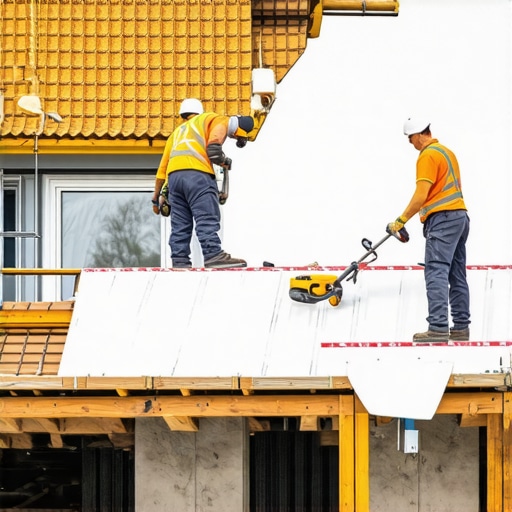
The Anatomy of a Slow-Motion Disaster
I was standing in a crawlspace in South Florida last Tuesday, smelling that familiar, cloying scent of wet cellulose and failure. The homeowner had a ‘new’ roof—only three years old—but the drywall over the kitchen island was sagging like a wet paper bag. Most roofing companies would have just looked at the shingles and told him he needed more caulk. I didn’t. I tore back the counter-flashing at the chimney and found exactly what I expected: galvanized steel that had turned into orange lace. The salt air and the 100% humidity had eaten through the metal before the mortgage was even broken in. This is why the industry is shifting. In 2026, the veteran crews—the guys who actually answer their phones five years after the job is done—are walking away from traditional metals and moving toward high-performance PVC flashing.
My old foreman used to say, ‘Water is a lawyer; it finds the loophole in every contract you sign with a shingle.’ He was right. Water doesn’t just fall; it climbs. It uses capillary action to pull itself upward into gaps, and it uses hydrostatic pressure to find the smallest pinhole in a soldered joint. When you use metal flashing, you are relying on mechanical bends and sealants that eventually dry out and crack under the brutal UV hammer of the Southern sun. PVC (Polyvinyl Chloride) flashing doesn’t just sit there; it creates a monolithic barrier. We are seeing local roofers adopt this because it can be heat-welded. When you weld two pieces of PVC together, they aren’t just ‘touching’—they are one single piece of material at the molecular level. No sealant to fail, no rust to start.
‘Flashing is the most vulnerable part of any roofing system. More than 90% of all roof leaks occur at transitions and penetrations.’ – National Roofing Contractors Association (NRCA)
The Physics of the ‘Wick’: Why Transitions Fail
Let’s talk about Mechanism Zooming. Think about a chimney transition. Most crews slap some step flashing down and cover it with a bead of solar-grade sealant. But as the house settles—and every house settles—the wood moves differently than the brick. That sealant gets stretched. Over a few seasons, a hairline fracture develops. During a tropical downpour, water hits that brick, runs down, and hits the gap. Because of surface tension, the water doesn’t just bounce off; it wicks behind the metal. Once it’s behind the metal, it’s trapped against the roof deck. It sits there, soaking into the edge of the plywood. Within months, you have fascia gaps and rot that you can’t see until the ceiling starts to drip.
PVC flashing solves this through flexibility. Unlike aluminum, which can be brittle, or lead, which is a nightmare to work with safely, PVC can handle the thermal expansion and contraction cycles of a 140°F roof cooling down to 70°F during a afternoon thunderstorm. When roofing crews use PVC, they are essentially wrapping the critical junctions of your home in a custom-fitted, waterproof gasket. It’s the difference between wearing a button-down shirt in a rainstorm and wearing a high-tech drysuit. If you are worried about the longevity of your transitions, check these 5 tips for chimney flashing to see what a proper install looks like.
Thermal Shock and the Death of Galvanized Steel
In the Southeast, the enemy isn’t just the water—it’s the heat. A dark shingle roof can reach temperatures that would fry an egg in minutes. This causes ‘Thermal Shock.’ Metal flashing expands and contracts at a different rate than the asphalt shingles and the wooden deck. This movement eventually ‘backs out’ the fasteners. I’ve seen thousands of ‘shiners’—nails that have been pushed up by the constant grow-and-shrink cycle of the roof. Once a nail pops, it’s a direct straw for water to enter the attic. This is a common cause of nail pop leaks that many homeowners mistake for shingle failure.
PVC flashing is chemically engineered to be UV-stable. In 2026, the formulations have improved to the point where they don’t lose their plasticizers. In the old days, plastic flashing would get ‘crunchy’ and shatter. The new 2026 PVC membranes remain pliable for decades. This is why roofing companies are now using them in high-wind zones where the ‘uplift’ forces would literally peel metal flashing away from the deck. When the wind is howling at 110 mph, you want a material that can flex without breaking its bond. If your roofer is still using thin-gauge aluminum in a hurricane zone, they are building you a ticking time bomb.
‘The building envelope shall be designed and constructed to prevent the accumulation of water within the wall assembly.’ – International Residential Code (IRC) R703.1
The Valley Problem: Where the Battle is Won or Lost
The valley is the ‘river’ of your roof. It carries the highest volume of water. Most local roofers use a ‘closed-cut’ valley or a metal W-valley. The problem with metal valleys in coastal areas is drip edge corrosion and electrolysis. If you have copper flashing touching galvanized nails, you get a chemical reaction that eats the metal. PVC is inert. It doesn’t care about galvanic scales or salt spray. By lining valleys with a reinforced PVC membrane, we eliminate the need for those bulky metal sheets that always seem to leak at the mitered joints. I’ve performed countless forensic inspections where the leak was caused by a tiny gap in a valley gap that was simply too small for a human eye to see during the install, but just right for a 60-mph wind-driven rain to penetrate.
Why the ‘Trunk Slammers’ Hate PVC
You won’t see the ‘fly-by-night’ guys using PVC. Why? Because it requires skill and specialized equipment. To install PVC flashing correctly, you need a hot-air welder and a roofer who knows how to calibrate it based on the ambient temperature. It’s a craft. The cheap contractors want to stick to a hammer, a bucket of ‘muck’ (roofing cement), and a pair of tin snips. They want to get the roofing job done in a day and get the check before you notice the shoddy work around the dormers. When you ask a company about their flashing materials and they mention PVC or TPO-clad metal, you know you’re talking to a professional who understands long-term moisture management. If you’re currently dealing with mystery drips, you might be facing buckling shingles caused by moisture trapped under the underlayment because of poor flashing ventilation.
The Financial Reality of ‘Doing it Right’
Yes, PVC flashing costs more per square than a roll of cheap aluminum. But let’s do the forensic math. A typical flashing failure costs about $400 for a ‘band-aid’ repair that lasts two years. If that failure leads to rotten decking and mold remediation in the attic, you are looking at a $5,000 to $10,000 problem. By spending an extra few hundred dollars on high-quality PVC transitions during the initial install, you are effectively buying insurance against the most common cause of roof replacement. Don’t let a contractor tell you that ‘standard flashing’ is enough. In the climate of 2026, standard isn’t good enough anymore. You need materials that can withstand the salt, the heat, and the pressure. If your roof is already showing signs of age, check for attic condensation, which is often the first red flag that your roof’s ‘skin’ isn’t breathing or sealing correctly. In the end, a roof is just a series of holes that we’ve tried to plug. Make sure your roofer is using the best ‘plug’ available.