
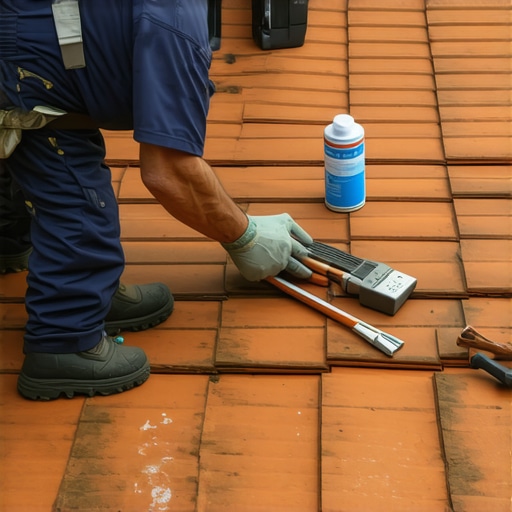
The Myth of the Eternal Tile
You see them everywhere in the Southwest—miles of clay and concrete barrels baked under a relentless sun that treats roofing materials like a slow-cooker. Most homeowners think because their tiles are heavy, they are invincible. But as a forensic roofer who has spent twenty-five years crawling through 160°F attics, I can tell you the truth: the tile is just the armor; the sealant and the underlayment are the actual lifeblood. My old foreman, Grizzly Pete, used to stand on a 6-pitch valley and bark at me, ‘Water is patient, but the sun is a predator. It doesn’t look for a hole; it creates one by eating your sealant.’ He was right. Most roofing companies use the cheapest tube of goop they can find at a big-box store, and by the second summer, that sealant has turned into a brittle, chalky mess that snaps like a dry twig.
We are looking toward 2026, and the technology is finally catching up to the physics of thermal expansion. When you have a roof that swings sixty degrees in temperature between high noon and midnight, your sealant needs more than just ‘stickiness.’ It needs movement capability. If the bond between your cricket flashing and your ridge tile doesn’t stretch, it fails. It’s called interfacial failure, and it’s why your ceiling has those brown rings despite you ‘just getting the roof serviced’ last year.
“Sealant joints must be designed to accommodate the anticipated movement of the substrates. Failure to account for thermal expansion is the primary cause of premature sealant degradation in tile systems.” – National Roofing Contractors Association (NRCA) Manual
Mechanism Zooming: Why Sealants Actually Fail
Let’s talk about the physics of the ‘Sun-Cooked Scab.’ When a local roofer smears a standard thermoplastic sealant over a tile gap, it looks great for a month. But under the microscopic lens, the UV radiation is busy breaking the polymer chains. This is photon bombardment. The solar energy literally snaps the molecular bonds that give the material its elasticity. Once those bonds are gone, the sealant shrinks. As it shrinks, it pulls away from the tile. Now you have a microscopic fissure. Rain hits, and through capillary action, that water is sucked upward against gravity, traveling behind the tile and onto your felt. If that felt is old and ‘crispy,’ you’re done. The water hits the decking, the wood swells, and suddenly you’re paying a roofing crew to tear off three squares of tile just to replace one sheet of rotted plywood.
The 2026 Heavy Hitters: Top 4 Sealant Technologies
1. High-Solids Inorganic Silicones
In the world of roofing companies, silicone used to be a dirty word because nothing sticks to it—including more silicone. But the 2026 high-solids formulations are different. These are inorganic. Because they aren’t carbon-based, the UV rays can’t find a ‘handle’ to break the molecules apart. It’s like trying to sunburn a rock. These sealants maintain 95% of their elasticity even after a decade of desert exposure. They are the gold standard for sealing around birdstops and headwall flashings where the heat is most intense.
2. Hybrid Polyethers (MS Polymers)
These are the workhorses. A hybrid polyether takes the strength of a polyurethane and mixes it with the weathering resistance of a silicone. What makes them ‘2026 ready’ is their damp-surface adhesion. In the humid fringe zones or during the monsoon season, a local roofer can’t always wait for a tile to be bone-dry. These hybrids bite into the substrate even when there’s a hint of moisture, preventing that dreaded ‘ghosting’ where the sealant just peels off in one long ribbon three months later.
3. Advanced Butyl Tapes and Gums
Sometimes the best sealant isn’t in a tube. For the areas under the tile—like where the valley metal meets the transition—we are seeing a massive shift toward high-performance butyl. This stuff never truly hardens. It stays ‘nasty’ and aggressive. If a nail goes through it (a shiner), the butyl self-heals, wrapping around the shank like a gasket. It’s the silent hero of roofing longevity.
4. Structural Alpha-Terminated Polyurethanes
When you need to bond a broken tile back together—maybe a rare piece that you can’t find a replacement for—you need structural strength. These 2026 urethanes offer insane ‘green strength,’ meaning they grab and hold almost instantly. They don’t just seal the gap; they become stronger than the concrete tile itself. But beware: if you use these on a joint that needs to move, something else is going to crack.
“The building envelope is a dynamic system; rigid fixes for flexible problems lead to catastrophic structural moisture intrusion.” – International Residential Code (IRC) Commentary
The Warranty Trap and The Contractor Truth
Every roofing salesman is going to promise you a ‘lifetime’ fix. That is marketing garbage. In the trade, we know that a sealant is a maintenance item. Even the best 2026 tech requires an eye on it every five years. If a company tells you they have a ‘permanent’ caulk, they are either lying or they haven’t been in the business long enough to see their own work fail. You want the guy who talks about ‘movement cycles’ and ‘ASTM C920 standards.’ That’s the pro who understands that your roof is a living, breathing, moving machine. Don’t let a ‘trunk slammer’ slap some cheap acrylic on your ridge caps and call it a day. Demand the high-solids stuff, or you’ll be calling me in three years to do a forensic tear-off of your ‘new’ roof.