
The Ghost in the Attic: Why Your Roof is Failing Before the First Leak
The drywall in your master bedroom is bone dry. You haven’t seen a single drip, and the local roofers who drove by after the last tropical depression said your shingles look ‘fine’ from the driveway. But you’ve got a gut feeling something is wrong because you heard that rhythmic thwack-thwack-thwack during the storm. That sound isn’t just the wind; it’s the sound of your investment being ripped apart one nail at a time. My old foreman used to say, ‘Water is patient. It will wait for you to make a mistake.’ In the humid, wind-ravaged Southeast, that mistake is usually ignoring the invisible lifting of shingles until the decking underneath turns into something resembling wet cardboard. We are talking about hydrostatic pressure and wind uplift—forces of nature that don’t care about your ’30-year warranty’ if the installation was botched by a crew of trunk-slammers.
The Physics of Failure: The Bernoulli Principle on Your Roof
To understand why shingles lift, you have to understand the physics of a house during a wind event. As high-velocity air hits the windward side of your home, it’s forced upward. This creates a zone of low pressure above the roof surface. Meanwhile, the air trapped inside your attic—often at a higher pressure due to poor ventilation—pushes upward against the underside of the roof deck. This pressure differential acts like an airplane wing, trying to lift the entire assembly. When the thermal sealant strip (that line of bitumen on the back of the shingle) fails due to age or heat, the shingle becomes a sail. This is the root cause of hidden shingle lifting. It’s not just a flap; it’s a mechanical breakdown of the roof’s primary defense layer.
“Wind-driven rain can be forced into the smallest of openings, even when gravity would normally pull water away. Proper attachment and sealant bond are the only defenses against capillary action and pressure-driven leaks.” – NRCA Manual excerpt
1. The Shadow Line: Detecting Parallel Lifting
The first sign isn’t a missing shingle; it’s a shadow. On a bright, high-noon day, walk to the edge of your property and look at the roof plane from a side profile. You are looking for ‘parallel lifting.’ This happens when the sealant bond has broken, but the nails are still holding the shingle in place. The shingle sits about an eighth of an inch higher than its neighbor. From the ground, this looks like a slight darkening or a thicker shadow line under the butt joint of the shingle. This gap is a highway for wind-driven rain. Once water gets under that flap, it uses capillary action to travel sideways until it finds a shiner—a nail that missed the rafter and provides a direct metal conduit for water to drip into your insulation. If you spot these shadows, you need to know how to spot shingle lifting before the next hurricane season turns that gap into a tear.
2. The Granule Sandbar in the Gutters
Shingles are engineered with a sacrificial layer of granules to protect the underlying asphalt from UV radiation. When a shingle lifts and drops repeatedly during a wind event, it creates mechanical friction at the ‘hinge’ point—the line where the shingle is nailed. This friction scrubs the granules off the surface. If you find what looks like a sandbar of asphalt granules in your gutters, it’s not just ‘normal wear.’ It’s the forensic evidence that your shingles are moving. In our region, the 140°F attic heat makes the shingles brittle, and this constant flapping accelerates the degradation. If you ignore this, the UV rays will bake the exposed asphalt, leading to early shingle curling, which further compromises the aerodynamics of the roof.
3. The Soft Step: Hidden Plywood Decay
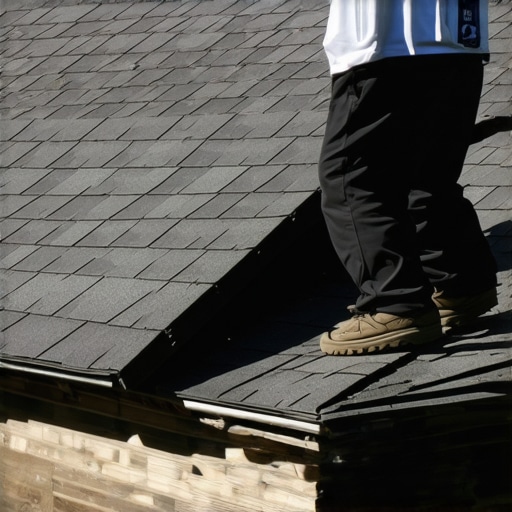
The most dangerous sign is one you can’t see; you have to feel it. When shingles lift, water doesn’t always pour in. Often, it just damps the underlayment. If your local roofers used cheap organic felt instead of high-performance synthetic underlayment, that moisture stays trapped against the plywood deck. Over time, the moisture triggers fungal growth. When I walk a roof, I’m looking for ‘the sponge.’ If a section of the roof feels soft or gives under my boots, I know the decking is delaminating. This is the ‘Surgery’ stage of roofing. You can’t just glue the shingle back down; you have to tear it off, replace the rotted square of plywood, and re-flash the area. Waiting only increases the cost as the rot spreads to the rafters.
“Fasteners shall be driven flush with the shingle surface and shall not be over-driven. Failure to meet these requirements reduces wind resistance by up to 50%.” – International Residential Code (IRC) R905.2.5
The Band-Aid vs. The Surgery
If you catch lifting early, a technician can often perform a ‘re-seal.’ This involves cleaning the dust from the old bitumen strip and applying a high-grade roofing cement to every tab. It’s tedious, but it saves the roof. However, if the lifting has gone on long enough to cause nail pulling—where the nail head is actually tearing through the shingle—the shingle is compromised. At that point, you’re looking at a partial replacement. You need to ensure your contractor isn’t just slapping caulk on top; they need to check for attic leaks that might be rotting the spine of your home from the inside out. Don’t let a ‘storm chaser’ tell you it’s a total loss if it’s just a sealant failure, but don’t let a ‘cheap’ roofer tell you it’s fine if the plywood feels like a marshmallow. Get a forensic inspection. Real roofing is about physics, not just hammers and nails.