
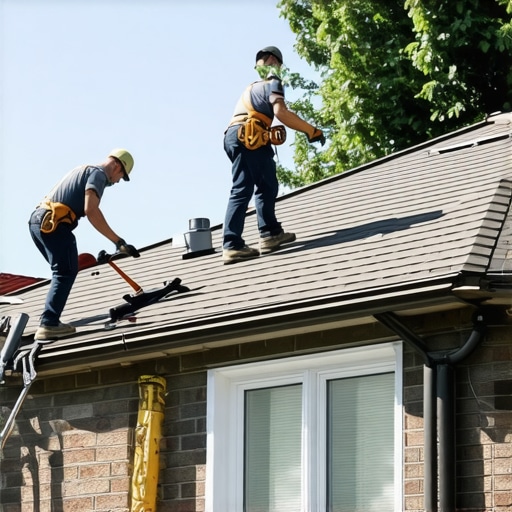
The High-Altitude Mirage of the ‘Forever’ Roof
I was walking a steep-slope job in the foothills outside of Denver last July, and the moment my boot hit the surface, I knew we had a problem. It felt like walking on a trampoline. The homeowner had paid a premium for synthetic shakes three years ago, convinced by a slick brochure that these polymer beauties were indestructible. But standing there in the 95-degree heat, I could smell it—not the crisp scent of cedar, but the heavy, chemical odor of overheating plastics and the damp, musty stench of trapped moisture. When we finally peeled back a square of those ‘indestructible’ shakes, I didn’t find a solid deck. I found a mess. The plywood had the structural integrity of a wet cardboard box. Most roofing companies won’t tell you this, but synthetic shake isn’t a ‘set it and forget it’ product. It’s a high-performance system that requires a forensic understanding of thermodynamics and water shedding. If you treat it like standard asphalt, you’re just counting down the days until your ceiling starts crying. This isn’t just about shingles; it’s about the physics of a system that has to survive UV radiation that would peel paint off a tank and thermal cycles that make materials grow and shrink like a breathing lung.
“A roof is only as good as its flashing, and with synthetic materials, the margin for error is razor-thin.” – Old Roofer’s Adage
1. Mastering the Expansion Gap: The Physics of Thermal Shock
In our Mountain West climate, we see temperature swings of 40 degrees in a single afternoon. Synthetic shakes are primarily composed of polyethylene or similar polymers. On a molecular level, those chains are constantly vibrating. When the sun beats down, they expand. If your local roofers didn’t leave the mandatory gap between shakes, those pieces have nowhere to go but up. They buckle. This creates a ‘fishmouth’—a gap that invites wind-driven rain to travel sideways through capillary action. Water gets sucked under the course, sits against the fastener, and begins the slow process of rotting out your deck. You need to inspect the side-laps. If the shakes are touching, the installer failed. Unlike natural cedar shake care, which involves managing organic rot, synthetic care is about managing physical movement. Every fastener needs to be dead-center in the factory-drilled slot. If a roofer ‘pinned’ the shake by nailing it too tight, the material will crack as it tries to expand. This is often where we find common reasons for fastener failure, where the nail head actually shears off or the shake pulls right over it, leaving an open hole for water to enter.
2. The UV Integrity Audit: Beyond the Color
Don’t be fooled by a roof that still looks pretty. UV radiation at high altitudes is a silent killer for polymers. Most roofing companies talk about ‘color-fastness,’ but I care about ’embrittlement.’ Over time, the UV inhibitors in the plastic can migrate to the surface and wash away. This leaves the shake brittle. During your annual walk-through, you shouldn’t just look for missing pieces; you need to check the ‘flex.’ A healthy synthetic shake should have some give. If you tap it and it sounds like ceramic tile or, worse, if a corner snaps off under thumb pressure, the polymer has failed. This is why many pros are shifting toward materials with higher resilience, often asking why roofing companies prefer poly-slate or advanced hybrids. If you notice chalking—a white, powdery residue on the shakes or in the gutters—that’s your roof literally disintegrating. At this stage, the material is no longer shedding water; it’s absorbing heat and becoming porous. You’re no longer looking at a simple repair; you’re looking at a structural liability.
“The building envelope must be viewed as a biotic system; once the outer skin is compromised, the skeletal structure follows rapidly.” – Modern Architectural Axiom
3. Drainage Path Clearances and the ‘Hidden’ Valley Danger
Synthetic shakes have deep grooves and textures designed to mimic hand-split wood. Those deep crevices are magnets for pine needles, leaf debris, and bird nests. In a desert or mountain environment, this debris acts as a dam. When it rains, water doesn’t flow down to the eave; it moves laterally. It finds the ‘valley’—the most vulnerable part of your roof. If your local roofers didn’t install a proper cricket behind chimneys or if the valley metal is obstructed, water will back up under the shakes. Because synthetic materials don’t breathe like wood, that trapped moisture has nowhere to go but into your decking. I’ve seen cases where homeowners ignored a small pile of needles in a valley, and two years later, we found signs of severe decking rot that required a full tear-off of the plywood. You must ensure your gutters and valleys are blown out twice a year. If you see ‘shiners’—nails that have backed out due to the wood deck swelling and shrinking—you have an active moisture problem. A single shiner can let in a gallon of water over a heavy storm season. Don’t let a ‘trunk slammer’ tell you a bit of caulk will fix it. Caulk is a Band-Aid for a bullet wound. You need to pull the compromised shakes, inspect the underlayment, and ensure the drainage path is clear from ridge to eave.