
The Phantom Leak: Why Your New Roof Might Be Rotting from the Inside Out
You spent twenty grand on a new roof. The shingles are architectural grade, the copper valleys look like jewelry, and the local roofers gave you a firm handshake. But six months later, your kid is sneezing in the upstairs bedroom, and there’s a faint, earthy stench wafting from the linen closet. You call the roofing companies back, they spray some water on the roof, and tell you there isn’t a leak in sight. They’re right—it’s not leaking from the sky. It’s leaking from your living room. Most homeowners in the North, from Minneapolis to Maine, don’t realize that their attic is a laboratory for biological growth during the winter months.
The Forensic Scene: Walking on a Sponge
I remember a call-out in a high-end subdivision last November. The shingles were barely three years old. From the driveway, the house looked like a magazine cover. But as soon as I set my ladder and took those first few steps near the ridge, my boots sank. Walking on that roof felt like walking on a sponge. I knew exactly what I’d find underneath. When we pulled back the shingles and the synthetic underlayment, the OSB decking didn’t just look wet—it looked like a petri dish. The entire underside of the wood was covered in a thick, velvet-black carpet of Stachybotrys. This wasn’t a failure of the shingles; it was a failure of the home’s respiratory system. The local roofing crew that installed it hadn’t accounted for the thermal bridging happening at the rafters, and the attic was basically a steam room with no exit strategy.
“A roof is only as good as its flashing, but a house is only as healthy as its attic ventilation.” – Old Roofer’s Adage
The Physics of Failure: Mechanism Zooming on Condensation
To understand why mold is thriving in 2026, we have to look at the physics of the ‘Stack Effect.’ In cold climates, your heated air is under pressure. It wants to go up. It finds every ‘attic bypass’ it can—recessed lights, the pull-down stairs, and plumbing stacks. This warm, moisture-laden air hits the sub-freezing underside of your roof deck. This is where the dew point happens. Imagine a cold beer can on a humid day. Now imagine that beer can is your roof. The water doesn’t just sit there; it undergoes capillary action. It seeps into the microscopic pores of the plywood or OSB. Once the moisture content of that wood hits 20%, it’s no longer just a structural component—it’s food for mold spores.
We also look for ‘shiners.’ A shiner is a trade term for a nail that missed the rafter and is just hanging out in the attic space. During a cold snap, these nails become thermal bridges. They get so cold that the humidity in the attic turns into hoarfrost on the nail head. When the sun hits the roof, that frost melts, dripping onto the insulation below. Over a thousand nails, that’s a lot of ‘leaks’ that never came from a hole in a shingle. If you see signs of hidden decking plywood decay, you aren’t looking at a roofing problem; you’re looking at a ventilation disaster.
The Autopsy: How Forensic Roofers Trace the Mold Trail
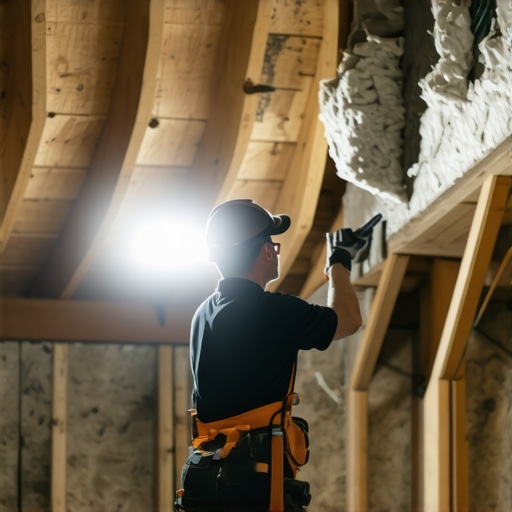
When professional roofing companies perform a deep-dive inspection, we aren’t just looking for missing granules. We are looking for the ‘Shadow.’ In the attic, mold often follows the path of least resistance for airflow. If your baffles are crushed by an over-eager insulation contractor, the edges of your roof deck will be the first to rot. This is often where we find poor attic ventilation. We use infrared thermography to find the cold spots where moisture is aggregating. If the temperature of the deck is significantly lower than the ambient attic air, you’ve got a condensation trap.
“The building envelope must be viewed as a single, integrated system where heat, air, and moisture flows are managed to prevent structural degradation.” – International Residential Code (IRC) Commentary
The real ‘Band-Aid’ that most cheap contractors use is just spraying some bleach and adding a cheap plastic vent. That’s like putting a bandage on a gunshot wound. The ‘Surgery’ involves restoring the balance. We check the intake at the soffits. If the intake doesn’t match the exhaust at the ridge, the system stalls. If the ridge vent isn’t cut wide enough—or if the local roofers used a low-profile vent that gets choked by a light dusting of snow—the moisture remains trapped. You can see the result of this when you notice poor ridge vent sealing, which often allows moisture to linger right at the peak where it does the most damage to the ridge beam.
Ice Dams: The Mold’s Best Friend
In the North, mold and ice dams are cousins. When heat leaks into the attic, it melts the snow on the roof. That water runs down to the cold eaves and freezes, creating a dam. Now you have standing water sitting over the most vulnerable part of your roof. This water is forced upward by hydrostatic pressure, getting under the shingles. Even if you have ‘Ice & Water Shield,’ the constant moisture increases the relative humidity in the attic to 90%+. This is the ‘wet season’ for mold. Learning how to stop ice dams is often the first step in a long-term mold remediation strategy. Without fixing the thermal leakage, you are just waiting for the next colony to sprout.
The Material Truth: OSB vs. Plywood in the Mold War
In 2026, many roofing companies have moved toward OSB (Oriented Strand Board) because it’s cheaper and flatter. But forensic investigations show that OSB behaves differently when wet. It tends to swell at the edges and stay wet longer than traditional CDX plywood. Once the glues in OSB start to fail due to high humidity, the structural integrity of your ‘Square’ of roofing is compromised. If you’re replacing a roof, we often recommend a ‘breathes-but-protects’ approach—using high-permeability underlayments that allow trapped moisture to escape outward while keeping rain from coming in.
The Cost of Waiting: Don’t Ignore the Musty Smell
Waiting to fix an attic mold issue is a fool’s errand. By the time the mold is visible on your bedroom ceiling, the structural rafters are likely already ‘punky’—trade talk for soft and rotting. A simple ventilation retrofit might cost a few hundred dollars today, but replacing a mold-blackened roof deck and the associated structural lumber will cost you tens of thousands. Look for local roofers who understand the science of the house, not just the mechanics of a hammer and a nail. If they don’t mention ‘bypasses’ or ‘intake ratios,’ they aren’t fixing your problem; they’re just covering it up.