
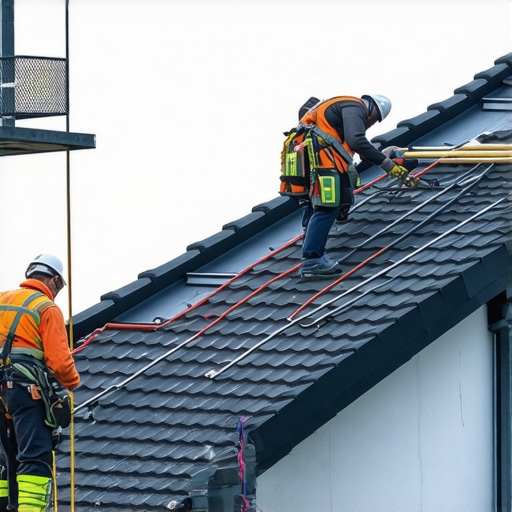
The Gravity Trap: Why Steep Pitches Aren’t the Safety Net You Think They Are
You’re sitting in your living room, listening to the rhythmic thwack-thwack of rain hitting your 12/12 pitch roof. You feel safe. After all, gravity is on your side, right? Wrong. As a forensic roofer who has spent three decades peeling back the layers of failed systems, I can tell you that high-slope roofs are where the most expensive, most invisible mistakes happen. In the trade, we see it every day: homeowners who paid a premium for a ‘steep’ roof only to find their interior drywall turning into a soggy mess three years later. Water doesn’t just run off a steep roof; it accelerates. It gains kinetic energy, find its way into gaps you didn’t even know existed, and performs a vanishing act right into your attic insulation.
My old foreman used to say, ‘Water is patient. It will wait for you to make a mistake.’ He was right. On a high-slope roof, that mistake is usually a lack of respect for physics. When you’re dealing with a pitch where you can’t even stand without a goat-rope or a roof bracket, the margin for error disappears. Most modern roofing companies in 2026 are still struggling with the basic mechanics of high-velocity water management. They think because the water moves fast, it doesn’t have time to leak. But fast water hits obstacles—like a poorly installed chimney or a lazy valley—and it splashes. It back-flows. It uses capillary action to climb uphill under the lip of a shingle. If your contractor didn’t account for the hydrostatic pressure at the base of a 40-foot run, you’re essentially living under a ticking time bomb.
The Forensic Autopsy: Anatomy of a High-Slope Failure
Let’s look at the physics of a failure I investigated last week. The homeowner had a gorgeous Victorian with gables that looked like they belonged in a gothic novel. From the ground, the shingles looked perfect. But inside, the master bedroom ceiling was sagging. When I got up there, I found the culprit: ‘shiners.’ For the uninitiated, a shiner is a nail that missed the rafter or was driven in at an angle because the roofer was struggling to keep their footing on the 14/12 slope. On a steep pitch, the tension on the shingles is immense. Gravity is literally trying to pull the entire ‘square’—that’s 100 square feet of material—off the deck. If those nails aren’t driven perfectly flush and into the ‘sweet spot’ of the shingle, the weight causes the shingle to sag, exposing the nail head. That nail head then acts as a heat sink, drawing frost from the attic, melting it, and letting it drip-feed directly into the local roofers 5 signs of 2026 decking rot you’ll eventually have to pay thousands to replace.
“A roof is only as good as its flashing.” – Old Roofer’s Adage
Then there is the issue of wind. You might think a steep roof sheds wind, but it actually acts like a sail. In high-wind regions, the uplift on the leeward side of a steep gable is massive. If the how 2026 roofing companies handle 2026 high wind risk protocols aren’t followed—meaning extra nails and specific starter strips—the wind will literally peel the roof back like an orange. I’ve seen entire slopes of high-end architectural shingles lying in a heap in the bushes because the ‘trunk slammers’ who installed it used standard 4-nail patterns on a 12/12 pitch. That’s not just laziness; it’s a violation of the International Residential Code (IRC) which mandates specific fastening schedules for high-slope applications.
The Capillary Action Nightmare
Most local roofers don’t understand capillary action. They think water only goes down. But on a steep roof, when water hits a valley at 30 miles per hour, it doesn’t just stay in the center of the metal. It hits the ‘baffle’ or the ‘cricket’ and creates a micro-tsunami. This water can be forced up and under the shingles on the opposing side of the valley. This is why how 2026 roofing companies fix 2026 valley-leaks usually involves more than just a tube of caulk. You need a ‘W-valley’ metal liner or a heat-welded membrane in those high-stress areas. If you see your roofer just slapping some ‘goop’ in a valley, fire them on the spot. Caulk is a temporary band-aid for a structural problem. It dries out in the UV sun, cracks, and then acts as a dam, holding water against the plywood until it turns into something resembling oatmeal.
I once walked on a roof in a mountain town where the pitch was so aggressive the owners had to install snow guards just to keep from being buried when it thawed. But they hired a guy who didn’t understand thermal bridging. The heat from the attic was escaping through ‘bypass’ areas—unsealed holes for wires and pipes—and hitting the cold underside of the roof deck. Because the roof was so steep, the resulting condensation didn’t just stay put; it ran down the underside of the plywood, gathering speed, until it pooled at the eaves. By the time I arrived, the fascia boards were so rotten I could poke a screwdriver through them with one finger. This is why local roofers 4 ways to spot 2026 buckling shingles is often the first step in a forensic audit—it’s the house telling you that it can’t breathe.
The 2026 Standard: Lidar and Logic
In 2026, the elite roofing companies aren’t guessing anymore. They are using why 2026 roofing companies now use 2026 lidar quotes to map every degree of that slope. Lidar allows us to see the ‘subsidence’ in the roof plane that the naked eye misses. On a high-slope roof, if the rafters have bowed even half an inch, it creates a ‘dip’ where water can congregate. You can’t see it when you’re standing on the ground looking up 30 feet, but the Lidar sees it. This technology ensures that the new decking is shimmed correctly, providing a perfectly flat surface for the underlayment. Without a flat deck, your shingles will never seal properly, leading to those annoying ‘tabs’ that flap in the wind until they snap off.
“Roofing systems shall be designed and installed in accordance with this code and the manufacturer’s installation instructions.” – International Residential Code (Section R903.1)
The ‘Surgery’ versus the ‘Band-Aid’ is the choice every homeowner face. The Band-Aid is the guy who says he can ‘seal’ your high-slope leak for $500. He’ll climb up there, smear some silicone on a flashing, and leave. Six months later, the leak is back, and now the wood is twice as rotten. The ‘Surgery’ is what we do: we tear off the affected area, inspect the substrate, install an Ice & Water shield that exceeds local codes, and integrate the flashing into the house wrap. It’s more expensive up front, but it’s the only way to sleep when the wind starts howling at 2 AM.
The High-Slope Survival Guide for Homeowners
If you have a high-slope roof, you need to be more vigilant than the average homeowner. You need to look for ‘granule loss’ in your gutters. On a steep roof, the sheer force of water strips the protective granules off shingles much faster than on a flat roof. Once those granules are gone, the asphalt is exposed to UV radiation, and it’s game over. The shingle becomes brittle, cracks, and loses its ability to shed water. You also need to keep an eye on your crickets—those small peaked structures behind chimneys. On a high slope, a cricket is the only thing standing between you and a massive leak. If the cricket is too small, water will ‘overshoot’ it and get behind the chimney flashing. It’s a game of inches, and gravity is a cruel referee.
Don’t fall for the ‘Lifetime Warranty’ sales pitch either. Those warranties almost always have an ‘out’ for ‘improper installation’ or ‘acts of God.’ If your roofer didn’t use the specific high-slope starter strips and the 6-nail pattern required by the manufacturer, that ‘Lifetime’ warranty is worth exactly the paper it’s printed on. You want a workmanship warranty from a company that has been in the same town for at least a decade. You want the guy who knows the local wind patterns and the way snow loads sit on a north-facing gable. In 2026, the best tools are still a pair of experienced eyes and a refusal to cut corners, no matter how steep the climb.