
The Forensic Autopsy of a Saturated Flat Roof
Walking on that 40,000 square foot warehouse roof in the rust belt felt like walking on a giant, waterlogged kitchen sponge. Every step I took resulted in a sickening ‘squish-hiss’ sound as trapped moisture underneath the old EPDM membrane shot out through a failed lap seam. The facility manager was standing next to me, staring at a $200,000 inventory loss inside from a leak he couldn’t find. He thought he had a ‘lifetime’ roof because a salesman told him so. I knew exactly what I would find when I pulled my core sampler out. The insulation was black with mold, and the steel deck was beginning to show signs of structural pitting. This is the reality of relying on adhesives in a climate that swings from -10°F to 100°F. Adhesive-based systems don’t fail because the material is bad; they fail because the glue is a secondary material with a different expansion rate than the membrane itself.
“A roof is only as good as its flashing.” – Old Roofer’s Adage
The Physics of Failure: Why Adhesives Quit
Most commercial roofing leaks happen at the seams. In an EPDM or TPO system that relies on seam tape or contact cement, you are fighting a losing battle against solvent migration. Over time, the chemicals that keep the glue flexible evaporate. The bond becomes brittle. When the sun beats down on a flat roof, surface temperatures can hit 160°F. The membrane expands, but the dried-out glue stays rigid. That tension creates ‘fish-mouths’—tiny gaps where capillary action pulls water uphill. Once water gets under the top layer, it sits there. It doesn’t evaporate. It travels along the insulation boards until it finds a fastener or a deck joint, and that is where you see the drip in the boardroom. If you have been seeing standing water on flats, you are already on borrowed time. You can learn more about standing water on flats to understand how this hydrostatic pressure accelerates seam failure.
Benefit 1: Molecular Fusion through Heat Welding
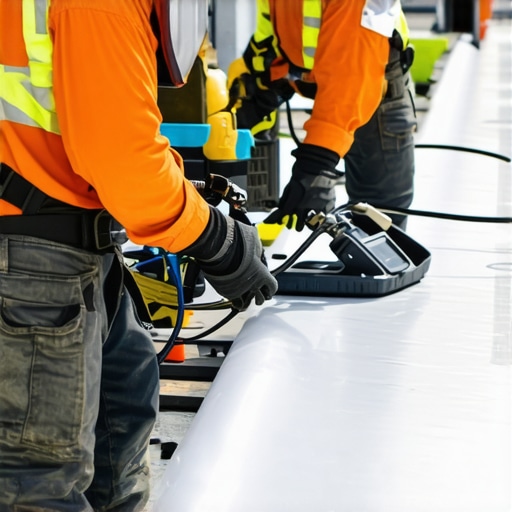
The primary benefit of PVC (Polyvinyl Chloride) seam welding is that it isn’t a bond—it is a weld. We use a robotic hot-air welder that crawls along the seam at about 10 feet per minute, blasting 1000°F air between the sheets. This melts the top and bottom layers of the PVC together. At a molecular level, the two sheets become one. In my 25 years, I have seen wind uplift tear the membrane itself before the weld gave way. This is critical for local roofers who deal with high-wind zones. Unlike a ‘trunk slammer’ who might try to hand-weld an entire roof with a heat gun and a silicone roller (leading to ‘cold welds’), a professional crew uses a calibrated machine that ensures consistent pressure and temperature. If your contractor isn’t talking about ‘peel tests’ on their test welds every morning, they aren’t doing it right.
Benefit 2: Chemical and Grease Resistance
If you are running a restaurant, a food processing plant, or a manufacturing facility, your roof is an exhaust vent. Grease, oils, and chemicals settle on the roof surface. These substances are the sworn enemies of asphalt and EPDM. They act as a solvent, liquefying the roof into a black goo. PVC is naturally resistant to these materials. The welded seams are particularly important here because they prevent grease from seeping into the insulation. I have seen ponding water mixed with kitchen grease eat through a standard roof in less than three years. If you’re unsure if your roof is holding up, you need to know how to identify ponding water before the structural deck starts to sag. PVC provides that forensic-level protection against chemical degradation that other membranes simply can’t touch.
Benefit 3: Superior Performance in Freeze-Thaw Cycles
In northern climates, the roof goes through a brutal cycle of expansion and contraction. During the day, the sun warms the dark roof; at night, the temperature plummets. This is called thermal shock. Because a welded PVC seam is a monolithic sheet, it expands and contracts at a uniform rate. You don’t have a glue line fighting against a rubber sheet. Adhesives lose their grip when ice dams form at the scuppers or drains. As ice expands, it pries into the tiny gaps of an adhesive seam. A welded seam, however, has no ‘edge’ for the ice to grab. This is why many roofing companies recommend PVC for hospitals and data centers where a single leak is a catastrophic failure.
“Standard practice for the application of PVC membranes requires all laps to be hot-air welded to create a permanent, watertight seal.” – NRCA Manual
Benefit 4: Long-Term Solar Reflectivity and Energy Savings
While TPO starts out white, it often loses its reflectivity as it weathers. PVC membranes are engineered with high-quality plasticizers that keep the surface smooth and resistant to dirt pick-up. This isn’t just about aesthetics; it’s about the HVAC bill. By reflecting 80% of solar radiation, you prevent the ‘heat island’ effect on your building. A cooler roof doesn’t just save money; it lasts longer because the material isn’t being baked to death. However, be wary of ‘Lifetime Warranties.’ Most are pro-rated and don’t cover the labor to find the leak, only the material. You want a No-Dollar-Limit (NDL) warranty, which only comes if you use a certified installer who performs proper seam welding. Don’t be fooled by marketing fluff; the only thing that matters is the integrity of the weld. When you hire local roofers, make sure they have a history of successful commercial installs, not just residential shingle jobs. You can check ways to verify general liability and certifications before signing that contract. A ‘shiner’ on a shingle roof is a nuisance; a bad weld on a 100,000 square foot flat roof is a lawsuit waiting to happen.