
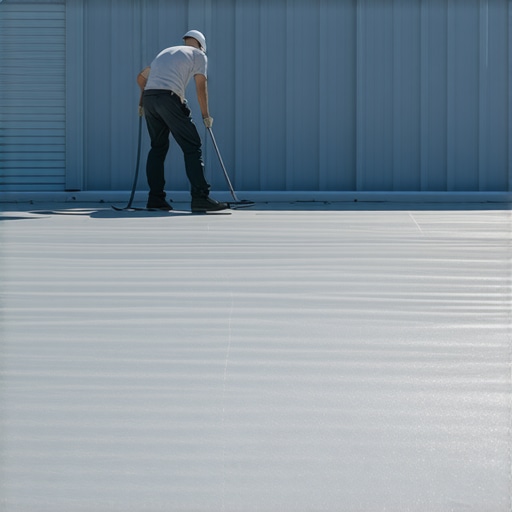
The Fluid-Applied Truth: Why Liquid Membranes Are Killing the Traditional Tear-Off
Walk onto any commercial flat roof in the humid, salt-heavy air of the Gulf Coast, and you’ll smell it before you see it: the damp, cloying scent of trapped moisture in the insulation. I’ve spent twenty-five years crawling over these structures, and I’m tired of seeing building owners get sold a bill of goods. My old foreman used to say, ‘Water is patient. It will wait for you to make a mistake, and then it will live there forever.’ He wasn’t talking about a major hurricane rip; he was talking about the microscopic failures at the seams where traditional roofing fails. Most roofing companies will push a standard TPO or EPDM replacement because it’s what they know, but in our tropical soup of an environment, the physics of a seam-heavy roof is just a countdown to disaster.
1. The End of the Seam: Monolithic Protection
The primary reason traditional roofing fails is simple: the seams. Whether it’s heat-welded or glued, every foot of seam is a potential entry point for wind-driven rain. A liquid-applied membrane, or fluid-applied roofing system, creates a monolithic surface. Think of it like a custom-molded rubber suit for your building. When we apply these coatings—whether it’s silicone, acrylic, or urethane—we aren’t just laying down a sheet; we are engaging in a chemical bond that fills every crack, crevice, and ‘shiner’ (those annoying missed nails that back out over time). This is crucial when dealing with capillary action. Water doesn’t just fall; it gets sucked into gaps through surface tension. A liquid membrane eliminates the gap entirely.
“Roofing systems shall be designed and installed in accordance with this code and the manufacturer’s installation instructions such that the roof system shall serve to protect the building or structure.” – International Building Code (IBC) Section 1501.1
By eliminating the seams, you also mitigate the risk of edge lift during high-wind events. In regions prone to tropical storms, the uplift pressure at the roof’s edge can unzip a mechanical system in seconds. Liquid membranes, however, are fully adhered to the substrate. There is no air gap for the wind to grab, which is why local roofers who specialize in high-velocity hurricane zones are increasingly pivoting to this technology. If you’ve ever had to compare PVC seam welding to a fluid-applied system, you know that while welding is good, having no seam at all is always better.
2. Thermal Shock and UV Defense
In the Southeast, the sun isn’t just bright; it’s a meat grinder for organic materials. Traditional asphalt-based roofing absorbs massive amounts of UV radiation, leading to ‘thermal shock.’ This is the process where a roof heats up to 160°F during the day and then rapidly cools during a late-afternoon thunderstorm. This expansion and contraction cycles the fasteners, eventually causing them to back out or widen the holes in the membrane. Liquid membranes are typically highly reflective (high Albedo). They don’t just sit there and take the heat; they bounce it back. This reduces the surface temperature by up to 60°F, significantly lowering the building’s cooling load and preventing the internal structure from warping. I’ve seen roofing companies try to fix ponding water issues on old BUR roofs that were caused entirely by thermal sagging, a problem that a lightweight liquid membrane simply doesn’t create.
3. The ‘No-Tear-Off’ Financial Strategy
The dirtiest secret in the trade is the cost of the landfill. When a contractor tells you that you need a total replacement, a massive chunk of that quote is just the labor and disposal fees for ripping off the old ‘square’ (100 square feet) of material. Liquid membranes allow for a ‘recover’ rather than a ‘replacement.’ If the underlying insulation is dry—which we verify with infrared thermography—we can apply the membrane directly over the existing roof after a proper cleaning and priming. This isn’t a ‘Band-Aid’; it’s a structural reinforcement. It saves the building owner about 40-50% in total project costs and avoids the nightmare of exposing the building’s interior to the elements during the process. I always tell my clients: don’t pay to haul away a roof that still has structural integrity; pay to make it waterproof again.
“A roof is only as good as its flashing, but a liquid membrane makes the flashing part of the roof itself.” – NRCA Manual Axiom
4. Seamless Flashing and Detail Work
Flashing is where 90% of leaks happen. Whether it’s around a HVAC curb, a plumbing vent, or a parapet wall, trying to wrap a flat sheet of plastic around a 3D object is like trying to wrap a basketball in gift wrap. You’re going to have folds, and folds are where the water wins. Liquid membranes are ‘detail-friendly.’ You paint the membrane right up the side of the pipe or curb. It creates a self-terminating, watertight seal that moves with the building. You don’t have to worry about a loose roof valley or failing pitch pockets. The fluid nature of the application means it seeks out the path of least resistance—the same path water takes—and plugs it before the rain ever starts.
Vetting Local Roofers for Liquid Applications
Don’t just hire any ‘trunk slammer’ with a bucket and a roller. Applying these systems requires precision. If the mix ratio is off on a two-component urethane, or if the ambient humidity is too high during an acrylic application, the membrane won’t cure properly, and it’ll peel off like a bad sunburn. You need to verify general liability insurance specifically for liquid-applied systems, as the fire-risk and chemical handling are different from standard shingle work. Ask for a ‘pull test’—a forensic check where they apply a small patch and use a scale to see how much force it takes to rip it off. If it doesn’t meet the manufacturer’s PSI requirements, walk away. A real professional won’t be offended by the question; they’ll be glad you aren’t looking for the cheapest bid. In this game, cheap is just another word for ‘leaking in two years.’ Use a warehouse ventilation strategy to keep the underside dry, and your liquid membrane will likely outlast the mortgage on the building.