
The Day I Walked on a Waterbed: A Tropical Roofing Nightmare
Walking on that commercial roof in Miami felt like walking on a giant, sun-scorched sponge. Every step I took resulted in a sickening squish as water migrated beneath the membrane. I knew exactly what I would find underneath before I even pulled my knife out: a failed adhesive seam. In the Southeast, where wind-driven rain and 95% humidity are the daily grind, relying on glue to keep a building dry is like using a sticky note to patch a dam. This particular building had ten thousand squares of TPO that had been poorly taped, but the section I was there to inspect was a newer PVC install that hadn’t been welded correctly. The insulation was so saturated it had turned into a toxic soup, and the steel deck was beginning to show the orange-red flakes of structural rot. This is why I tell every building owner who will listen: if you aren’t heat-welding your seams, you aren’t roofing; you’re just stalling the inevitable.
The Physics of the Weld: Molecular Fusion vs. Surface Adhesion
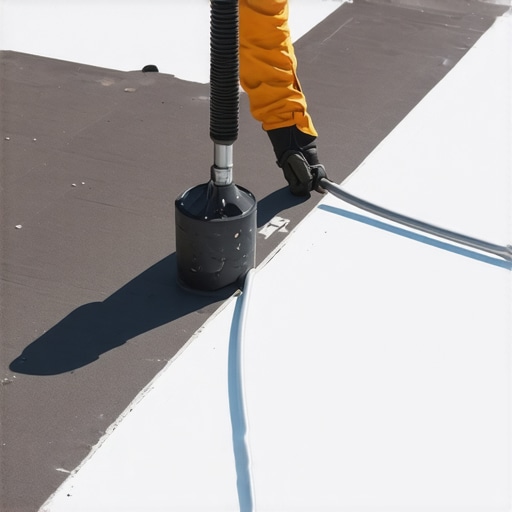
When most local roofers talk about seams, they think in terms of stickiness. But in the forensic world, we look at the molecular level. PVC (Polyvinyl Chloride) is a thermoplastic. This means when you apply the right amount of heat—typically between 800°F and 1,100°F—the polymer chains actually break apart and re-knit with the adjacent sheet. This isn’t a bond; it’s a fusion. Once that silicone roller passes over the heated lap, those two sheets become one. There is no longer a ‘seam’ in the traditional sense; there is only a continuous run of reinforced membrane. Contrast this with older EPDM systems that rely on seam tape. Over time, the plasticizers in the membrane migrate, the adhesive dries out, and capillary action begins. Water is patient; it finds a microscopic void in the glue and, through simple physics, pulls itself uphill into your building. Welded PVC seams are immune to this because there is no void to exploit. For a deeper look at maintenance, check out these 4 points for flat roof seam safety.
“A roof is only as good as its flashing and its seams. If the material is waterproof but the joinery is mechanical, you have a sieve, not a shelter.” – Old Roofer’s Adage
Benefit 1: Impermeability to Ponding Water and Hydrostatic Pressure
In the tropics, a flat roof is rarely truly flat. Deflection in the structural steel or clogged scuppers lead to ponding water. Most roofing manufacturers will void your warranty if water sits for more than 48 hours because they know their adhesives will emulsify. PVC seam welding changes the math. Because the seam is a monolithic fusion, it can withstand constant hydrostatic pressure without delaminating. I’ve seen PVC roofs submerged under six inches of water for a week after a hurricane, and the seams didn’t give an inch. This is why roofing companies that specialize in high-stakes commercial environments almost always lead with PVC. It’s about creating a bathtub-tight seal that doesn’t rely on the chemical stability of a double-sided tape that was manufactured three years ago. If you’re dealing with older tech, you might notice loose roof valley seam flashing, which is a precursor to total system failure.
Benefit 2: Resistance to the Harsh Chemical Soup of the Southeast
Commercial roofs aren’t just dealing with rain. They are dealing with HVAC condensate, grease from restaurant vents, and salt spray if you’re within ten miles of the coast. PVC is naturally resistant to animal fats and many industrial chemicals that would turn a standard asphalt or EPDM roof into a gummy mess. When you weld those seams, you ensure that the chemical resistance is uniform across the entire roof square. I once investigated a food processing plant where the rooftop exhaust was dumping vegetable oil directly onto the roof. The areas with welded PVC were fine; the areas where they had tried to use a ‘universal’ sealant had melted into something resembling black molasses. This chemical stability is why reflective roofs are mandatory now in many jurisdictions; they maintain their integrity while reflecting the UV that breaks down lesser materials.
Benefit 3: Superior Wind Uplift Ratings for Hurricane Zones
Physics doesn’t care about your budget when a Category 3 hurricane rolls through. Wind moving over a flat roof creates a low-pressure vacuum—the Bernoulli principle in action. This lifts the membrane. If your seams are glued, the peel strength of that adhesive is the only thing keeping your roof on the building. A welded PVC seam has a peel strength that often exceeds the strength of the membrane itself. During a forensic pull test, the membrane will usually tear before the weld snaps. This is why many roofing companies focus on the safety records of PVC—it stays put. When the wind gets under a loose edge, it creates a ‘bellows’ effect, pumping air into the building envelope. If you see your roof billowing, you need to look into emergency roof services immediately before the entire deck is compromised.
Benefit 4: Longevity and the Myth of the ‘Quick Fix’
The industry is full of ‘trunk slammers’ who want to sell you a liquid coating or a tape-down repair. They promise it’s just as good as a full weld for half the price. It’s a lie. The lifecycle of a properly welded PVC roof can easily exceed 25 to 30 years with minimal maintenance. Why? Because the weak point of every roof—the seam—has been eliminated. Every time I see a contractor applying caulk to a commercial seam, I see a shiner in the making; it’s a temporary fix that hides a deeper structural flaw. If you are serious about your asset, you invest in the specialized equipment and labor required for hot-air welding. It requires a skilled technician who knows how to calibrate the robot welder for the ambient temperature and the wind speed. If it’s too cold, the weld is ‘cold’ and brittle; too hot, and you scorch the scrim, weakening the reinforcement. You can read more about how to vet these professionals in this guide on vetting roofing companies. For those interested in the specifics of the process, see PVC membrane welding benefits.
“The National Roofing Contractors Association (NRCA) emphasizes that thermoplastic membranes, when properly fused via heat welding, provide the highest level of seam security in the low-slope industry.” – NRCA Technical Manual
The Forensic Verdict: Stop Patching, Start Fusing
If you find water on your conference room table, the autopsy of your roof will likely point to a seam failure. Don’t let a contractor talk you into a ‘fast’ fix with high-VOC glues. In the high-heat, high-moisture environment of a tropical climate, those glues have a shelf life shorter than a gallon of milk. Demand a welded system. It’s the difference between a roof that protects your investment and a roof that becomes a liability. Whether you are looking for preparation for rain seasons or a total overhaul, the weld is the gold standard. Stop hoping your glue holds and start knowing your roof is fused. For those managing large facilities, understanding how to vent large warehouse seams is equally important to prevent internal pressure from popping those very welds you worked so hard to secure.