
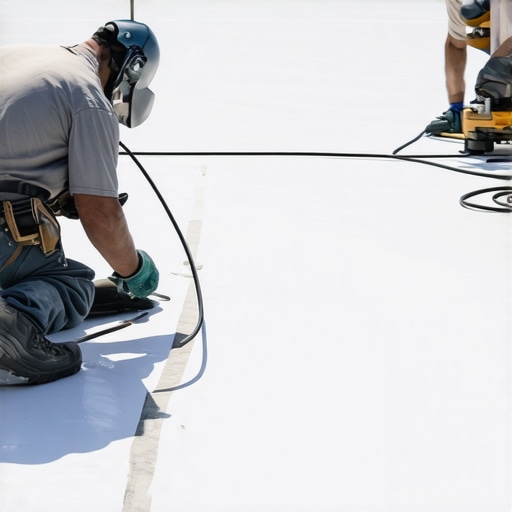
The Forensic Reality of Flat Roof Failures
I’ve spent the better part of three decades climbing ladders and crawling across saturated decks, and if there is one thing I’ve learned, it’s that water is the most patient predator on earth. Walking on that roof felt like walking on a wet sponge; I knew exactly what I’d find underneath before I even pulled my knife. The building owner in Miami was baffled. He had a ‘new’ roof, yet the ceiling in his server room was dripping. When we peeled back the TPO, the glue had crystallized into a brittle dust, and the seams were gaping like fishmouths. This is the reality of many roofing companies pushing cheap adhesives in high-UV environments. They sell you a price point, not a system. If you want a roof that actually survives the tropical humidity and the relentless sun of the Southeast, you stop looking at buckets of glue and start looking at molecular fusion. We’re talking about PVC membrane welding—the gold standard for anyone who doesn’t want to see me back on their roof in five years for a forensic autopsy.
“The roof shall be designed and installed to resist the wind uplift pressures… as determined in accordance with Section 1609.” – International Building Code (IBC) Chapter 15
1. Molecular Fusion vs. Mechanical Failure
When most local roofers talk about seams, they’re talking about tape or contact cement. In the world of commercial roofing, that’s a liability. PVC (Polyvinyl Chloride) is a different beast entirely. We use a hot-air welder—a robotic crawler or a hand-held gun—to heat the overlapping sheets to roughly 1,100°F. At that temperature, the polymer chains in the top and bottom sheets literally vibrate and intermingle. As the material cools, those two sheets become one single, monolithic piece of plastic. It’s not a ‘stick,’ it’s a weld. To understand the physics, you have to look at the capillary action of water. In a glued system, a tiny ‘shiner’ or a missed spot of adhesive creates a microscopic tunnel. Over time, the expansion and contraction of the building—what we call thermal shock—widens that tunnel. Water is sucked in, it freezes or sits, and the seam fails. With PVC seam welding, the seam is actually the strongest part of the entire ‘square’ (that’s 100 square feet for you civilians). If you try to pull it apart, the membrane will tear before the weld breaks.
2. Chemical and Grease Resistance for High-Stress Environments
Most people think a roof just has to handle rain. If you’re running a restaurant, a manufacturing plant, or a hospital, your roof is basically a chemical waste site. Kitchen exhaust fans spew animal fats and oils; HVAC units leak condensate and chemicals. If you put a standard EPDM or TPO roof near a grease trap, the rubber will swell and turn to mush within eighteen months. It looks like melted chocolate. PVC is naturally resistant to these organic fats and oils. It’s the same material we use for plumbing pipes for a reason. When we inspect a deck and see standing water on flats, the chemical stability of the membrane is what prevents the water from leaching the plasticizers out of the sheet. Without those plasticizers, the roof becomes a giant potato chip—it cracks the moment you step on it. PVC keeps its flexibility because the weld seals those additives inside the matrix of the material.
3. Superior Wind Uplift Ratings in Hurricane Zones
Down here, wind isn’t just a breeze; it’s a crowbar trying to pry your building apart. When wind hits the edge of a flat roof, it creates a low-pressure vacuum on top, effectively ‘sucking’ the membrane upward. If your seams are held together by tape, that suction pulls at the adhesive bond. Once one inch of that seam lets go, the whole sheet can unzip like a cheap windbreaker. Because a welded PVC seam is a permanent bond, it handles these ‘uplift pressures’ significantly better. We often see the decking plywood delaminate before the PVC weld fails. For roofing companies working in coastal regions, this is the only way to meet the stringent ‘High Velocity Hurricane Zone’ (HVHZ) codes. If your contractor isn’t talking about wind uplift ratings, they aren’t a commercial roofer; they’re a guy with a truck and a dream. You need a system that acts as a secondary water barrier even when the wind is trying to peel the building like an orange.
4. Managing Ponding Water and Heat Load
Flat roofs aren’t actually flat—or at least they shouldn’t be. But in the real world, buildings settle, and crickets (those little wedges we use to divert water) aren’t always installed perfectly. You end up with ‘ponding water.’ In the Southeast, that water can reach 140°F in the summer sun, creating a literal slow-cooker environment for your roof. Glued seams can’t handle being submerged for weeks at a time; the moisture eventually breaks down the chemical bond of the adhesive. PVC welds are impervious to standing water. While you should always work with experts to identify ponding water and fix the drainage, having a welded seam gives you a margin of safety that other materials simply can’t offer. Furthermore, the white surface of a PVC membrane reflects up to 80% of solar radiation. This reduces the ‘thermal expansion’ of the roof deck, meaning less stress on the fasteners and the structure below. It’s the difference between your building breathing and your building suffocating.
“A roof is only as good as its flashing and its seams.” – Old Roofer’s Adage
The Trap: The Lifetime Warranty Mirage
Don’t fall for the ‘Lifetime Warranty’ nonsense. Most of those warranties are written by lawyers to protect the manufacturer, not you. They exclude ‘ponding water,’ they exclude ‘consequential damages,’ and they certainly exclude ‘improper installation’—which is the cause of 95% of leaks. You don’t need a piece of paper; you need a fused seam. When you hire local roofers, ask to see their welding equipment. If they pull out a tube of caulk and a roll of tape for a commercial flat roof, show them the door. You want to see the Leister robots. You want to see a technician who knows how to ‘probe’ a seam with a metal hook to find the smallest ‘cold weld.’ That level of forensic detail is what separates a 20-year roof from a 2-year nightmare. If you ignore the integrity of the seam, you’ll eventually deal with hidden rafter rot, which costs triple to fix once the structural integrity of the building is compromised.