
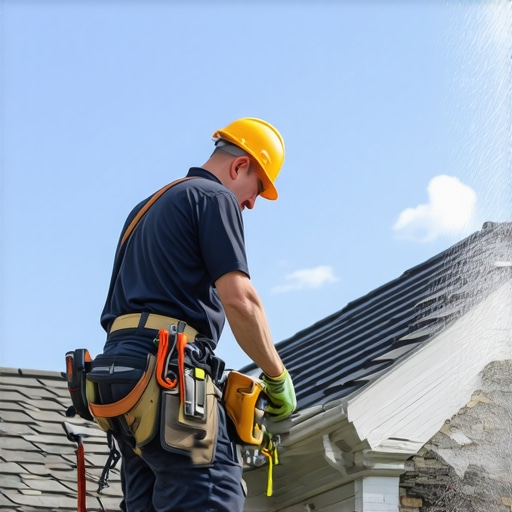
The Anatomy of an Uplift: When Your Roof Tries to Take Flight
You hear it before you see it. That rhythmic, sickening thwack-thwack-thwack of a fiberglass mat hitting a wood deck at 60 miles per hour. By the time you notice a shingle in your front yard, the forensic failure has been in progress for months. Most homeowners think shingles blow off because the wind was too strong. I’ve spent 25 years on ladders from Mobile to Jacksonville, and I’m telling you: the wind is just the messenger. The real culprit is usually a ‘trunk slammer’ with a nail gun set to the wrong PSI or a total disregard for the laws of physics. When we talk about emergency roof services, we aren’t just talking about slapping a tarp down; we are talking about stopping the progressive unzip of your entire envelope. In this tropical corridor, wind-driven rain doesn’t just fall; it gets shoved sideways into every microscopic gap in your assembly. My old foreman used to say, ‘Water is patient. It will wait for you to make a mistake.’ And when wind lifts a shingle, it creates a vacuum that sucks water straight into the heart of your home.
“Fasteners shall be driven flush with the shingle surface and shall not be overdriven.” – International Residential Code (IRC) R905.2.5
The Physics of Failure: Why Shingles Catch Air
To stop a shingle from blowing, you have to understand the Bernoulli effect on a pitched surface. As high-velocity wind hits your rake edge, it speeds up, creating a low-pressure zone directly above the shingles. If your attic isn’t pressurized correctly or if the seal strip has failed, that low pressure acts like a giant vacuum cleaner. It pulls at the tabs. If the roofer left a shiner—that’s a nail that missed the rafter or was driven into a gap—the structural integrity of that square is compromised. Once the first tab lifts, the wind gets underneath it, increasing the surface area for the wind to grab. Now, instead of a flat surface, you have a sail. This is when you start seeing shingle lifting early storm symptoms that lead to total catastrophic loss of the substrate. If you don’t catch it, the next step is shingle buckling which exposes the underlayment to UV and direct moisture.
1. The Surgical Hand-Seal: Beyond the Factory Strip
The first way to stop shingles from blowing in an emergency is a strategic hand-seal. Every shingle has a factory-applied thermoplastic adhesive strip. In a perfect world, the sun heats these up and they bond. But in a storm, the ‘sun’ is nowhere to be found. If you have tabs flapping, you need to apply three one-inch diameter spots of asphalt roof cement under each tab. Don’t go overboard; too much cement prevents the shingle from breathing and can cause blistering later. You’re looking for a bond that mimics the factory seal. This is the ‘Band-Aid’ that prevents the ‘Surgery.’ This is a classic move for immediate leak storm patches. You have to be careful, though; if the shingle is already cold and brittle, you’ll snap it like a cracker. This is why you hire local roofers who know how to handle materials in 95% humidity without sliding off a 12/12 pitch.
2. Fastener Remediation: Hunting for the Shiner
I’ve seen it a thousand times: a crew gets paid by the square and they fly through the job. They ‘high-nail.’ If the nail isn’t through the common bond—where two layers of the shingle overlap—the shingle has zero wind resistance. In an emergency, we go in and find the shingles that are lifting and check the nail line. If we find nails driven above the line, we have to add fasteners. But you can’t just keep punching holes in the roof. Each new nail is a potential leak. We use a flat bar to carefully lift the tab above the failed shingle, drive a galvanized nail into the proper strike zone, and then seal the old hole with mastic. This is forensic roofing. It’s slow, it’s hot, and it’s the only way to ensure the uplift ratings actually mean something. If you ignore this, you’ll eventually need to mitigate interior damage when the ceiling starts bubbling.
“A roof is only as good as its flashing.” – Old Roofer’s Adage
3. Starter Strip Reinforcement at the Rake and Eave
The edges are where roofs die. The rake (the sloping edge) and the eave (the horizontal edge) are the most vulnerable to wind gusting. If the starter strip wasn’t installed with the proper offset, the wind will get a ‘toe-hold’ and peel the roof back like a banana. In an emergency, we reinforce these edges. This might involve installing a drip edge with a wider flange or using a specialized starter shingle that has an aggressive adhesive. If you’re looking at roofing companies, ask them how they secure their starters. If they say they just use regular shingles turned sideways, fire them on the spot. That’s a amateur move that fails in any wind over 40 mph. Local roofers who understand the coastal codes will always use a dedicated starter strip and a six-nail pattern for high-wind zones.
4. Managing the Cricket and Valley Dynamics
Sometimes the blowing isn’t caused by the wind hitting the roof, but by the turbulence created by the roof’s own geometry. Large chimneys or wide dormers create ‘vortex shedding’—basically mini-tornadoes that rip at the shingles in the valley. To stop this, we often have to install a cricket, which is a small peaked structure behind a chimney to divert water and break up the wind flow. If shingles are blowing off specifically around a chimney or in a valley, it’s a design failure. We use heavy-duty modified bitumen or metal valley flashing to create a ‘hardened’ zone that wind can’t get under. Before hiring anyone, make sure to check for valid insurance because valley work is high-risk and requires precision that ‘tailgate contractors’ simply don’t possess.
The Cost of Waiting: Why a Single Shingle Matters
I once walked a roof where the homeowner ignored a single missing shingle for three weeks. When I got up there, the 7/16-inch OSB plywood was so saturated I could poke my finger through it. It looked like wet cardboard. That one shingle caused a $15,000 deck replacement because the ‘secondary water resistance’ was non-existent. When you see a lift, you aren’t just looking at a cosmetic issue; you are looking at the start of a structural rot. You need roofing pros who don’t just look at the surface but understand how the whole system—from the drip edge to the ridge vent—functions as a shield against the brutal humidity and wind of our region. Don’t let a ‘trunk slammer’ tell you it’s just a simple fix. Get a forensic look, get it sealed, and get it done right before the next storm turns your attic into a swimming pool. “,