
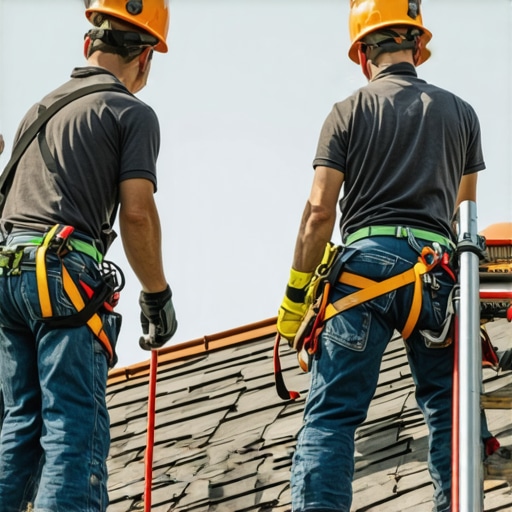
My old foreman used to say, ‘Water is patient, but gravity is efficient. It doesn’t need a crack to get in; it just needs one heavy boot to slip on a loose granule.’ I remember standing on a roof in the biting damp of a late October morning, watching a young kid—new to the trade—try to ‘get a jump’ on the day. He was moving fast, trying to be early, but he hadn’t accounted for the micro-layer of frost on the synthetic underlayment. He didn’t go off the edge, but the sound of his boots scrambling for purchase against the slick polymer is a sound that stays with you. It sounds like a heart attack in the making. That is the reality for roofing companies that prioritize speed over the physics of the fall.
The Forensic Autopsy of a Roof-Site Slip
When I’m called in to consult after an ‘incident,’ I don’t look at the paperwork first. I look at the roof. Most failures in safety happen because of a fundamental misunderstanding of friction and kinetic energy. In cold climates, the enemy isn’t just the height; it’s the transition of states. You have local roofers starting at 6:00 AM to beat the sun, walking on shingles that haven’t reached their ‘grip’ temperature. Asphalt shingles rely on their ceramic granules to provide traction. When those granules are coated in a thin film of frozen dew, they act like ball bearings. If your crew is ‘fast early’ without checking the surface temperature, they are essentially skating on a 6:12 pitch.
“Fall protection shall be provided to employees when they are exposed to a fall of 6 feet or more to a lower level.” — OSHA 1926.501(b)(1)
The physics of a fall are brutal. A 200-pound roofer falling just six feet generates nearly 1,200 pounds of impact force. If that roofer is using a ‘shiner’—a nail that missed the rafter—as an anchor point for their lanyard, that anchor is going to rip out of the OSB like a hot knife through butter. To prevent this, you need to understand the structural ‘meat’ of the house. You aren’t just nailing into the deck; you are anchoring into the skeleton of the building. This is why roofing companies need specific safety compliance protocols that go beyond the basic harness.
1. The Structural Integrity of Anchor Points
The most common mistake I see? Anchors installed over the ridge with nails that only penetrate the sheathing. In my 25 years, I’ve seen ‘fast’ crews slap an anchor down and move on. To do it right, you have to find the rafter. If you don’t feel the bite of the screw into solid wood, that anchor is a lie. It’s a decorative piece of metal that offers zero protection. For local roofers, this means training the eye to find the rafter tails and mapping the structure before the first bundle of shingles even hits the deck. This is vital when dealing with roof snow load safety issues, where the deck might already be stressed.
2. Managing the ‘Fast Early’ Rush and Morning Frost
Speed is the enemy of safety. When companies push for ‘fast early’ starts, they often skip the morning walk-around. In northern zones, the north-facing slope of a roof can stay frozen two hours longer than the south-facing side. A crew that moves from the sunny side to the shaded side without adjusting their gear is asking for a disaster. We use sensory checks: the ‘scuff test.’ If you can’t scuff the surface with your boot and feel the grit of the shingle, you don’t belong on that slope without a roof ladder or a toe board. If you’re managing a crew, you need to ensure they have the right general liability insurance, but more importantly, you need to ensure they have the common sense to wait for the thaw.
3. Ladder Mechanics and the 4-to-1 Rule
I’ve investigated more ‘ladder kicks’ than I care to count. A ladder is a simple tool, but the math behind it is unforgiving. For every four feet of height, the base needs to be one foot out. Too steep, and you’ll tip backward when you reach the top with a heavy bundle on your shoulder. Too shallow, and the feet will slide out from under you, especially on wet grass or slick pavement. I always tell my guys: ‘Tie the top.’ If you aren’t securing the top of the ladder to the fascia or a temporary block, you’re just gambling. This is a primary step in handling project crew safety correctly.
4. Fall Arrest Geometry and the Pendulum Effect
Most people think a harness stops you from hitting the ground. They forget about the ‘swing.’ If your anchor point is 15 feet to your left and you fall, you don’t just drop; you swing like a pendulum. You’ll hit the side of the house, a chimney, or a truck with enough force to shatter bone. Proper safety means keeping your work area within a 30-degree cone of your anchor point. If you move further, you reset the anchor. It takes an extra ten minutes—that ‘fast early’ crowd hates it—but it’s the difference between a close call and a funeral. This level of detail is what separates professional roofing companies from the ‘trunk slammers’ who give us all a bad name.
“The roof is a system of defenses; the moment you treat it as a playground, the system fails.” — Forensic Engineering Axiom
5. Heat Stress and Dehydration Physics
Even in the North, a 90-degree day turns a roof deck into a 140-degree griddle. The ‘fast early’ mentality is often about finishing before the heat becomes unbearable, but this rush leads to ‘shiners’—nails that miss the mark—and poor craftsmanship. More dangerously, it leads to heat exhaustion. A roofer who is dizzy is a roofer who is going to fall. We implement mandatory ‘shade breaks’ and electrolyte replacement. If you’re not tracking the hydration of your crew, you aren’t managing safety; you’re managing a liability. This is especially true as labor shortages force companies to hire less experienced workers who don’t know their limits yet.
The Final Word: The Cost of the Shortcut
The ‘fast early’ approach to roofing is a double-edged sword. Yes, you beat the heat or the rain, but if you skip the forensic-level safety checks, you’re paying for that speed with human risk. A single fall can bankrupt a small company, even with insurance. But beyond the money, there’s the smell of the job site after an accident—the silence that falls over a crew when they realize one of their own isn’t going home. You can fix a ‘shiner’ in a shingle. You can’t fix a ‘shiner’ in a safety protocol. Do the work. Find the rafter. Tie the ladder. Wait for the thaw. That is how you run a roofing business that lasts for 25 years instead of 25 weeks.