
The Autopsy of a Wet Warehouse: Why Seams Matter
I was standing in a distribution center in Philadelphia last November, watching a manager point at a stack of water-damaged electronics. The roof was only six years old. The owner was bewildered because the ‘cheap’ roofing company he hired had used a high-solids adhesive on every seam. But when I got up there, the smell hit me first—that unmistakable, sour odor of saturated insulation. Walking across the deck felt like stepping on a wet sponge. My old foreman, a man who had more tar on his boots than most guys have in their brains, used to say, ‘Water is patient. It will wait for you to make a mistake, and then it will invite all its friends in.’ That’s exactly what happened here. The adhesive had succumbed to plasticizer migration, turning the once-strong bond into a gummy, useless mess. This is the forensic reality of commercial roofing: if you aren’t welding your seams, you aren’t roofing; you’re just hoping.
The Physics of the Molecular Bond
When we talk about PVC (Polyvinyl Chloride) seam welding, we aren’t talking about sticking two things together. We are talking about fusion. Most local roofers who specialize in residential work don’t understand the sheer scale of thermal movement on a 50,000-square-foot commercial deck. A roof is a living thing. It breathes, it expands under the 140°F summer sun, and it contracts when the temperature drops to single digits. Adhesives are static. They are a third-party material trying to hold two membranes together. Eventually, that adhesive becomes the weak link.
‘The most reliable method for joining thermoplastic membranes is heat welding, which creates a permanent, monolithic bond between sheets.’ – National Roofing Contractors Association (NRCA) Manual
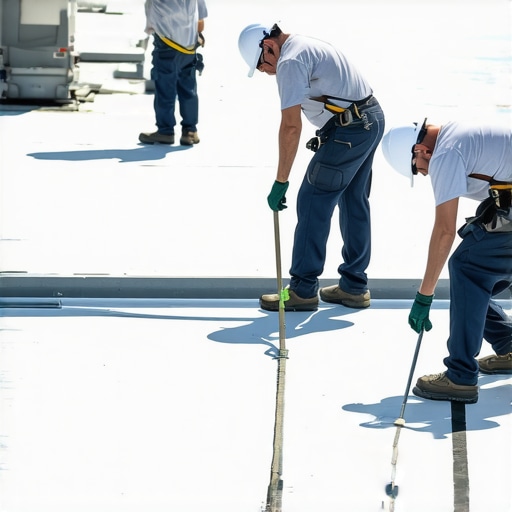
PVC seam welding uses a hot-air welder—often an automated robot or a handheld unit—to blast air at roughly 1,000°F between the overlap. This heat melts the top and bottom layers of the membrane. As the weighted roller follows, it compresses the two layers into one. This is ‘Mechanism Zooming’ at its finest: at the molecular level, the polymer chains from both sheets intermingle and lock as they cool. You no longer have a seam; you have a continuous sheet of reinforced plastic. This is why roofing companies that prioritize longevity push for PVC over cheaper EPDM or TPO glued systems. If you want to see how to avoid these issues early, check out how to seal a flat roof against standing water properly.
Benefit 1: Impermeability to the Elements
The primary enemy in any commercial setting is the ‘Fishmouth.’ This is a trade term for a small ripple in the seam where the membrane hasn’t bonded correctly. In a glued system, a fishmouth is a death sentence. Capillary action—the physics of water moving into tight spaces against gravity—sucks moisture into that gap. Once it’s under the membrane, it travels. It finds the fast-track to your decking, often through a ‘shiner’ (a missed nail) or a fastener plate. PVC welding eliminates this risk. Because the bond is monolithic, there is no physical gap for the water to enter. Even if there is standing water—which we hate but often see on poorly sloped decks—a welded seam can remain submerged without losing its structural integrity. If you’ve noticed sagging in your structure from previous leaks, you need to look at repairing attic decking rafters before installing the new membrane.
Benefit 2: Chemical and Grease Resistance
Commercial roofs aren’t just dealing with rain. If you’re running a restaurant or a manufacturing plant, your roof is likely a graveyard for kitchen grease, HVAC oils, and various chemicals exhausted from the building. Most roofing materials, especially those that are asphalt-based or EPDM, will literally dissolve when they come into contact with animal fats or certain oils. They turn into a soft, jelly-like substance. PVC is naturally resistant to these contaminants. When you weld the seams, you aren’t introducing a glue that can be broken down by these chemicals. You are maintaining the chemical resistance of the membrane across the entire ‘square’ (100 square feet) of the roof. For property owners, this means fewer emergency calls for repairs caused by ‘invisible’ damage from the building’s own exhaust vents.
Benefit 3: Superior Wind Uplift Ratings
Wind doesn’t just blow across a roof; it creates a vacuum. On a large flat roof, the wind moving over the parapet wall creates low pressure on the surface, essentially trying to suck the roof off the building. This is where glued seams fail most spectacularly. Once the edge of a seam is lifted just a fraction of an inch by the wind, the pressure enters the lap and peels the rest of the sheet back like a banana. PVC welding provides a much higher peel strength. In forensic testing, the membrane itself will usually tear before the welded seam fails. This is a critical distinction for buildings in high-wind zones or coastal areas.
‘Mechanical attachment and heat-welded seams are the primary defense against catastrophic wind uplift failure.’ – International Building Code (IBC) Section 1504.3
Many local roofers might try to cut corners on the perimeter, but the perimeter is where the most ‘uplift’ occurs. You need a contractor who understands the physics of air movement. For more on ensuring your deck is ready for this kind of stress, see hidden decking decay signs.
Benefit 4: Ease of Forensic Inspection and Repair
One of the biggest headaches with commercial systems is finding the leak. In a glued system, water can travel 50 feet from the entry point before it drips into the building. With PVC seam welding, the leak is usually right where the damage is. Why? Because the seams are the strongest part of the roof, not the weakest. When I perform a forensic inspection, I use a ‘probe’—a small metal tool with a hook—to drag along the seams. If the welder was set to the wrong temperature, the probe will find a ‘cold weld’ where the layers are just resting on each other instead of fused. It’s an immediate, objective test. You can’t do that effectively with glue without potentially damaging the bond. If a repair is needed, you simply clean the old PVC and weld a new patch onto it. It’s ‘surgery’ rather than a ‘Band-Aid.’ For those looking to hire, knowing how to find reliable roofing companies is the first step to avoiding a botched installation.
The Trap: The ‘Cheap’ Quote and the Warranty Myth
I hear it all the time: ‘But the other guy is 20% cheaper and offers a lifetime warranty.’ Let me be blunt: a warranty is just a piece of paper if the company goes out of business or if the ‘fine print’ excludes damage caused by ‘improper maintenance’ (which is how they describe glued seams failing after five years). You aren’t buying a warranty; you are buying the physics of the roof. If the physics are flawed—like using adhesive in a climate with high thermal cycling—the warranty won’t stop the mold from growing in your walls. High-quality PVC systems require expensive equipment and certified technicians. They aren’t the cheapest option upfront, but they are the only option if you want to sleep when the rain starts hitting the metal deck at 3:00 AM. Don’t fall for the roofing companies that use ‘trunk slammers’ who have never held a hot-air welder. If you are dealing with an older roof, you might want to look into hidden shingle lifting or similar issues if you have a sloped section. Ultimately, the cost of a failed commercial roof isn’t just the price of the repair; it’s the cost of the lost inventory, the business interruption, and the structural damage that occurs while you’re waiting for the ‘warranty’ guy to call you back.