
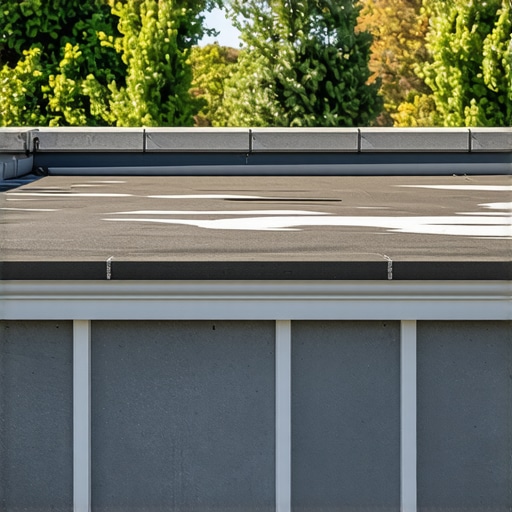
The Autopsy of a Failure: When Flat Roofs Turn Into Lakes
Walking on that roof in Milwaukee felt like walking on a sponge. I knew exactly what I’d find underneath. The sun was barely up, but the humidity was already thick enough to chew on, and the smell—the unmistakable, cloying scent of rotting OSB and stagnant water—hit me before I even stepped off the ladder. I’ve spent twenty-five years investigating why roofs fail, and this was a textbook case of a contractor who didn’t understand the physics of standing water. In our trade, we don’t call them ‘flat’ roofs; we call them low-slope roofs, because if they are truly flat, they are already dead. When I pulled back a section of the EPDM membrane, the insulation underneath was so saturated it crumbled like wet cake. This wasn’t a leak; it was an environmental disaster caused by poor drainage and a fundamental misunderstanding of hydrostatic pressure.
The Physics of Ponding: Why Water is Patient
Standing water, or ponding, is defined by the National Roofing Contractors Association (NRCA) as water that remains on a roof for more than 48 hours after a rainfall. But water doesn’t just sit there. It exerts constant, relentless pressure on every seam and every penetration. Think about a 10×10 area of water, just one inch deep. That’s roughly 600 pounds of dead weight sitting on your structure. Over time, that weight causes the roof deck to deflect, creating a deeper bowl that collects even more water. It’s a self-reinforcing cycle of structural failure. When local roofers ignore the slope, they are essentially building a swimming pool with a ticking clock. Water finds its way through capillary action, a phenomenon where liquid travels through tiny gaps in seams, defying gravity by being pulled along by surface tension. If your seams aren’t perfect, the water is already inside.
“Water ponding on roofs is a primary cause of premature failure of the roof membrane. Positive drainage is required to ensure the longevity of the system.” – NRCA Manual
Mechanism Zooming: The Molecular Failure of Seams
In 2026, we are seeing more extreme weather events, and standard ‘glue-and-go’ methods are failing at record rates. Let’s zoom in on the seam of a TPO (Thermoplastic Polyolefin) or PVC roof. On a healthy roof, these seams are fused together using hot-air welding, creating a monolithic piece of plastic. However, if the technician moves too fast or the temperature isn’t dialed in, you get what we call a ‘cold weld.’ To the naked eye, it looks sealed. But under the constant weight of standing water, the molecular bonds begin to pull apart. This is where pvc seam welding becomes the only viable defense. Unlike EPDM, which relies on adhesives that can break down under UV radiation and chemical exposure, a properly welded PVC seam is actually stronger than the membrane itself. When water sits on a glued EPDM seam for weeks, the solvents in the adhesive can emulsify, leading to a total failure of the bond. Once the seal is breached, water travels laterally under the membrane, often surfacing as a leak thirty feet away from the actual hole.
The Anatomy of Drainage: Scuppers, Crickets, and Drains
If you want to seal a roof against standing water, you don’t just add more sealant; you move the water off the building. This starts with Tapered ISO (Polyisocyanurate) insulation. We don’t just lay flat boards anymore. We use boards that are sloped—usually 1/8″ or 1/4″ per foot—to create a literal hill for the water to run down. Then there are crickets. A cricket is a diamond-shaped structure built behind a chimney or a large HVAC unit to divert water around the obstruction. Without a cricket, water hits the unit, stops, and forms a stagnant pool. This is where you see hidden decking plywood decay start. The water eats through the flashing, hits the wood, and within three seasons, you’re looking at a five-figure structural repair. I’ve seen warehouses where they forgot the scuppers (the holes in the side of the parapet wall), and the roof literally collapsed under the weight of a heavy spring rain. The International Building Code (IBC) is very clear about this.
“All roofs shall be sloped a minimum of one-fourth unit vertical in 12 units horizontal (2-percent slope) for drainage unless designed for ponding water.” – International Building Code, Section 1507.10
The ‘Band-Aid’ vs. The Surgery: Real Solutions
I get calls every week from folks asking if they can just slather some silicone over a leak. That’s a Band-Aid, and in many cases, it makes the problem worse. Silicone is great for certain things, but if you have thermal bridging occurring in a cold climate like ours, the moisture is coming from inside the building as well as outside. Warm air from the building hits the cold underside of the roof deck, condenses, and rots the wood from the bottom up. To truly seal a flat roof, you need to address the entire system. This means checking for ‘shiners’—those missed nails that act as heat conductors and cause condensation drips—and ensuring you have a high-quality synthetic underlayment or a dedicated vapor barrier. For those dealing with EPDM, you must use epdm kits that include specialized primers and seam tapes, not just hardware store caulk. If you see a contractor reach for a tube of cheap clear silicone on a flat roof, fire them on the spot. They are setting you up for a catastrophic failure when the first freeze hits and that water expands, tearing the seam wide open.
Contractor Red Flags: Don’t Hire a Trunk Slammer
The roofing industry is full of ‘trunk slammers’—guys who show up in a beat-up pickup, give you a low-ball quote, and disappear when the first leak starts. In 2026, roofing companies should be using thermal imaging and drone technology to find hidden moisture before they ever give you a quote. If they aren’t looking for wet insulation, they are just burying the problem. Ask about their uplift ratings and what kind of stainless nails they use if you are near the coast. A roof is only as good as the person installing it. If they don’t mention secondary water resistance or how they plan to handle the flashing around vent pipes, they are probably going to cut corners on the most important parts. If you find your roof leaks around vent pipes after a storm, it’s almost always because the boot wasn’t sealed correctly for a standing-water environment.
The Final Word: The Cost of Waiting
Water is patient. It will wait for you to make a mistake. It will wait for that one seam to dry out, for that one piece of flashing to pull away during a thermal expansion cycle, or for that one scupper to get clogged with leaves. By the time you see a brown spot on your ceiling, the damage is already done. You are no longer just fixing a roof; you are replacing insulation, potentially remediating mold, and structural lumber. Sealing a 2026 flat roof isn’t about the surface; it’s about the system. It’s about drainage, slope, and molecular-level bonding. Don’t let your roof become a forensic scene for the next guy to investigate. Get it done right, get the slope verified, and make sure those seams are welded like your building depends on it—because it does.