
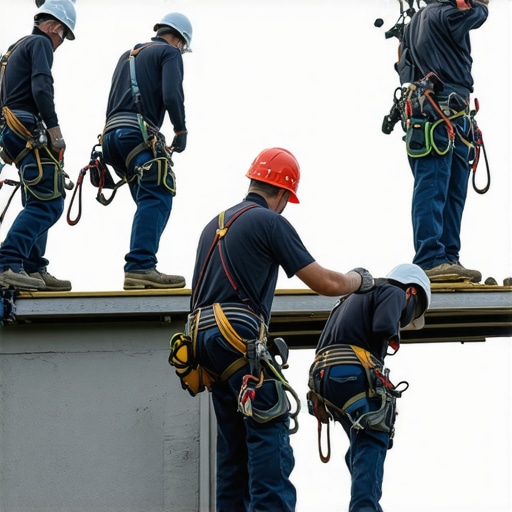
The Anatomy of a Failed Safety Record
I’ve spent twenty-five years watching the Florida sun bake the life out of 3-tab shingles, and I’ve seen more ‘fast’ jobs fail than I care to count. When you hear a roofing company talking about ‘building local project safety records fast,’ your alarm bells should be ringing. Speed in this trade is usually a mask for negligence. I remember my old foreman, a man who had more scars than a discarded piece of flashing, used to say, ‘Water is patient. It will wait for you to make a mistake.’ He wasn’t just talking about leaks; he was talking about the structural integrity of the entire crew and the home beneath them. When a local roofer tries to cut corners to hit a deadline, the first thing to go is the safety protocol, and the second is the roof itself.
1. The Physics of the Fall: Beyond the Harness
In the humid Southeast, where a morning dew can turn a 6:12 pitch into a skating rink, safety isn’t just about a rope. It’s about the physics of friction. Most ‘trunk slammers’ think a harness is a suggestion, but a forensic look at safety records shows that falls happen during the ‘easy’ parts of the job—like carrying a 70-pound bundle of shingles up a ladder without a hoist. To build a real safety record, roofing companies must prioritize crew safety through rigorous fall-arrest training. This means checking the D-ring on every harness for corrosion and ensuring the anchor point isn’t just nailed into a single layer of OSB that’s already suffering from delamination. If you aren’t inspecting your safety gear with the same intensity you use to look for hail damage, you don’t have a safety record; you have a ticking clock.
“Safety is not an option; it is a fundamental requirement for the professional application of any roofing system.” – National Roofing Contractors Association (NRCA)
2. The ‘Shiner’ Epidemic and Structural Integrity
You want to know why a roof fails during a Category 1 storm while the neighbor’s roof stays put? It’s usually a ‘shiner.’ That’s a nail that missed the rafter, driven blindly by a guy trying to move too fast. Those missed nails don’t just cause leaks; they compromise the wind uplift rating of the entire deck. When water finds that shiner, it travels down the shank via capillary action—where water literally climbs against gravity—and begins the slow rot of the rafter. Within three years, that wood is as soft as oatmeal. To build a reputable safety record, you have to identify signs of improper roof nailing before the final inspection. A real pro checks the nail pattern to ensure it meets the 130-mph wind code, not just the minimum ‘four nails per shingle’ rule that leaves roofs vulnerable to the next tropical depression.
3. Verifying the 2026 License Status Early
I’ve seen dozens of companies pop up after a storm, claim they have a ‘perfect safety record,’ and disappear before the first leak call. A legitimate record starts with a paper trail. You cannot trust a verbal guarantee. In today’s market, you need to verify a 2026 license status before a single toe-board is nailed to your roof. An unlicensed contractor isn’t just a legal risk; they are a physical safety risk. They don’t carry worker’s compensation, which means if a ‘shiner’ causes a fall on your property, you’re the one holding the bag. Building a local safety record means being transparent with documentation from day one.
4. Managing Crew Size for Quality Control
There is a dangerous myth that a bigger crew is a better crew. I’ve walked onto job sites where twenty guys are swarming a 30-square roof, and it’s pure chaos. Nobody is watching the valley flashing, and someone is definitely going to step on a ‘cricket’ and crush it. To maintain safety and quality, you have to evaluate the crew size based on the complexity of the roof. A massive crew often leads to communication breakdowns where the ridge vent isn’t cut properly or the drip edge is installed upside down. A smaller, disciplined crew that follows a ‘Forensic Autopsy’ approach to every tear-off will build a better safety record than a mob of day laborers moving at breakneck speed.
“A roof is only as good as its flashing, and a crew is only as safe as its slowest worker.” – Old Roofer’s Adage
5. The Secondary Water Resistance (SWR) Standard
In Florida and the Gulf Coast, your safety record depends on what happens when the shingles are gone. During a replacement, the house is at its most vulnerable. If the company isn’t using a high-quality synthetic underlayment or a peel-and-stick membrane for secondary water resistance, they are failing the safety test. We look for ‘thermal shock’—the expansion and contraction of the roof deck during those 100-degree days followed by sudden thunderstorms. If the underlayment isn’t rated for high-heat environments, it will bake and crack. For a truly ‘fast’ but safe record, following safety record protocols ensures that even if the primary roof covering fails, the interior remains dry. This is about preventing the hydrostatic pressure that forces water under shingles during wind-driven rain. It’s the difference between a minor repair and a total loss. When selecting local roofers, look for those who obsess over the ‘unseen’ layers. That is where a real reputation is built—not in the glossy brochures, but in the heat of a 140°F attic where the real forensics of roofing takes place.