
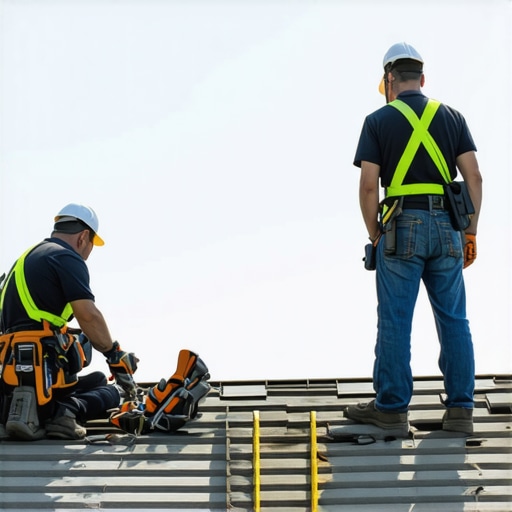
The Forensic Scene: Walking on a Sponge
I remember a tear-off job in Savannah where the client complained about a ‘soft spot’ near the chimney. When I stepped onto that roof, it didn’t just give a little; it felt like walking on a giant, waterlogged sponge. I knew exactly what was happening beneath those sun-baked shingles. The previous crew had skipped the cricket—that small peaked structure designed to divert water—and the 100-degree humidity had turned the plywood into mulch over five years of tropical downpours. That wasn’t just a leak; it was a safety hazard waiting to swallow a roofer whole. My old mentor used to say, ‘Water is patient, and gravity is its best friend. If you don’t respect both, you’re just an insurance claim waiting to happen.’ In the roofing business, a safety record isn’t a trophy you win at the end of the year; it’s a living document you build in the first fifteen minutes of every morning. When local roofers talk about ‘moving fast,’ they usually mean cutting corners. But if you want to build a real safety record that actually protects your crew and your bottom line, you have to look at the forensics of the job before the first nail is even driven.
“A roof is only as good as its flashing.” – Old Roofer’s Adage
The physics of a fall are brutal. In the Southeast, we deal with a specific kind of treachery: high-velocity wind zones and the invisible slickness of algae. If your roofing companies aren’t accounting for the sheer uplift ratings required by code, they aren’t just doing bad work—they are creating a liability. When we talk about how 2026 roofing companies manage site safety, it starts with understanding the material truth of our climate. You can’t use the same protocols in the humid salt air of the coast that you’d use in a dry desert. The salt air eats through standard galvanized nails in years, not decades, leading to fastener failure that can cause entire squares of shingles to slide off under the weight of a worker. This is why forensic analysis of every failure is the only way to prevent the next one.
1. The Early Documentation of Structural Integrity
Building a safety record starts before the ladder hits the gutter. You need to identify the ‘ghosts’ in the attic. This means checking for signs of roof decking decay before anyone even steps onto the slope. If you have decking rot, the structural capacity of the roof is compromised. A ‘fast’ safety record is built by using tech to spot these issues early. We’re seeing more roofing companies use drone video to perform initial inspections. This keeps boots off the ground (and off the roof) until we know the substrate can handle the load of a six-man crew and three pallets of asphalt shingles. It’s about the physics of load distribution; a standard sheet of 7/16″ OSB that’s been soaked by a slow leak around a pipe boot has the structural integrity of a wet cracker. If you don’t catch that early, your safety record is toast.
2. The ‘Shiner’ Audit and Fastening Precision
Nothing grinds my gears more than a ‘shiner.’ That’s a nail that missed the rafter and is just hanging out in the attic, doing nothing but providing a path for capillary action to pull water into the insulation. But from a safety perspective, shiners are a symptom of a rushed crew. If a crew is missing rafters, they are likely missing their tie-off points too. A real safety record is built on the forensic inspection of fastening patterns. You have to check if the eave drip is properly secured because if that metal edge slips while a guy is leaning on it, he’s gone. This is why many local roofers check roof fastening protocols twice a day. It’s not just about keeping the shingles on during a hurricane; it’s about ensuring every component of the roof can withstand the lateral forces of a working human body.
3. Combatting the Tropical Slip-and-Slide
In the Southeast, algae isn’t just an eyesore; it’s a lubricant. Gloeocapsa magma—that black streak you see on roofs—holds moisture and makes the surface as slick as a skating rink. If your safety record is going to hold up, you need a plan for algae growth. We often recommend ways to stop algae growth specifically to maintain surface friction for maintenance crews. Furthermore, the heat in a Florida attic can reach 140°F, leading to thermal expansion of the roof deck. This movement can cause underlayment tears if the material isn’t high-quality. If the underlayment is torn, the grip between the shingle and the deck is compromised. You need to be looking for signs of underlayment tears during every phase of the project. A safety record that ignores the micro-climates of the roof surface is a lie.
“Safety is not a gadget but a state of mind.” – Architectural Axiom
4. Managing the Perimeter and Gravity’s Pull
The edges are where most roofing accidents happen. The fascia board and the soffit aren’t just decorative; they are the perimeter of the safe zone. If a roofer is relying on a gutter hanger to stabilize their ladder and that hanger is rusted out, they are in trouble. I’ve seen too many guys trust a fascia board that was actually pulp because of a poorly installed drip edge. You have to look for signs of fascia board decay before you even think about set-up. A fast safety record is built by having a ‘perimeter boss’ whose only job is to ensure that the transition points—the valleys, the hips, and the ridges—are handled with surgical precision. If you don’t manage the edges, gravity will manage them for you, and gravity never loses an argument.
5. The Post-Game Autopsy of Near-Misses
Finally, a safety record is a cumulative history of what didn’t happen. Every time a tool slides down the roof and gets caught by the toe board, that’s a data point. Every time a worker notices shingle granule loss that makes the slope extra slippery, that’s a warning. Local roofing companies that want to dominate their market in 2026 are starting to use roof asset logs to track these near-misses. They look at ridge cap lift or flashing rust as more than just repair items; they see them as forensic evidence of how the roof is failing and how those failures could lead to an accident. If you ignore the small signs, like nail pop leaks, you’re ignoring the fact that the roof deck is slowly losing its grip. A safety record built early is one built on the brutal, cynical honesty of a veteran who knows that the roof is always trying to shed more than just water.