
The Cost of Cutting Corners: Why Your Studio’s Roof is Failing
Walking into a high-end recording or art studio in a cold climate like Minneapolis or Boston, you expect to smell expensive gear or oil paints, not the damp, earthy stench of rotting plywood. My old foreman used to say, ‘Water is patient. It will wait for you to make a mistake.’ He was right. Over twenty-five years on the roof deck, I’ve seen hundreds of ‘eco-friendly’ projects turn into forensic nightmares because local roofers treated a sophisticated studio like a backyard shed. In 2026, the tech has changed, but the physics of water remains the same. If you are building a studio, you aren’t just looking for a roof; you are looking for a thermal envelope that won’t dump a gallon of condensation onto your mixing console during the first deep freeze.
When we talk about studios, we are talking about high-occupancy, often high-humidity environments. In northern climates, the primary enemy isn’t just the rain—it’s vapor drive. Warm, moist air from inside the studio wants to move toward the cold exterior. If your roofing companies didn’t account for thermal bridging, that vapor hits the underside of your cold roof deck and turns into ‘indoor rain.’ This is where the physics of ‘eco-friendly’ roofing gets complicated. You can’t just throw some recycled shingles up and call it a day.
“A roof is only as good as its flashing.” – Old Roofer’s Adage
1. Recycled Polymer Slate: The High-End Aesthetic Without the Carbon Footprint
One of the most robust solutions I’m seeing in 2026 is the use of recycled polymer slate. Traditional slate is heavy and expensive to ship, but these synthetic alternatives are made from post-industrial plastics and rubbers. From a forensic perspective, what I love is their impact resistance. Unlike natural slate that cracks when a branch hits it, these tiles have a ‘give’ that handles thermal expansion and contraction like a champ. When you look at the benefits of recycled slate tiles, the real winner is the longevity. However, a warning: if your roofer uses cheap ‘shiners’—those missed nails that peek through the underlayment—you’ll have a leak by winter. These tiles require precision fastening because the polymer expands differently than the wood deck beneath it.
2. High-Performance TPO with Bio-Glu Seams
For flat-roof studios, Thermoplastic Polyolefin (TPO) has been a staple, but the 2026 versions are using plant-based adhesives. In the old days, we used harsh chemical solvents that would make your eyes water. Now, we are seeing bio-glu seams that create a molecular bond stronger than the membrane itself. Mechanism zooming: think about the seam not as two pieces of plastic glued together, but as a single, fused sheet. In a cold climate, this is vital because traditional adhesives become brittle at -10°F. If the seam loses its elasticity, capillary action will suck water under the lap, and before you know it, your R-Value is shot because your insulation is a sponge.
3. Integrated Solar with Decoupled Brackets
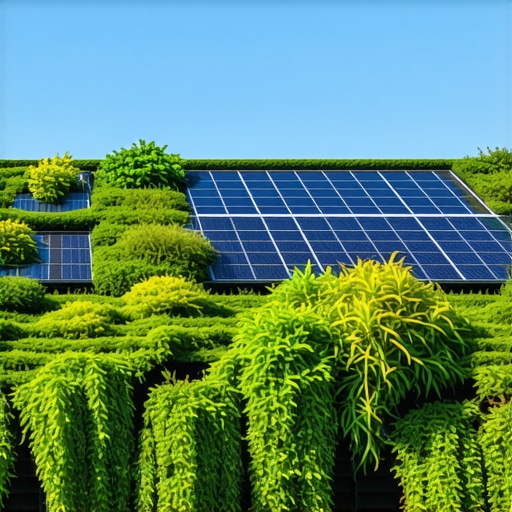
Every studio owner wants solar, but most roofing companies treat panels as an afterthought. They drill holes, slap some caulk on it, and call it a day. That’s a recipe for a ‘valley’ of standing water behind the rack. The 2026 standard for eco-studios involves decoupled solar brackets that allow the roof to breathe. These brackets use a thermal break to prevent the cold from the metal rail from transferring into the attic space. Without this, you get ‘ghosting’—lines of condensation on your ceiling that eventually lead to mold. It’s not just about the energy; it’s about the structural integrity of the penetration points.
4. The Green Roof Dilemma: Living Systems
Green roofs are the holy grail of eco-roofing for studios because of their incredible acoustic dampening properties. Soil is a fantastic sound insulator. However, as a forensic guy, I have to tell you the truth: they are heavy. I’ve walked onto job sites where you could see the signs of structural shifting because the architect didn’t account for the weight of saturated soil during a spring thaw. If you go this route, you need a secondary water resistance layer that is bulletproof. I’m talking about a monolithic membrane that can handle hydrostatic pressure. If that membrane has even a pinhole, the weight of the dirt makes finding the leak like looking for a needle in a haystack of mud.
“Buildings shall be provided with a roof covering that is designed, constructed and installed in accordance with this code.” – International Residential Code (IRC), Section R903.1
5. Recycled Metal with High-Albedo Kynar Finishes
Metal is the king of recyclability. You can melt it down and turn it into a new roof forever. For northern studios, a standing seam metal roof is great for shedding snow, preventing the dreaded ‘ice dam.’ But the ‘eco’ part comes from the Kynar finishes that reflect UV rays even in the winter. Mechanism zooming: the heat from your studio rises, but the Kynar finish ensures that the sun’s radiation doesn’t bake the metal from the outside while the attic heat bakes it from the inside. This prevents ‘oil canning’—that wavy look metal gets when it’s stressed. If your local roofers don’t use a ‘cricket’ behind your chimney or skylight, the metal will expand, pull the fasteners, and leave you with a ‘square’ of rotten decking within five years.
The Warranty Trap: Why “Lifetime” Means Nothing
Don’t get sucked into the ‘Lifetime Warranty’ marketing. Most of those warranties are prorated and don’t cover labor. If a ‘trunk slammer’ installs your eco-friendly roof and skips the starter strip or the drip edge, the manufacturer will laugh at your claim. They’ll point to a single ‘shiner’ and tell you the failure was due to poor workmanship. In 2026, the best roofing companies are using lidar quotes to map every inch of your roof before they even touch a hammer. This ensures the pitch is correct and the drainage is calculated to the millimeter. If your roofer is still using a tape measure and a prayer, find someone else.
Final Verdict: Surgery vs. Band-Aids
Building an eco-friendly studio in a cold climate is a game of inches. You can spend $40k on a fancy recycled roof, but if your attic bypasses aren’t sealed, you’ll still get ice dams. The ‘surgery’ involves a total system approach: proper R-Value insulation, air sealing the attic flats, and using a high-performance membrane. The ‘band-aid’ is just more caulk. Choose the surgery every time. Your gear—and your lungs—will thank you when the snow starts to pile up and your studio stays bone-dry.