
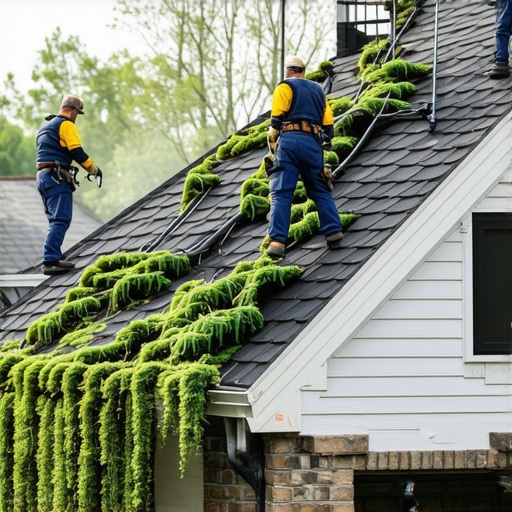
The Black Streak Autopsy: Why Your Roof is Turning Into a Petri Dish
I’ve spent three decades climbing ladders in humidity that feels like breathing through a hot, wet towel, and if there’s one thing local roofers see more than actual storm damage, it’s the slow, creeping rot of Gloeocapsa magma. You call them ‘black streaks.’ I call them an expensive buffet. You see, modern asphalt shingles aren’t just oil and grit anymore; they’re packed with limestone filler. To these algae spores, your roof is a 3,000-square-foot calcium tablet. My old foreman used to say, ‘Water is patient, but algae is persistent. It will wait for you to make a mistake, then it will eat your investment from the outside in.’ If you’re seeing those dark stains, your roofing is literally being digested. This isn’t just a cosmetic eyesore; it’s a thermal nightmare. Those black streaks absorb UV radiation, turning your attic into a 140-degree oven that cooks your rafters and sends your AC bill into the stratosphere.
“Algae growth on asphalt shingles is a primary concern in humid regions, often requiring specific material enhancements to prevent premature aesthetic and structural degradation.” – ARMA (Asphalt Roofing Manufacturers Association)
When you hire roofing companies, most will just offer to power-wash the problem away. That is a rookie mistake that will shave five years off your roof’s life in twenty minutes. High pressure strips the granules—the very armor of the shingle—leaving you with nothing but exposed matting and a ‘shiner’ or two where the nails were driven too shallow. To truly stop the green and black creep in 2026, you have to understand the physics of the shingle surface. Here are the five forensic-level strategies to keep your deck clean.
1. The Ion Defense: Why Copper and Zinc Rule the Ridge
The most effective way to kill algae is to make the roof a toxic environment for it—molecularly speaking. Every time it rains, a tiny amount of metallic ions should wash down the slope. This is why you see clean spots under lead chimney flashings. For a permanent fix, we install heavy-gauge strips at the peak. If you look at the local roofers 3 benefits of 2026 zinc strips, you’ll see how those ions create a chemical shear that prevents spores from ever taking root. It’s not magic; it’s chemistry. The rain hits the metal, picks up the ions, and distributes a microscopic layer of herbicide across every square. If your contractor isn’t talking about ion distribution, they’re just selling you a temporary fix.
2. High-Ratio Copper Granules in ‘AR’ Shingles
Don’t fall for the ‘Algae Resistant’ (AR) stamp without checking the specs. In 2026, the best roofing companies are moving toward shingles with a 10% or higher copper granule blend. The industry standard used to be 3-5%, which lasts about as long as a cheap pair of boots. You want the stuff that’s engineered to release those ions slowly over 20 years. When I inspect a failed roof, I often find that the ‘AR’ shingle used was a base-grade product with a thin coating that washed off after three seasons of tropical downpours. You need to verify the origin of your materials to ensure the copper is embedded, not just dusted on. Check out how to local roofers 4 ways to verify 2026 shingle origin to make sure you aren’t getting the ‘trunk slammer’ special.
3. Correcting the Airflow Stagnation
Algae loves a swamp, and a roof that stays damp for four hours after a rain is a swamp. This usually points to a failure in the attic’s ‘lungs.’ If your intake vents are clogged with insulation or bird nests, the roof deck stays cool from the underside while the shingles bake, creating a condensation sandwich. This moisture feeds the algae from below. By using local roofers 4 ways to increase 2026 roof airflow, you decrease the surface drying time. A dry roof is a clean roof. I’ve seen roofs in the Southeast that looked like they were covered in carpet simply because the ridge vent was choked off by a poorly installed cricket or sagging rafters.
“A roof system must be designed to shed water and manage moisture vapor effectively to maintain the integrity of the building envelope.” – NRCA Building Standards
4. The Switch to Bio-Based Sealants
Old-school petroleum sealants eventually crack and trap organic debris—pollen, dust, and dirt—which acts as soil for moss and algae. In 2026, we are seeing a shift toward why 2026 roofing companies prefer 2026 bio-sealants. These materials are smoother at a microscopic level, meaning the spores have nothing to grab onto. When you have a valley or a dormer that collects leaves, these sealants allow the debris to wash off rather than becoming a compost pile on your shingles. If you ignore this, you’ll eventually see local roofers 5 signs of 2026 fascia wear as the moisture wicks upward from the clogged gutter line.
5. Professional Chemical Soft-Washing (The Last Resort)
If the algae is already there, you can’t just ignore it. But for the love of your deductible, do not let anyone up there with a power washer. You need a low-pressure ‘soft wash’ using a sodium hypochlorite solution mixed with a surfactant. This kills the root system of the algae without blowing the granules into your gutters. Once the roof is clean, you must immediately follow up with local roofers 4 tips for 2026 moss control to prevent a resurgence. If you don’t treat the root, it’s like mowing a weed; it’ll be back in six months, and it’ll bring friends.
The Warranty Trap: Don’t Get Fooled
Most roofing companies will shout about a ‘Lifetime Warranty,’ but if you read the fine print on algae coverage, it usually pro-rates after just a few years. They count on you moving or forgetting. A forensic look at these contracts reveals they only cover ‘structural failure,’ and many manufacturers don’t consider black streaks a failure—they call it an ‘environmental condition.’ That’s why the physical defenses like zinc and copper are your only real insurance policy. Don’t buy a roof based on a shiny brochure; buy it based on the physics of the materials and the airflow of the system. If your roofer isn’t looking at your ventilation and the copper content of the granules, they aren’t solving your problem; they’re just covering it up with a new layer of ‘oatmeal’ for the algae to eat later.