
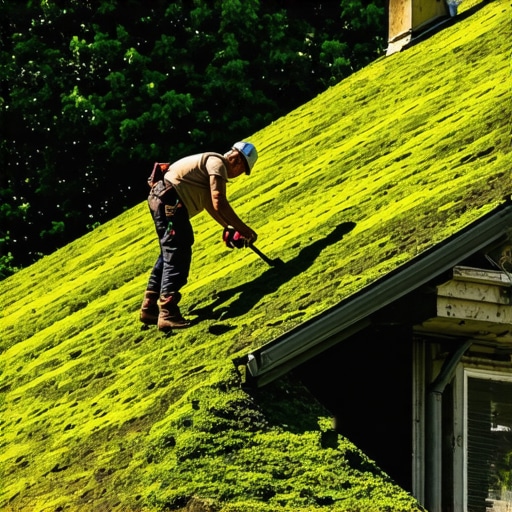
The Biology of a Failing Roof: Why Moss is Your Home’s Silent Predator
I’ve spent thirty years on steep-slope decks, and if there is one thing I’ve learned from the thousands of squares I’ve torn off, it’s that nature is remarkably patient. My old foreman, a grizzly guy named Miller who smelled like tobacco and hot asphalt, used to say, ‘A roof isn’t a shield; it’s a water-management system that nature is constantly trying to reclaim.’ When we talk about moss in 2026, we aren’t just talking about some green fuzz that makes your house look like a cottage in the woods. We are talking about a biological mechanism that is actively dismantling your shingles through moisture retention and physical displacement.
Local roofers often treat moss like a cosmetic blemish, but a forensic look at a 15-year-old roof in a damp climate reveals a different story. Moss uses tiny anchoring structures called rhizoids. Unlike tree roots, these don’t pull nutrients, but they do wedge themselves into the granules of your asphalt shingles. As the moss grows, these rhizoids expand, prying the ceramic granules loose. Once those granules are gone, the underlying bitumen is exposed to UV radiation, and that’s when the clock starts ticking toward a total system failure. The smell of a moss-infested roof is unmistakable—a damp, earthy rot that suggests the plywood deck underneath is already starting to lose its structural integrity.
“Roofing systems must be designed to shed water rapidly. Anything that impedes the flow of water, including biological growth, increases the risk of moisture infiltration and structural degradation.” — National Roofing Contractors Association (NRCA) Guidelines
The Material Truth: Why Your Choice of Shingle is the First Line of Defense
When you call local roofing companies for a replacement, they’ll likely pitch you on ‘Lifetime’ shingles. Let’s be real: ‘Lifetime’ is a marketing term, not a physical law. For 2026, the technology has shifted toward copper-infused granules that are more than just a coating; they are baked into the laminate. The physics of this is simple but effective. Every time it rains, a minute amount of copper ions is released. These ions are toxic to bryophytes (moss and liverworts). If you live in a high-shade area near the coast or under a heavy canopy, opting for a standard 3-tab or a cheap architectural shingle without high-grade algae resistance is just asking to pay for another roof in twelve years.
Tip 1: The Physics of Zinc and Copper Strips
One of the most overlooked tools in the trade is the sacrificial metal strip. We install these at the ridge, just below the ridge cap. As rainwater washes over the zinc or copper, it creates a chemical environment that prevents moss spores from ever taking hold. But here is where the ‘trunk slammers’ mess up: they use the wrong fasteners. If you put a galvanized nail through a copper strip, you’re creating a galvanic cell. In the trade, we call this a ‘suicide joint.’ The two metals will react, the nail will corrode, and before you know it, you’ve got a shiner—a missed or backed-out nail—that provides a direct conduit for water to travel down into your attic bypass and rot your rafters.
Tip 2: The Myth of Pressure Washing
I see it every spring: some kid with a high-pressure wand on a ladder, blasting away at a roof. It makes my stomach turn. If a roofing company suggests pressure washing to remove moss, fire them on the spot. A pressure washer at 3,000 PSI is a scalpels that strips the life out of your roofing. It shears off the protective granules, leaving the fiberglass mat exposed. You might have a clean-looking roof for a month, but you’ve effectively aged it ten years in a single afternoon. The right way to handle existing growth is a low-pressure chemical application—specifically something that neutralizes the pH of the roof surface without killing your landscaping. We use a soft-wash approach that relies on chemistry, not brute force.
Tip 3: The Role of Attic Ventilation in Moss Proliferation
You might wonder what your attic has to do with moss on the outside. It comes down to the temperature of the roof deck. A poorly ventilated attic creates hot spots. In the winter, this leads to uneven snow melt, which contributes to ice dams. In the summer, a hot attic cooks the shingles from the inside out. But in the shoulder seasons, a warm attic keeps the roof surface just warm enough to encourage moss growth even when the air temperature is cool. If your local roofers aren’t checking your intake vents at the soffit or the exhaust at the ridge, they aren’t fixing the problem; they’re just covering it up. Proper airflow keeps the deck cool and dry, making it a hostile environment for moss spores.
“The building envelope shall be provided with a ventilated space between the roof deck and the insulation to prevent the accumulation of moisture and to control the temperature of the roofing materials.” — International Residential Code (IRC) R806.1
Tip 4: Correcting the ‘Micro-Dam’ Effect in Valleys
Valleys are the most vulnerable part of any roof because they handle the highest volume of water. When moss takes root in a valley, it creates what I call a ‘micro-dam.’ Water flowing down the valley hits the moss, slows down, and begins to move sideways via capillary action. It gets under the edges of the shingles where the flashing should be. If the previous guy didn’t install a proper ice and water shield or used a cheap ‘closed valley’ technique where shingles are woven together, that water is going to find its way into your home. A ‘California Cut’ or an ‘Open Metal Valley’ is often the better choice for high-moss zones because it allows for a smoother exit for debris and water.
The Forensic Conclusion: How to Vet Local Roofing Companies
Don’t fall for the lowest bid. The lowest bid is usually someone who is going to skip the starter strip or use cheap plastic vents that will crack in three years. Ask your contractor about ‘Mechanism Zooming’—if they can’t explain how water moves through a valley or why a cricket is necessary behind a wide chimney, they don’t understand the physics of their own trade. Look for a crew that treats the roof like a laboratory, not a jigsaw puzzle. You want someone who is obsessed with the drip edge, the flashing, and the specific biology of your local climate. Anything less is just a temporary patch on a permanent problem.“,