
The Forensic Reality of the ‘Sponge’ Roof
Walking on that roof felt like walking on a sponge. I knew exactly what I’d find underneath: a thousand gallons of trapped water that had migrated through a failed adhesive seam, turning the polyiso insulation into a soggy, useless mess. In the roofing business, we call this the ‘invisible swimming pool.’ When you’re standing on a commercial deck in the blistering 115°F heat of a Mesa afternoon, the last thing you want to smell is the sour, metallic stench of rotting deck and stagnant water. That specific failure didn’t happen because the membrane was old; it happened because the contractor relied on contact cement in a climate that eats glue for breakfast. By 2026, reputable roofing companies have finally abandoned the ‘sticker’ method for Thermoplastic Polyolefin (TPO) and shifted entirely to molecular fusion.
“The primary purpose of a roof is to shed water or, in the case of low-slope roofing, to remain watertight under hydrostatic pressure.” – NRCA Roofing Manual
Mechanism Zooming: The Physics of the Hot-Air Weld
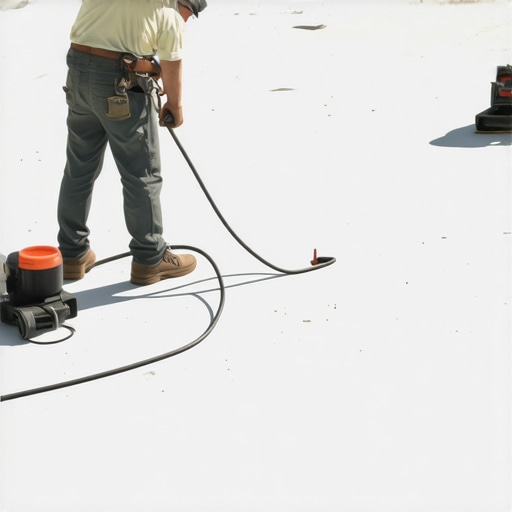
When we talk about 2026 TPO heat seams, we aren’t talking about two sheets of plastic stuck together. We are talking about a monolithic structure created through thermal fusion. An automatic robotic welder moves along the lap at a precise speed, injecting 1,148°F air between the sheets. This doesn’t just melt the surface; it breaks down the polymer chains, allowing them to interweave. As the weighted drive wheel follows behind, it compresses these molten layers. This is why 2026 TPO seaming is the standard: the seam becomes the strongest part of the entire square. In the Southwest, where the sun beats down with relentless UV radiation, adhesive-based seams eventually crystallize and fail. The glue dries out, becomes brittle, and the constant thermal expansion—the roof growing and shrinking as the sun hits it—creates tiny fish-mouth openings. Water finds those openings via capillary action, literally sucking moisture under the membrane like a straw.
The Trap of the ‘Lifetime’ Warranty
Local roofers love to throw around the word ‘Lifetime,’ but in the flat roofing world, that’s usually marketing fluff designed to distract you from the fine print. Most warranties are voided if you have standing water for more than 48 hours or if you didn’t perform documented maintenance. When you’re comparing quotes, look past the glossy folder. If a company isn’t using LIDAR quotes to ensure the drainage slope is accurate to the millimeter, they’re setting you up for failure. A TPO roof is only as good as its drainage. I’ve seen 20-year-old roofs that looked brand new because they were pitched correctly, and 2-year-old roofs that had to be scrapped because they were installed with ‘shiners’—missed fasteners that eventually back out and puncture the membrane from the inside out.
[image_placeholder]
The Material Truth: TPO vs. The Old Guard
For decades, we relied on EPDM (rubber) or BUR (Built-Up Roofing/Tar and Gravel). While EPDM is tough, those black sheets absorb heat like a cast-iron skillet, sending your attic temperatures soaring to 160°F and cooking your HVAC units. TPO is white or light gray, reflecting up to 80% of solar radiation. But the real shift in 2026 is the reinforcement. Modern TPO uses a heavy-duty polyester scrim. If a roofer doesn’t properly encapsulate the ‘cut edges’ of that scrim, moisture can wick into the fabric, traveling hundreds of feet under the roof surface. This is why flat roof prep is so vital. You don’t just sweep and slap it down; you must ensure the substrate is bone-dry and the edges are sealed with specialized PVC flashing or TPO-clad metal to prevent perimeter failure.
“A roof is only as good as its flashing.” – Old Roofer’s Adage
How to Spot a ‘Trunk Slammer’ Installation
If you see a crew using hand-held heat guns for the entire roof, run. Hand-welding is for detailed penetrations and corners, not for the long runs of a 50-square deck. Human error is the number one cause of ‘cold welds’—seams that look fused but pop open under the first sign of hydrostatic pressure. Before signing a contract with any roofing companies, ask to see their seam probe logs. A real pro uses a pointed tool to physically try and ‘hook’ every inch of that seam after it cools. If the probe sinks in, the weld failed. To catch what the eye misses, many top-tier firms now use heat cameras during the final inspection to verify that the thermal signature of the weld is consistent across the entire project. Don’t let a cheap contractor turn your building into a forensic scene for the next guy like me to investigate.