
The Anatomy of a Slow-Motion Disaster
It usually starts at 2:00 AM. You hear a rhythmic plink against the hardwood floor in the hallway. You grab a bucket, curse the ceiling, and tell yourself you will look at it tomorrow. But here is the thing: by the time that water reaches your hallway, it has already won. It has bypassed the shingles, saturated the 15-pound felt, and turned your OSB decking into something resembling wet Shredded Wheat. My old foreman used to say, ‘Water is patient. It will wait for you to make a mistake.’ He was right. After twenty-five years of inspecting failed systems from Boston to Buffalo, I can tell you that most homeowners are blind to the physics of their own shelter. They see a roof; I see a complex thermal envelope that is currently fighting a war against ice dams and vapor pressure. If you are going to play detective on your own roof deck in 2026, you cannot just lean a ladder against the gutter and squint. You need to understand the mechanism of failure. Water does not just fall through a hole; it travels via capillary action, pulled sideways by surface tension across the bottom of a shingle until it finds a shiner—one of those missed nails that acts as a perfect conduit for moisture to enter your attic. To find these gremlins before they rot your rafters, you need the right kit.
“The roof shall be covered with approved roof coverings secured to the building or structure in accordance with the provisions of this code.” – International Residential Code (IRC) R903.1
1. Thermal Imaging Cameras (The Delta-T Detective)
In our northern climate, the greatest enemy is not the rain—it is the heat leaving your house. A high-resolution thermal camera for 2026, like the latest FLIR smartphone attachments, is the most powerful forensic tool in your arsenal. You are looking for ‘thermal bridging.’ On a cold night, go into your attic. If you see bright spots on the underside of the roof deck, that is heat escaping. That heat melts the snow on the roof, which then runs down to the cold eaves and freezes, forming an ice dam. This dam backs water up under your shingles. Without a thermal camera, you are just guessing where the insulation is failing. If you notice significant heat loss, you might be looking at attic decking that is beginning to sag from repeated moisture cycles.
2. High-Resolution Drones with Obstacle Avoidance
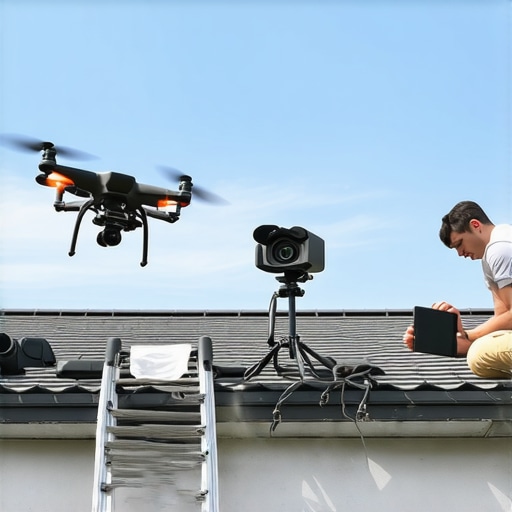
I have seen too many ‘trunk slammers’ and DIYers fall off a 6/12 pitch because they stepped on a patch of black algae. In 2026, there is no reason to put boots on shingles for a preliminary check. A drone allows you to see the ‘granule desert’ in your gutters. When shingles age, the asphalt dries out and the ceramic granules slough off. If your gutters are full of sand, your UV protection is gone. However, remember that drones cannot see everything, such as the softness of the wood beneath the felt. Use the drone to spot ‘tab lift’—where the wind has broken the sealant strip and the shingle is flapping like a loose tooth.
3. The Pinless Moisture Meter
A moisture meter is how you separate ‘surface dampness’ from ‘structural rot.’ A pinless meter uses electromagnetic signals to check the moisture content of the wood without poking holes in it. If you are inside the attic and the plywood looks dark, hit it with the meter. If it reads over 20%, you have active fungal growth. This is often where you will find signs of hidden decking decay that could lead to a total tear-off if ignored. A roof is a system of layers; if the bottom layer is compromised, the top layer is just a heavy tarp.
4. Pole-Mounted 360 Cameras
For the areas where a drone might be too risky—like under heavy tree overhangs or near power lines—a 360-degree camera on a telescoping fiberglass pole is indispensable. You can extend it over the valley (the V-shaped intersection where two roof planes meet) to check for debris buildup. Valleys are the primary site of failure because they handle the highest volume of water. If your valley flashing is rusted or lifting, you are inviting a flood. It is a common reason people end up calling reliable roofing companies for emergency repairs.
5. Digital Pitch Gauges and Angle Finders
Physics matters. A roof with a low pitch (anything under 4/12) requires completely different underlayment than a steep-slope roof. I have seen contractors install standard shingles on a 2/12 porch roof without a secondary water barrier, and it leaked within eighteen months. Use a digital pitch gauge app to know exactly what you are dealing with. If your pitch is shallow, you need to be hyper-vigilant about spotting shingle lifting early, as wind-driven rain can easily push water uphill on low-slope surfaces.
6. The ‘Cricket’ Inspector (Laser Distance Measurers)
When you have a chimney wider than 30 inches, the code requires a cricket—a small peaked structure behind the chimney to divert water. Without it, the chimney becomes a dam. Use a laser measurer to check the dimensions and ensure the flashing height meets the 8-inch minimum standard. Most leaks I investigate around chimneys aren’t the shingles; they are the lack of a proper cricket or counter-flashing that has pulled away from the brick.
“A roof is only as good as its flashing.” – Old Roofer’s Adage
7. Professional-Grade Safety Harnesses
If you must go up, do not do it without a Fall Arrest System. This is not just a rope; it is a shock-absorbing lanyard, a full-body harness, and a roof anchor. Every year, I hear about a homeowner who ‘just wanted to fix one shingle’ and ended up in the ICU. Even local roofers who have been doing this for decades won’t step on a roof without checking their tie-off points. Your life is worth more than a square of shingles.
The Surgery vs. The Band-Aid
Identifying the problem is only half the battle. When you find a leak, you have to decide if you are doing surgery or applying a Band-Aid. Smearing a tube of plastic roof cement over a leak is a Band-Aid. It will dry out, crack, and fail within a year because of thermal expansion. The ‘Surgery’ involves pulling the shingles back, replacing the saturated underlayment, and installing new flashing with proper ‘shingle-fashion’ overlapping. If you find your shingles are brittle and cracking under your touch, it’s time to stop DIY-ing and start interviewing local crews. Avoid the out-of-state storm chasers who show up after a hail hit; they won’t be there when the ice dams start forming next January. A forensic inspection is about honesty. If the plywood feels like a sponge when you walk on it, the deck is gone. No amount of new shingles will fix a rotted substrate. Take the data from your tools, document the failure points, and make a plan. Because in the world of roofing, the only thing more expensive than doing it right is doing it twice.