
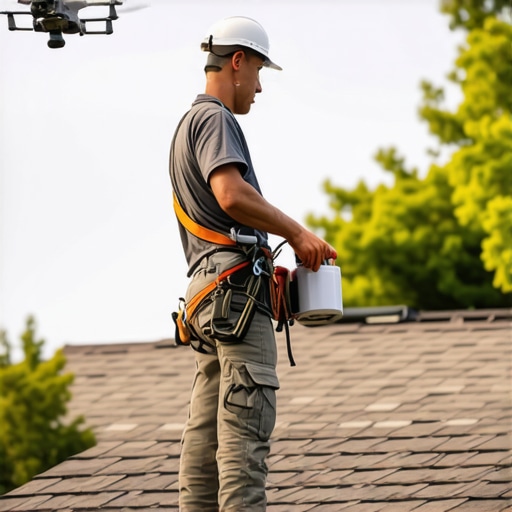
The Forensic Scene: A Ghost in the Insulation
Walking on that roof felt like walking on a sponge. I knew exactly what I would find underneath, even before I pulled the first shingle. The homeowner told me the ceiling was bone dry, but the smell—that unmistakable, heavy scent of fermented wood and damp fiberglass—didn’t lie. I’ve spent twenty-five years crawling through attics that felt like ovens and balancing on 12/12 pitches, and if there is one thing I’ve learned, it is that water is a patient predator. It doesn’t just fall; it creeps, it sucks, and it hides. In 2026, the best roofing companies aren’t just looking for missing tabs; they are hunting thermal ghosts with drones.
The old way of finding a leak involved a garden hose, a prayer, and a lot of wasted time. You’d spray the roof for an hour, wait for a drip, and hope you weren’t just saturating the decking further. But water has a habit of traveling. It might enter at a cricket behind a chimney on the north side, run six feet down a rafter, and finally decide to drop onto the master bedroom ceiling on the south side. This is where local roofers using infrared thermography change the game. We aren’t looking at the shingles anymore; we are looking at the energy. On a cold night in the North, a wet patch of Ice & Water Shield or saturated plywood holds onto the heat from the house much longer than the dry sections. On the drone’s screen, that hidden rot shows up as a glowing hot spot against the cold, dark purple of the healthy roof.
The Physics of Failure: Why It Leaks When You Can’t See It
Most homeowners think a leak is a hole. It’s rarely a hole. It’s usually a failure of surface tension. Consider the valley of your roof. When a local roofer gets lazy and leaves a shiner—a nail that missed the rafter and sits exposed in the attic space—it becomes a thermal bridge. In the dead of winter, that cold nail head meets the warm, humid air leaking through an attic bypass. The nail frosts over. When the sun hits the roof, that frost melts, dripping onto the insulation. Over a single season, you’ve got a gallon of water sitting in your ceiling, and you haven’t had a single drop of rain. This is why roofing in cold climates is more about air sealing than it is about the shingles themselves.
“A roof is only as good as its flashing.” – Old Roofer’s Adage
Then there is capillary action. This is the mechanism where water is literally sucked upward between two flat surfaces. If the starter strip isn’t offset correctly, or if the shingles are butt-jointed too tightly without a proper offset, wind-driven rain gets trapped. The water finds the seam, and through a combination of pressure differentials and surface tension, it moves horizontally under the shingle. It bypasses the primary drainage plane and hits the underlayment. If your contractor used cheap #15 felt instead of a high-quality synthetic, that felt will wrinkle and hold the moisture against the plywood. Eventually, that plywood turns into what we call “black sludge”—a structural failure that looks like Oreo cookie filling and has the structural integrity of wet cardboard.
The 2026 Standard: Infrared Diagnostics and Thermal Mass
Why are roofing companies pivoting to drones now? Because the building codes have caught up to the reality of thermal bridging and R-Value loss. The IRC now demands higher levels of continuous insulation, which means roofs are thicker and more complex. You can’t just ‘feel’ a soft spot through three layers of rigid foam and a ventilated nail base. The drone measures the emissivity of the roof surface. Different materials radiate heat at different rates. When a square of roofing is saturated, its thermal mass increases. It takes longer to heat up and longer to cool down. By flying a drone during the ‘thermal crossover’—the period just after sunset—the professional roofer can see the exact signature of trapped moisture that would be invisible to the naked eye for another three years.
“The roof shall be covered with approved roof coverings in accordance with the provisions of this chapter.” – International Residential Code (IRC) R903.1
I remember a job last November where the owner was convinced he needed a total tear-off. Every local roofer who came out gave him a quote for $30,000 based on a few water stains. I flew the drone. The thermal map showed that 90% of the roof was bone dry and performing perfectly. The issue was a single failed step flashing on a dormer that was allowing water to track behind the siding. We didn’t need a $30,000 replacement; we needed a $1,200 surgical repair. That is the difference between a contractor who wants to sell you a square and a forensic expert who wants to solve a problem. If your roofer isn’t talking about the ‘thermal signature’ of your decking, they are still living in 1995.
The Anatomy of a High-Tech Roof Audit
A proper drone-assisted inspection follows a specific hierarchy of evidence. First, we establish the baseline. We look at the ridge vent to ensure the attic is breathing. If the attic is too hot, it bakes the shingles from the inside out, causing the oils to migrate and the granules to slough off into the gutters. Once the granules are gone, the UV radiation destroys the asphalt. This is the ‘sunburn’ of the roofing world. Second, we hunt for the ‘hot’ spots. A concentrated area of heat loss often points to a gap in the insulation or a failed ice and water shield. Finally, we verify with a moisture meter. The drone points the finger; the hand-held meter confirms the kill. This prevents the ‘Band-Aid’ approach where a guy with a tube of caulk tries to smear his way out of a structural problem. Caulk is not a roofing material; it is a temporary fix that usually hides the rot until the warranty expires.