
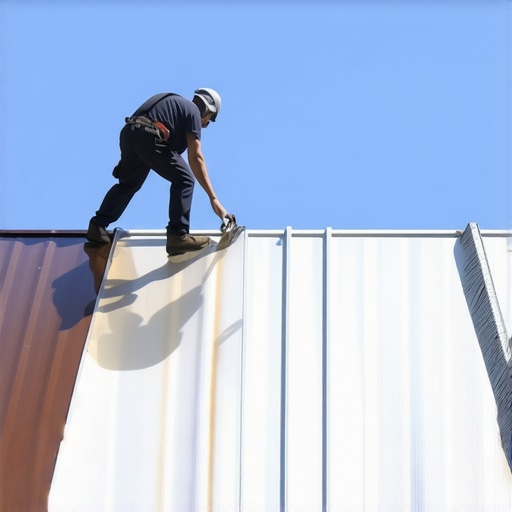
The Autopsy of a Flat Roof Failure
Walking on that roof felt like walking on a sponge. I knew exactly what I’d find underneath the moment my boot sank three inches into the membrane. It was a mid-rise commercial building where the owner had opted for EPDM—that black rubber stuff—just eight years ago. As I knelt down, the smell hit me: the cloying, sour stench of rotting oriented strand board (OSB) that had been marinating in trapped moisture for years. I pulled at a seam, and the adhesive gave way like the peel of an overripe orange. This wasn’t a storm-damage issue; it was a physics issue. By 2026, many roofing companies have finally stopped chasing the low-bid dragon and started demanding PVC for flat and low-slope applications. As a forensic roofer, I’ve seen the ‘black rubber’ dream turn into a saturated nightmare too many times to count.
The Physics of the Seam: Why Glue Fails
To understand why local roofers are moving toward PVC, you have to look at how these systems hold water—or fail to. EPDM is a great material in a laboratory, but it relies on ‘seam tape’ or liquid adhesives to stay watertight. In the roofing world, we call this a chemical bond. The problem is that a chemical bond is a ticking clock. Every time the sun beats down on that black surface, the temperature hits 160°F or higher. That heat creates a phenomenon called thermal expansion. The rubber stretches, the adhesive dries out, and eventually, the seam ‘creeps.’ Once that happens, capillary action takes over. Water doesn’t just sit there; it’s pulled sideways through the microscopic gaps in the glue, wicking into the insulation and turning your R-value into a joke.
“A roof is only as good as its flashing and its seams. If you rely on glue to keep a building dry, you aren’t roofing; you’re arts-and-crafting.” – Old Roofer’s Adage
PVC, or Polyvinyl Chloride, operates on a completely different set of rules. Instead of glue, we use a hot-air welder. We’re talking about a tool that blasts air at 1,100°F to melt the two sheets together. This creates a molecular bond. When those two sheets cool, they are no longer two sheets; they are one monolithic piece of reinforced plastic. If you try to pull a proper PVC weld apart, the membrane itself will tear before the weld fails. For roofing professionals who don’t want to get a callback in the middle of a January blizzard, that weld is the difference between sleeping soundly and waiting for the phone to ring.
Mechanism Zooming: The Plasticizer Migration Myth
Critics of PVC always point to ‘plasticizer migration’—the idea that the chemicals that make the material flexible will evaporate, leaving the roof brittle like a potato chip. While that was true in the 1980s, the 2026-grade membranes have solved this with high-molecular-weight plasticizers and heavy-duty polyester scrims. We’re seeing PVC roofs from the late 90s that are still pliable enough to weld onto today. Compare that to an EPDM roof where the ‘shinkage’ factor actually pulls the membrane away from the parapet walls, creating ‘bridging’ that eventually snaps the flashing right off the wall. When the membrane shrinks, it creates tension on every corner, every cricket, and every scupper. PVC stays dimensionally stable because of that internal scrim, meaning it doesn’t try to crawl off the building when the temperature drops.
The Thermal Shock Factor in Modern Climates
In our current climate, we are seeing more extreme temperature swings than ever. A roof can go from 150°F in the afternoon sun to 60°F during a sudden thunderstorm. This is ‘thermal shock.’ EPDM, being black, absorbs every bit of that UV radiation. It expands drastically and then snaps back. PVC is typically white or light grey, reflecting up to 80% of the sun’s energy. This isn’t just about saving a few bucks on the AC bill; it’s about the longevity of the structure. By keeping the roof surface cool, we reduce the expansion and contraction cycles that stress the fasteners and the roof deck. When local roofers install a PVC system, they aren’t just putting on a waterproof layer; they are installing a thermal shield that protects the entire building envelope.
“The roof covering shall be installed in accordance with the manufacturer’s published instructions and the requirements of this chapter.” – International Building Code (IBC) Section 1507.1
The ‘Square’ Math: Cost vs. Value
Let’s talk about the ‘Square’—that’s 100 square feet in trade talk. Yes, PVC is more expensive per square than EPDM. The rolls cost more, and the labor is more intensive because you need a technician who knows how to calibrate a Leister welder, not just a guy who can slap a paint roller into a bucket of goop. But the forensic reality is different. I’ve seen property owners save $5,000 on the initial install by choosing EPDM, only to spend $15,000 five years later on ‘search and destroy’ leak repairs and interior drywall fixes. When you factor in the lifecycle, PVC wins every time. It’s the difference between buying a pair of boots that last a decade and buying a pair every year because the soles keep falling off.
Warranties: The Marketing Smokescreen
Don’t let a roofing company sell you on a ‘Lifetime Warranty’ without reading the fine print. Most EPDM warranties have exclusions for ‘standing water’ or ‘consequential damages.’ In 2026, PVC manufacturers are offering NDL (No Dollar Limit) warranties that actually mean something because the material is naturally resistant to ponding water and chemical exposure. If you have a rooftop AC unit that leaks a little oil, it will eat through an EPDM roof like acid. PVC is largely unaffected by the greases and oils that typically kill a rubber roof. This is why you see PVC on every restaurant and industrial facility in the country—it’s built to survive the environment, not just the rain.
The Verdict from the Roof Deck
If you’re looking for roofing companies to handle your project, ask them one question: ‘How do you handle your laps?’ If they start talking about tape and primer, thank them for their time and keep looking. You want the guy who talks about probe-testing welds and setting the speed on an automatic hot-air rover. In the forensic world, we don’t look at what’s cheapest today; we look at what won’t be in the landfill in fifteen years. PVC is the professional’s choice for a reason. It handles the heat, it handles the seams, and it handles the truth of what a roof actually goes through. Don’t wait until you’re staring at a ‘shiner’—a missed nail—or a peeling seam to wish you’d invested in a welded system. The peace of mind is worth every extra penny per square.