
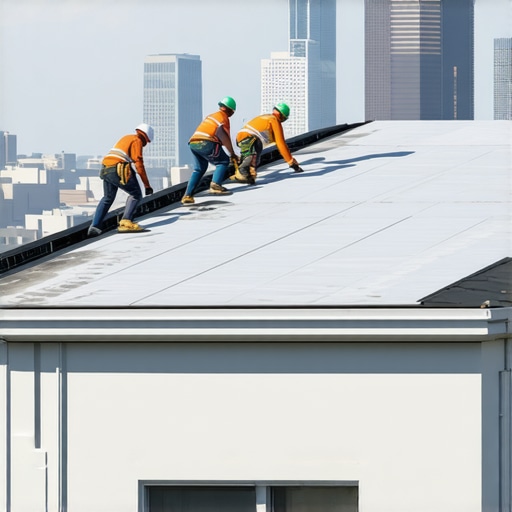
The Forensic Scene: When the Underlayment Tells a Story
Walking on that roof in Miami felt like walking on a sponge. I knew exactly what I’d find underneath before I even pulled my flat bar out of my belt. The shingles looked fine from the street—granules were still there, no major curling—but the deck was bouncing like a trampoline. When I finally peeled back a square of the high-definition laminate, the horror show began. The plywood was black, weeping with a fungal growth that smelled like a damp basement in July. This wasn’t a flashing failure. This was a seam failure. Water had siphoned under the shingles during a standard tropical downpour, found a gap in the felt, and sat there for three years, slowly digesting the structural integrity of the home. Local roofers are tired of these callbacks, which is why the industry is shifting toward the hybrid seam approach.
The Physics of Failure: Why Standard Seams Quit
To understand why 2026 roofing companies are abandoning traditional methods, you have to look at the mechanism of the leak. Most people think water falls down. In a hurricane-prone zone, water moves sideways, upwards, and in circles. When wind hits a roof slope, it creates a high-pressure zone on the windward side and a low-pressure vacuum on the leeward side. This pressure differential literally sucks water through the overlaps of traditional underlayment. We call this capillary action, but on a roof, it’s more like a vacuum cleaner. If you have a shiner—a nail that missed the rafter and just pokes through the deck—that nail acts as a cold-sink, attracting condensation and providing a direct path for that siphoned water to drip onto the ceiling. The old-school felt paper just can’t handle the hydro-static pressure of modern storms.
“Underlayment shall be applied in accordance with the manufacturer’s installation instructions. Where high winds are expected, the roof deck shall be sealed to prevent water intrusion in the event of roof covering loss.” – International Residential Code (IRC), R905.1.1
The Material Truth: What is a Hybrid Seam?
The 2026 hybrid seam isn’t just a single product; it’s a surgical approach to the roof deck. It combines a high-tensile synthetic base with a secondary fluid-applied or self-adhering polymer at every junction. Think of it as a double-deadbolt for your house. We’re moving away from the days when roofing companies just slapped down some paper and hoped for the best. A hybrid system involves a mechanical fastener for the main field, but every valley, ridge, and horizontal lap is fused. This creates a monolithic membrane. If the shingles blow off—and in a Category 3, they might—the house stays dry. The local roofers who care about their reputation are using this because it eliminates the ‘wicking’ effect where moisture creeps through the nail holes.
The Trap of the Lifetime Warranty
Don’t get me started on the ‘Limited Lifetime Warranty’ stickers you see on every bundle of shingles. Those warranties cover the product, not the labor, and certainly not the water damage caused by a seam failure. Most of those documents are written by lawyers to ensure the manufacturer never pays a dime if your ventilation isn’t perfect to the square inch. I’ve seen 140°F attics where the heat was so intense it literally baked the adhesive out of the shingles, and the warranty was void because the cricket behind the chimney wasn’t oversized. The hybrid seam is your real warranty. It’s the forensic-grade insurance that the physical laws of water tension won’t ruin your living room furniture.
“A roof is not a cover; it is a thermal and moisture management system. If any part of the system is bypassed, the entire assembly is compromised.” – NRCA Manual of Quality Control
The Cost of the ‘Trunk Slammer’ Special
You’ll always find a guy with a ladder and a beat-up truck who will bid your job $3,000 lower than the pros. He’s skipping the hybrid seams. He’s using ‘contractor grade’ felt that tears if you sneeze on it. He’s not thinking about thermal expansion or the way different materials move at different rates when the sun hits them. When you hire local roofers, you have to ask about the seam integration. Are they using stainless nails to prevent galvanic corrosion in our salt air? Are they taping the deck joints? If they look at you like you have two heads, move on. The cost of a cheap roof is paid twice: once when you buy it, and once when you have to replace the moldy drywall and rotted rafters five years later. In the 2026 climate, a roof that ‘almost’ works is a total failure.