
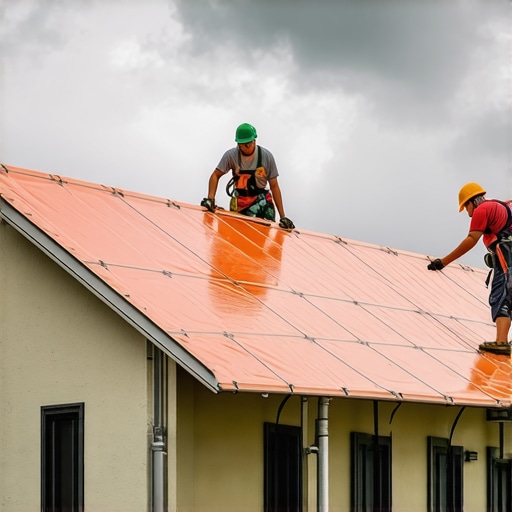
The 3 AM Drip: Why Your Shingles Are Only Your First Line of Defense
Imagine it is three o’clock in the morning in a coastal city like Mobile or Houston. The wind is howling at sixty miles per hour, pushing rain sideways against your house. You hear a rhythmic thwack-thwack on the roof, followed by the terrifying sound of water hitting your bedroom ceiling. By sunrise, you’re calling local roofers, only to find they are all booked for three weeks. This is the nightmare that 2026 roofing standards are designed to eliminate through the adoption of what many are calling ‘backup tarps’—or more accurately, Secondary Water Resistance (SWR) systems.
The Forensic Scene: Walking on a Sponge
Walking on that roof felt like walking on a sponge. I knew exactly what I’d find underneath before I even pulled my flat bar from my belt. When we peeled back the three-tab shingles, the plywood didn’t just look wet; it looked like wet cardboard. The homeowner was baffled because the shingles themselves were only ten years old and appeared intact from the ground. But the physics of failure don’t care about aesthetics. Underneath those shingles, the old-school #15 felt paper had disintegrated into brittle flakes. Every time the wind picked up, it created a vacuum that sucked water uphill through a process called capillary action. Without a functional underlayment, that water had a direct path to the deck. This is why the industry is pivoting. In 2026, a ‘finished’ roof without a secondary seal is considered an incomplete job by any forensic veteran.
The Physics of Failure: How Water Defies Gravity
Most homeowners believe shingles are a waterproof lid. They aren’t. Shingles are a water-shedding system, designed to move liquid downward via gravity. However, nature rarely provides a straight path. When wind-driven rain hits a roof, it undergoes hydrostatic pressure. It searches for every lap, every ‘shiner’ (a nail that missed the rafter and left a hole), and every ‘dead valley’ where debris collects. If the wind is strong enough, it can force water under the shingle tabs and over the top of the starter strip. If your roofing companies are still using standard felt, you are essentially relying on a thick piece of paper to save your drywall. This is where the ‘backup tarp’ concept—specifically high-performance synthetic underlayments and self-adhering membranes—changes the equation.
“The roof covering is the first line of defense, but the underlayment is the final boundary between safety and structural rot.” – International Residential Code (IRC) Commentary
Mechanism Zooming: Capillary Action and Surface Tension
Let’s zoom in on a single shingle lap. Water has a natural property called surface tension, which allows it to ‘stick’ to surfaces. In a heavy storm, water doesn’t just run off; it clings. If there is a microscopic gap between two shingles, surface tension and wind pressure work together to pull that water sideways. Once it hits the nail line, it finds a ‘shiner.’ That nail acts like a straw, drawing moisture directly into the attic. In the humid Southeast, that moisture triggers a biological clock. Within 48 hours, mold begins to feast on your rafters. By the time you see a brown spot on your ceiling, the structural damage is already six months old. The 2026 ‘backup tarp’ approach involves sealing the entire deck with a modified bitumen membrane. It’s like wrapping your house in a giant, puncture-resistant sticker before the shingles even arrive.
The ‘Backup Tarp’ vs. The Blue Tarp
When we talk about 2026 roofing companies installing backup tarps, we aren’t talking about the ugly blue plastic sheets held down by 2x4s after a hurricane. We are talking about Secondary Water Resistance. This is a layer of protection that stays on the roof permanently. In many jurisdictions, insurance companies are now mandating these ‘Seal-the-Deck’ methods to reduce interior loss claims. If the shingles blow off in a 100-mph gust, the ‘backup tarp’ underneath stays perfectly intact, keeping the house bone-dry while you wait for the local roofers to arrive with replacement materials.
The Trap: Why ‘Lifetime Warranties’ Often Fail You
Don’t get suckered by a ‘Lifetime Warranty’ printed on a shingle bundle. Those warranties almost always cover the product, not the performance. If a shingle blows off because of a ‘shiner’ or poor nailing, the manufacturer will point the finger at the installer. If the installer used cheap felt that rotted out, they’ll point the finger at the manufacturer. The veteran roofer knows that the only warranty that matters is the one built into the physics of the roof deck itself. By using a high-tack synthetic underlayment, you are removing the human element from the waterproofing equation. Even if the ‘trunk slammer’ contractor misses a few nails, the membrane self-seals around the fastener, preventing leaks.
The Cost of the ‘Cheap’ Roof
I’ve spent 25 years watching people try to save $1,500 on a $15,000 roof by skipping the high-end underlayment. It is a fool’s errand. A standard square (100 square feet) of roof requires roughly $20 in basic felt or $80 in high-performance SWR. On a 30-square roof, that’s a $1,800 difference. Now, compare that to the cost of replacing 10 sheets of rotted OSB, 400 square feet of wet insulation, and a whole room’s worth of popcorn ceiling texture. The ‘cheap’ roof is the most expensive thing you will ever buy. The 2026 trend isn’t about luxury; it’s about forensic-level prevention.
“A roof is only as good as its flashing and its secondary seal; the shingles are just the shingles.” – Old Roofer’s Adage
Identifying a Quality Contractor in 2026
When interviewing roofing companies, stop asking about the brand of shingle. Every major manufacturer makes a decent architectural shingle. Instead, ask about their deck-sealing protocol. Do they use stainless nails near the coast to prevent galvanic corrosion? Do they install a cricket behind wide chimneys to divert water? Do they tape the seams of the plywood with a 4-inch flashing tape? If they look at you like you have three heads, they aren’t ‘local roofers’ you can trust; they are just shingle-hangers. A true roofing professional understands that the ‘backup tarp’ is what keeps them from getting a callback during the next tropical depression. They know that water is patient, and eventually, it will find a way in unless you’ve built a fortress underneath the aesthetic layer.
Conclusion: The Future is Under the Surface
As we move into 2026, the industry is finally acknowledging what forensic investigators have known for decades: the exterior layer is for show, but the underlayment is for dough. The shift toward permanent ‘backup tarps’ through SWR systems is the biggest leap in residential protection since the invention of the laminated shingle. Don’t wait for the next storm to prove your roof is a sponge. Demand a sealed deck, skip the cheap paper, and make sure your roofing project is built to survive the physics of the real world.