
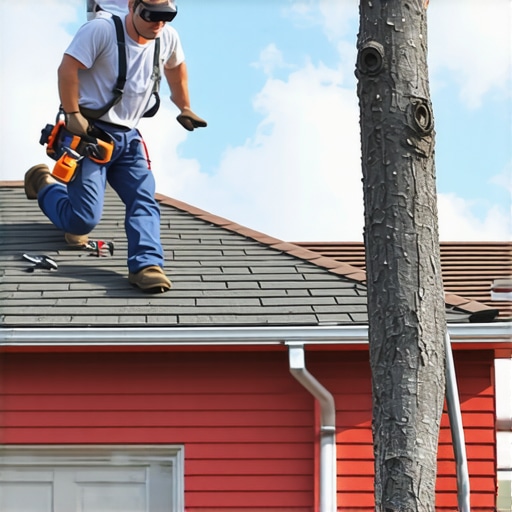
The Ghost in the Attic: Why Your Ceiling Stain is a Lying Snitch
I’ve spent the better part of three decades crawling through 140-degree attics in the humid sprawl of the Gulf Coast, smelling the distinct, sickly-sweet scent of rotting OSB and wet fiberglass. If there is one thing I have learned, it is this: by the time you see a brown ring on your living room ceiling, the battle is already half-lost. That water didn’t just fall from the sky and land there. It migrated. It traveled. It’s been living in your home for months, eating your structure from the inside out. For years, local roofers had to play a guessing game, tearing up perfectly good shingles just to find the source of a ‘mystery leak.’ But as we head into 2026, the game has changed. The smart roofing companies are now using Augmented Reality (AR) to see through your shingles, and it is saving homeowners thousands in unnecessary ‘exploratory surgery.’
The Mentor’s Warning: Water is Patient
My old foreman used to say, ‘Water is patient. It will wait for you to make a mistake, and then it will wait for the wind to blow just right to exploit it.’ He was right. In our tropical climate, where wind-driven rain hits at 70 miles per hour, water doesn’t just fall down; it moves sideways, upwards, and diagonally. It finds a shiner—one of those nails that missed the rafter—and uses it as a highway. The nail gets cold, the warm attic air condenses on it, and suddenly you have a drip that looks like a roof leak but is actually a ventilation failure. Identifying that distinction used to take hours of forensic poking. Now, it takes a headset.
“A roof is only as good as its flashing.” – Old Roofer’s Adage
Mechanism Zooming: The Physics of the Stealth Leak
Why does a small leak cost so much to find? It’s all about capillary action. Imagine two shingles overlapping. When rain hits the roof, it should run off. But if the pitch is low or the wind is high, water can get trapped between those layers. Through surface tension, the water is actually sucked upward, defying gravity, until it finds the top of the underlayment. From there, it hits a seam in the plywood. Roofing systems in the Southeast are under constant assault from humidity and hydrostatic pressure. If your local roofers didn’t install a proper cricket behind your chimney, water pools there, creating a tiny pond that eventually finds a microscopic gap in the sealant.
In the past, finding that gap meant tearing off five squares of shingles just to trace the path. In 2026, AR-equipped inspectors use thermal-overlay headsets. They aren’t just looking at the roof; they are looking at temperature differentials. Water retains heat differently than wood or asphalt. By looking through an AR lens, a technician can see the thermal ‘bloom’ of moisture trapped under the shingles. It looks like a glowing blue vein running toward the source. That is how you avoid a $4,000 full-slope replacement when you only needed a $500 flashing repair.
The $3,000 Math: How Tech Cuts the Fat
When roofing companies give you a high estimate, they are often ‘padding’ for the unknown. They don’t know how much rotted wood is under there, so they bid for the worst-case scenario. AR inspections remove the ‘unknown.’ By mapping the moisture levels across the entire deck before a single nail is pulled, the contractor can provide an exact surgical plan. You save money because you aren’t paying for ‘just in case’ materials or the labor of a four-man crew searching for a leak for six hours. You’re paying for the fix, not the hunt.
“The 2024 International Residential Code (IRC) Section R903.2 requires flashing to be installed at wall and roof intersections, at gutters, and at changes in roof slope or direction.” – Building Code Standards
Why Your ‘Lifetime Warranty’ Is Marketing Garbage
I’ve seen a thousand ‘trunk slammers’ sell a roof based on a 50-year warranty. Here’s the trade secret: those warranties almost never cover ‘consequential damage’ or ‘improper installation.’ If your local roofers didn’t understand the uplift ratings required for our wind zone, or if they used galvanized nails that are currently being eaten by salt air, that warranty is a paper shield. True protection comes from forensic-level installation. We’re talking about Secondary Water Resistance (SWR)—a peel-and-stick membrane that goes directly on the deck. In 2026, AR tools allow us to verify that every lap of that membrane is sealed perfectly, documented with a digital twin of your roof before the shingles even go on.
The Forensic Fix: Surgery vs. Band-Aids
If a roofer shows up with a bucket of mastic (we call it ‘roof tar’ or ‘silver bullet’) and starts smearing it around your vents, fire him. That’s a band-aid. It will dry out in the 100-degree sun, crack, and leak again in six months. Proper roofing in a tropical climate requires ‘surgery.’ We pull the shingles back to the deck, replace the saturated insulation, and install new metal flashing with a proper hemmed edge to kick the water away from the wall. The AR data tells us exactly where the surgery starts and ends. No guesswork, no ‘maybe this fixed it’ prayers.
Don’t let a contractor talk you into a full replacement because they can’t find a leak. In 2026, if they aren’t using moisture-mapping technology and AR visualization, they are still living in the dark ages. You deserve a roof that is built for the physics of the Gulf, not a sales pitch. Watch for the signs: the smell of the attic, the sound of the wind, and the tech in the roofer’s hands. That’s how you keep $3,000 in your pocket and the rain out of your drywall.
I’ve worked in roofing for over 15 years, and it’s clear that technology like AR is revolutionizing how we approach leak detection. It’s impressive how thermal imaging can pinpoint moisture that would have taken hours of guesswork to find previously. I’m curious, though—how reliable are these AR tools in very humid climates? I’ve seen some older models struggle with high moisture levels, leading to false readings. It seems like integrating these advancements with traditional inspection methods could provide the best results. It’s also encouraging to see how this technology can save homeowners a lot of money—no more unnecessary tear-offs or guesswork. Has anyone experienced a situation where AR helped prevent a full roof replacement when only a small patch was needed? I believe combining these tools with seasoned judgment is the way forward for the industry, especially here in the Gulf Coast where water infiltration is such a tricky problem.
The article sheds light on a game-changing shift in roofing technology, especially for humid and water-prone areas like the Gulf Coast. I’ve personally seen how thermal imaging and AR can drastically reduce unnecessary repairs and cost by pinpointing moisture exactly where it needs to be addressed. In my experience, when combined with traditional inspection methods, these tools are incredibly reliable even in high humidity conditions, provided the equipment is calibrated correctly. One challenge I’ve noticed is that high moisture levels can sometimes produce ambiguous thermal signatures, so proper analysis remains crucial. I’m curious, has anyone here integrated AR moisture mapping with drone inspections for large roofs? That combination might take leak detection to an even higher level, especially in hard-to-access areas. It’s exciting to think how these advancements will result not only in cost savings but also in longer-lasting, more resilient roofs. Do others see potential in expanding AR’s capabilities, maybe even incorporating AI to interpret thermal data more efficiently?