
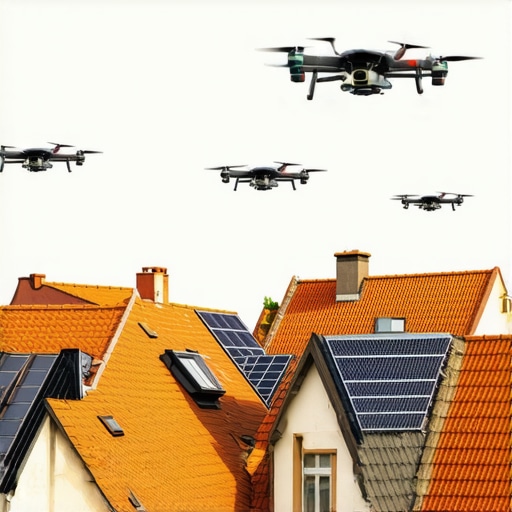
The Death of the Tape Measure
I remember the days when a local roofer was just a guy with a tattered ladder, a 25-foot Stanley tape, and a gut feeling. We called it ‘guestimating.’ In 2026, if your roofing companies are still walking your roof with a notepad and a pair of worn-out boots to figure out your pitch, you’re already behind the eight ball. I’ve spent twenty-five years crawling into attics where the smell of moldy OSB was so thick you could taste it, all because someone miscalculated the slope and used the wrong underlayment. Walking on a roof today in the Northeast, specifically during these brutal freeze-thaw cycles, I knew exactly what I’d find underneath a poorly measured valley: rot, plain and simple.
“A roof is only as good as its flashing.” – Old Roofer’s Adage
The physics of a roof doesn’t care about your aesthetic. It cares about gravity and surface tension. When we talk about 2026 drone mapping, we aren’t just talking about pretty pictures. We are talking about photogrammetry and LiDAR that can detect a 1/8-inch dip in a structural rafter from fifty feet in the air. For those of us in the North, this tech is the difference between a roof that lasts thirty years and one that becomes a backyard skating rink after the first blizzard. Water is patient. It will wait for you to make a mistake. If the slope isn’t mapped perfectly, water finds its way under the shingle through capillary action—that sneaky process where liquid literally climbs uphill against gravity because the gap is tight enough and the pressure is right.
The Forensic Scene: Why Slope Data Saves Your Plywood
Last winter, I inspected a job where the homeowner was convinced they had a ‘shingle defect.’ Walking on that roof felt like walking on a sponge. I didn’t need a drone to tell me the decking was gone, but a drone would have caught the structural deflection two years ago. The AI mapping tools we see hitting the mainstream now identify where the ‘cricket’—that small peaked structure behind a chimney—is failing to divert water. If the slope is too shallow and the roofer doesn’t transition to a double-layer of ice and water shield, that chimney becomes a funnel for every drop of rain. In the cold zones like Boston or Buffalo, the enemy isn’t just rain; it’s the ice dam. When your attic bypass leaks warm air, it melts the snow on the roof. That water runs down to the cold eave and freezes. If your drone mapping didn’t account for the thermal bridging and the exact degree of the slope at the eave, your ‘new’ roof is just an expensive filter.
“The integrity of the building envelope is predicated on the precision of the shedding surface.” – IRC Building Code Commentary
The Physics of Failure: Mechanism Zooming
Let’s get technical about why AI drones are changing how local roofers work. When a drone maps a roof, it calculates the ‘square’—that’s 100 square feet of roofing area—with zero margin for error. But more importantly, it maps the velocity at which water will leave that surface. On a steep 12/12 pitch, water screams off the roof. On a lower 4/12 pitch, it lingers. If you have a ‘shiner’—a nail that missed the framing and is sticking out in the attic—it becomes a magnet for condensation. In the North, that shiner frosts up in the winter. When it thaws, it drips. AI mapping detects these structural inconsistencies before the first shingle is even torn off. It sees the ‘thermal signature’ of the roof. If one section of your roof is five degrees warmer than the rest, you don’t have a roofing problem; you have an insulation problem that’s going to kill your new shingles in five years.
The Material Truth vs. The Marketing Lie
Roofing companies love to sell you on the ‘Lifetime Warranty.’ Let me give you some truth: those warranties are usually worth the paper they’re printed on if the installation doesn’t account for the climate-specific physics. In the Northeast, we deal with thermal expansion. The materials grow during the day and shrink at night. If the drone mapping didn’t help the contractor calculate the proper ventilation for that specific volume of attic space, your shingles will ‘cook’ from the inside out. I’ve seen ’30-year’ shingles turn to potato chips in ten years because the attic was a 140-degree oven. AI drones now calculate the exact R-value needed based on the roof’s orientation to the sun and its slope. This isn’t just roofing; it’s forensic science. When you hire local roofers, ask if they are using drone-based slope analysis. If they pull out a tape measure and a ‘pitch gauge’ that looks like it survived the 1970s, thank them for their time and keep looking. You want a contractor who understands that a roof is a system, not just a pile of shingles.
Protecting Your Investment from the ‘Trunk Slammers’
The ‘trunk slammer’ is the guy who shows up with a ladder and a hammer and promises you a deal that’s $3,000 cheaper than everyone else. He doesn’t use drones. He doesn’t understand ‘capillary action.’ He doesn’t know what a ‘thermal bridge’ is. He’s going to nail over your old flashing because he’s ‘saving you money.’ But when that first ice dam hits and the water starts pouring through your light fixtures, he’ll be three counties away. Use the tech. The 2026 AI mapping standards allow you to see a 3D digital twin of your home before the work starts. You can see exactly where the valleys meet, where the crickets are located, and how the ice and water shield will be layered. It’s the only way to ensure that your ‘square’ of roofing is actually protected. Don’t let your home become a forensic case study for guys like me. Map it right, nail it right, and keep the water on the outside.