
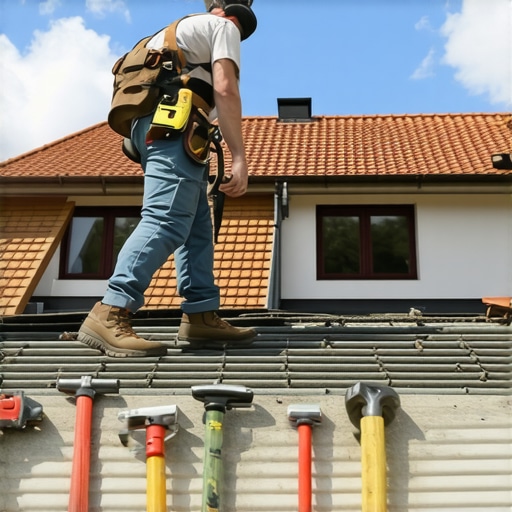
The Reality of the 140-Degree Deck: Why Your Roof is Failing
Walking on that roof felt like walking on a sponge. I knew exactly what I’d find underneath before I even pulled my pry bar. The homeowner was complaining about a mystery leak, but as a forensic investigator, I saw the truth: years of thermal shock in this brutal desert heat had turned the asphalt mat into a brittle sheet of glass. A single stray branch—maybe a heavy bird or a careless HVAC tech—had created a puncture no bigger than a dime. But in the roofing world, a dime is a doorway. Local roofers often miss these micro-fractures during a ‘quick look’ because they aren’t looking for the mechanism of failure; they are looking for a quick commission.
“Roofing systems shall be designed and installed to resist the wind loads and impact loads as specified in this code.” – International Residential Code (IRC) R903.1
By 2026, we are seeing a shift in how roofing companies must approach puncture resistance. It isn’t just about the thickness of the shingle anymore. It’s about the physics of the entire assembly. When a foreign object strikes a roof, the kinetic energy doesn’t just vanish. It travels through the granules, into the asphalt, and hits the deck. If your decking is compromised by dry rot or poor ventilation, that energy has nowhere to go but ‘through.’ We are talking about star-shaped fractures in the matting that allow water to move sideways through capillary action, creeping under the laps and soaking the plywood until it resembles wet cardboard.
1. The Shift to High-Density SBS Modified Bitumen
In the trade, we know that standard oxidized asphalt is a ticking time bomb in high-UV zones. By 2026, the best roofing companies are pivoting to SBS (Styrene-Butadiene-Styrene) modified shingles. Think of SBS as adding rubber to the asphalt. When a hailstone or a dropped tool hits an SBS shingle, the material flexes. It absorbs the impact rather than shattering like a ceramic plate. If you are hiring local roofers, ask them about the ‘polymer-modified’ options. If they look at you sideways, show them the door. You need a roof that behaves like a gasket, not a brittle shell.
2. The Underlayment as a Secondary Shield
Stop thinking of felt paper as a barrier; in the modern era, it’s a relic. To stop puncture damage, the pros are moving toward high-performance synthetic underlayments and self-adhering membranes. We call it ‘the double-down.’ If an object manages to pierce the primary shingle layer, a self-healing membrane underneath will ‘grip’ the puncture, sealing around it like a surgical bandage. I’ve seen ‘shiners’—those missed nails that peek through—cause massive rot because the underlayment couldn’t seal the hole. A high-quality synthetic underlayment prevents this catastrophic moisture migration.
3. The Thermal Expansion Trap
Physics is a cruel mistress. In the Southwest, your roof expands and contracts every single day. This constant movement fatigues the material. A fatigued shingle loses its ability to resist punctures. This is why proper ventilation is non-negotiable. If your attic is a furnace, you are cooking the life out of your shingles from the bottom up. We see it in the valleys first—the area where two roof planes meet. A poorly ventilated valley becomes brittle and cracks under the weight of even a small amount of debris. Every roofing company worth their salt should be measuring your net free ventilating area before they give you a quote.
“A roof is only as good as its flashing.” – Old Roofer’s Adage
4. Strategic Walk-Pad Installation
For roofs that see any kind of traffic—be it for solar panel maintenance or HVAC servicing—puncture damage is often ‘man-made.’ The 2026 standard for high-end roofing involves the use of walk-pads. These are heavy-duty, reinforced mats placed in high-traffic areas. They distribute the load and protect the granules. Most roofing companies won’t suggest these because they add cost and labor, but if you have a technician dragging a tool bag across your ridge, you’ll wish you had them. One square of protection in the right place can save you ten squares of replacement later.
5. The Fastener Precision Protocol
I can’t tell you how many ‘pro’ jobs I’ve inspected where the installers were ‘high-nailing.’ When a nail is driven too high, it doesn’t catch the common bond of the shingle. This creates a pivot point. Wind catches the shingle, it flaps, and the mechanical stress creates a puncture point right at the nail head. This is basic trade knowledge, yet ‘trunk slammers’ ignore it for speed. A puncture isn’t always from an outside object; it can be the roof’s own hardware failing from within. Demand that your roofing company uses a six-nail pattern and checks the air pressure on their guns. A nail driven too deep is just as dangerous as one left high.
Protecting your home in 2026 requires more than just picking a pretty color. It requires an understanding of how moisture moves, how heat destroys, and how impact energy is dissipated. Don’t let a salesman tell you a warranty will cover puncture damage—it won’t. Punctures are considered ‘maintenance’ or ‘act of god’ issues. Your only real defense is a system designed for impact from the start. Look for the local roofers who talk about deck integrity and SBS modifiers, not just the ones with the lowest bid. Your attic—and your wallet—will thank you when the next storm rolls through.
This post highlights some critical advances in roofing technology that often get overlooked in the industry. I agree that impact resistance is no longer just about thicker shingles but how the whole system responds to stresses. I’ve seen firsthand how SBS modified shingles can make a real difference in high-impact zones, especially during hailstorms. It’s interesting to think about the importance of proper ventilation, too — I’ve noticed that poorly ventilated attics accelerate shingle deterioration, which in turn increases the risk of puncture and water intrusion. With climate conditions becoming more extreme, do others have advice on identifying qualified roofing contractors who prioritize these newer impact-resistant and ventilation systems? I’ve found that some of the smaller, newer companies focus more on these innovative solutions, but it’s hard to tell until you ask the right questions.