
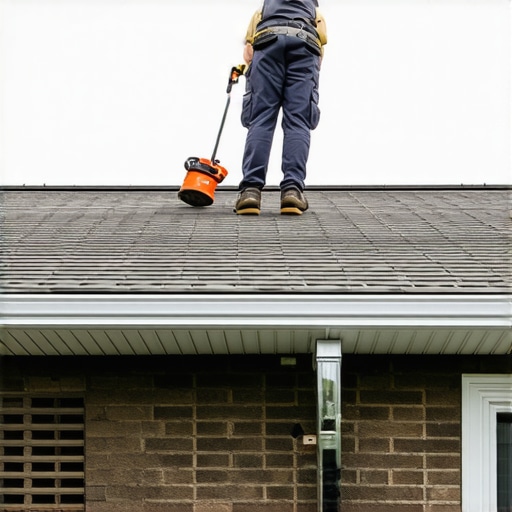
The Autopsy of a Saturated Foundation
Last Tuesday, I stood in a crawlspace in the humid heat of the Gulf Coast, the air thick with the smell of damp earth and the unmistakable tang of rotting rim joists. The homeowner was baffled. They had just paid one of the local roofing companies for a brand-new architectural shingle install. The roof was beautiful, but the basement was a swamp. This is where most roofing companies fail: they treat the roof like an island, forgetting that every drop of water captured by those squares of shingles has to go somewhere. Water is patient. It doesn’t care about your new shingles if the exit strategy—the downspout—is a bottleneck. My old foreman, a man who had more tar under his fingernails than blood in his veins, used to growl, ‘Water is a predator. It will wait for you to leave a gap, and then it will eat your house from the bottom up.’
The Physics of the 2026 Downspout: More Than Just a Pipe
Most roofing projects are sold on the aesthetics of the shingle, but the forensic reality is that the downspout is the most overworked component of the system. In 2026, we are seeing higher-intensity rain bursts. If you’re still using 2×3 inch downspouts, you’re trying to drain an Olympic swimming pool through a soda straw. When that water backs up, it doesn’t just stay in the gutter. It creates a hydrostatic head. This pressure forces water behind the fascia board, soaking the rafter tails. By the time you see the stain on your ceiling, the structural damage is three years old. We talk about ‘shiners’—those missed nails that provide a direct path for moisture—but a poorly designed downspout is a systemic failure that ruins entire walls.
“The primary purpose of a drainage system is to move water away from the building’s foundation as quickly as possible to prevent hydrostatic pressure buildup.” – National Roofing Contractors Association (NRCA) Handbook
Tip 1: The Mandatory Kick-Out Flashing
If your local roofers didn’t install a kick-out flashing where a roof eave meets a vertical sidewall, they’ve handed you a ticking time bomb. Without that small piece of bent metal, water follows the roofline and dives straight behind the siding. It bypasses the gutter entirely. I’ve seen ‘reputable’ roofing companies skip this $15 part, leading to $20,000 in structural rot. The water uses capillary action to ‘cling’ to the wall, saturating the house wrap until it gives way. In 2026, a forensic-grade install requires a oversized kick-out that forces the water’s trajectory into the center of the gutter, not the edge.
Tip 2: The 5-Inch vs. 6-Inch Gutter Math
Let’s talk volume. A single square (100 square feet) of roofing can shed 60 gallons of water in one inch of rain. If you have a 3,000-square-foot roof, that’s 1,800 gallons. In the Southeast, where we get three inches of rain in twenty minutes, your standard gutters are useless. You need 6-inch K-style gutters paired with 3×4 inch downspouts. This isn’t an ‘upsell’ from roofing companies; it’s a mathematical necessity. When the downspout is too small, the water creates a vortex at the outlet, slowing the drainage. This turbulence causes the gutter to overflow, leading to soil erosion and foundation cracks.
Tip 3: The Critical Diverter and Discharge Point
A downspout that dumps water at the base of your house is just a vertical pond. In 2026, local roofers should be recommending underground discharge lines or, at the very least, five-foot extensions. If the water isn’t moved past the ‘backfill zone’—that loose dirt around your foundation—it will seep straight down to your footings. This causes the soil to expand and contract, which is why your doors start sticking in the summer. It’s not ‘settling’; it’s a drainage failure. We use crickets on the roof to move water around chimneys; think of your downspout extensions as crickets for your foundation.
Tip 4: Eliminating the Elbow Clog
The elbow is the heart of the downspout, and it’s where most forensic investigations begin. Standard elbows have sharp internal ridges where debris—granules from your roofing shingles, twigs, and pine needles—gets snagged. Once a small dam forms, the water slows, and more debris piles up. By 2026, we are moving toward smooth-radius elbows. These prevent the ‘bridge’ effect of debris. If your roofing company is using cheap, crimped elbows, they are inviting a clog that will eventually burst the seam of the downspout during a freeze-thaw cycle or a tropical deluge.
Tip 5: Fastener Integrity and Galvanic Corrosion
How are those downspouts attached? I’ve seen contractors use zinc screws on aluminum downspouts. In a salt-air environment like Florida or Houston, that’s a recipe for galvanic corrosion. The screw eats a hole in the downspout, and suddenly you have a leak at every strap. A forensic-grade roofer uses stainless steel fasteners or color-matched aluminum rivets. We also avoid ‘shiners’—screws that penetrate the interior of the downspout and act as hooks for hair and debris. Every fastener must be external to the water path.
“Water is the most common cause of building envelope failure, yet it is the least understood by the average installer.” – Vitruvius, The Ten Books on Architecture (Modern Interpretation)
The Cost of the ‘Cheap’ Fix
When you hire local roofers, don’t just look at the shingle warranty. Ask about the drainage physics. A ‘lifetime’ shingle won’t protect your home if the downspout is backing up into your soffits. The 2026 standard isn’t just about shedding water; it’s about total water management. If you see water splashing over the front of your gutters, or if you hear a ‘thumping’ sound during rain, your system is failing. Don’t wait for the mold to start growing in your drywall. Address the exit strategy now, or pay for it in foundation repairs later.