
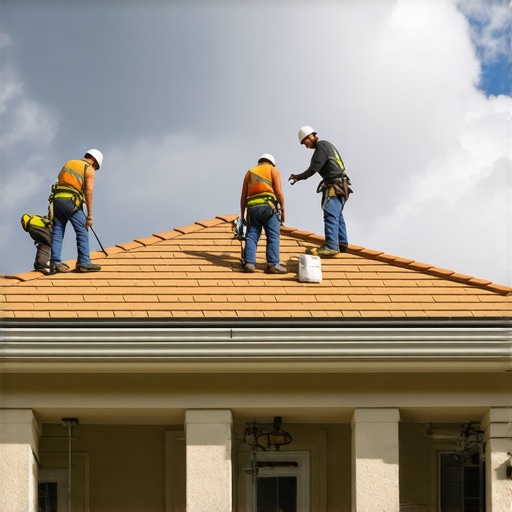
The Sound of the Next Big One: Why 2026 Will Be Different
I remember sitting in a truck outside a coastal bungalow in 2024, watching the sky turn a bruised shade of purple. My old foreman, a man who had more limestone dust in his lungs than oxygen, used to say, ‘Water is patient. It will wait for you to make a mistake.’ He wasn’t just talking about a loose shingle. He was talking about the physics of failure. As we look toward the 2026 storm season, the stakes for roofing companies and homeowners alike have shifted. The climate isn’t just getting wetter; the wind is getting smarter at finding the holes your last contractor left behind. Most people think a roof failure starts with a hurricane. It doesn’t. It starts with a ‘shiner’—a missed nail—two years prior that has been slowly weeping rust and rot into your decking.
“A roof is only as good as its flashing.” – Old Roofer’s Adage
1. The Storm Chaser’s Mirage: Spotting the ‘Free Roof’ Scam
After the 2026 storms hit, the vultures will arrive before the rain even stops. You’ll hear the knock on the door. They’ll offer a ‘free roof’ by ‘covering your deductible.’ Let’s talk trade for a second. In this industry, there is no such thing as a free square of shingles. When a roofing company tells you they can eat a $5,000 deductible, they aren’t doing you a favor; they are cutting $5,000 out of the guts of your home. They’ll use ‘seconds’ for the starter strip, skip the drip edge, or hire a crew that doesn’t know the difference between a closed valley and a woven one. In high-wind zones, these shortcuts are fatal. The 2026 recovery requires a forensic eye. You need local roofers who understand the specific uplift ratings required by current codes. If they can’t explain the difference between a 110-mph and a 150-mph fastening pattern, show them the sidewalk.
2. Physics of the 2026 Storm: Beyond Cosmetic Bruising
When hail hits, most adjusters look for ‘bruises’ or granule loss. But forensic roofing looks at the matting. During a major storm event, the impact of a 2-inch hailstone creates a micro-fracture in the fiberglass mat. This isn’t just about looks. It’s about hydrostatic pressure. When the next rain comes, water sits in that tiny depression. Through capillary action, it is drawn into the fracture. During the night, as temperatures drop, that water expands. It’s a slow-motion car crash happening on top of your house. Local roofers often miss this because they are rushing to the next job. You need a company that performs a ‘test square’—marking off a 10×10 area and literally feeling the shingles for soft spots that indicate a ruptured substrate. If the mat is broken, the roof’s structural integrity is compromised, regardless of how many granules are still stuck to the asphalt.
3. The ‘Secondary Water Resistance’ Mandate
By 2026, the building codes in storm-prone regions will likely move toward mandatory Secondary Water Resistance (SWR). This isn’t just extra felt paper. We’re talking about taping every single seam in the plywood decking or using a full-deck self-adhering membrane (Ice & Water Shield). Think of it as a wetsuit for your house. If the shingles blow off—and in a 130-mph gust, some will—the SWR is the only thing standing between your vaulted ceiling and the elements. Many roofing companies hate SWR because it’s sticky, miserable work that requires a clean deck and a lot of labor. But listen to the sound of a roof failing: it’s not a bang, it’s the quiet drip-drip-drip into your attic insulation that turns into a thousand-pound sponge, eventually collapsing the drywall onto your dining table. If your contractor isn’t talking about ‘seam-taping’ the deck, they aren’t preparing you for 2026.
“The roof shall be covered with approved roof coverings secured to the building or structure in accordance with the provisions of this code.” – International Residential Code (IRC) R905.1
4. The Adjuster Maze: Functional vs. Cosmetic Damage
The biggest battle in 2026 storm recovery won’t be on the roof; it will be on the phone with the insurance company. Carriers are increasingly using ‘cosmetic waivers’ to avoid paying for hail damage that doesn’t cause an immediate leak. This is where you need a roofing company that speaks ‘Adjuster.’ You don’t want a salesman; you want a forensic technician. They need to document ‘functional damage’—damage that affects the lifespan or water-shedding ability of the system. This includes looking for ‘spalling’ on the chimney, ‘dings’ in the soft metals like the turtle vents, and ‘creep’ in the flashing. When we find a cricket—that small peaked structure behind a large chimney—clogged with debris and showing signs of back-flow, that’s evidence of a system failure. A local roofer who can point out how wind-driven rain has been pushed uphill under the shingles (capillary rise) is worth ten times the guy who just shows the adjuster a few missing tabs. Don’t let them tell you it’s just ‘aesthetic’ when the thermal expansion of the roof is already starting to pull the nails out of the wood.
The Forensic Reality of the ‘Square’
Every 100 square feet of your roof—what we call a ‘square’—is a complex assembly of ventilation, fastening, and layering. In the heat of a 140°F attic, if your ventilation isn’t balanced, those shingles are cooking from the inside out. When a storm hits a ‘cooked’ roof, the shingles are brittle. They don’t flex; they shatter. As you vet roofing companies for 2026, ask them about their ventilation calculations. If they don’t ask to see the inside of your attic to check the intake at the soffits, they are just guessing. A true pro knows that a roof is a breathing organism. It needs to inhale cool air at the bottom and exhale hot, moist air at the ridge. Without that balance, your ’30-year’ shingle will be a ’12-year’ pile of trash. Don’t wait for the leak to find the truth; the truth is already there, written in the rust on your nails and the dust in your eaves.