
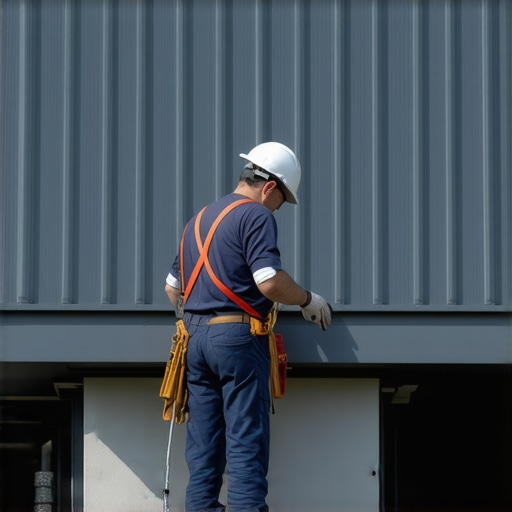
The Desert Sun vs. Your Metal Roof: A Forensic Investigation
Listen, I’ve spent three decades staring at baked-out R-panels and standing seam systems that look like they’ve been through a war zone. My old foreman used to say, “The sun is a slow-moving fire. It doesn’t burn the house down in a day; it just cooks the life out of it for thirty years.” If you are looking at your commercial or residential metal roof and seeing that faded, chalky mess, don’t think for a second that your local roofers can just climb up there with a bucket and a brush and fix the problem. Metal is a living, breathing beast in the Southwest heat, and if you don’t understand the physics of what’s happening at the molecular level, you’re just throwing money into the wind.
When we talk about roofing in the desert, we aren’t just talking about keeping water out. We are talking about managing a radiator that reaches 160°F by noon. I’ve seen metal roofs expand so violently that they’ve sheared off the very fasteners holding them down—what we call “shiners” when they miss the purlin, but even when they hit the meat, the thermal expansion turns a round hole into an oval. By 2026, the coatings we use have to account for this violent movement, or they will simply delaminate and peel off like a bad sunburn. [image_placeholder_1]
“A roof is only as good as its flashing.” – Old Roofer’s Adage
Tip 1: The Physics of De-Chalking and Surface Energy
The first mistake most roofing companies make is underestimating the “chalk.” That white powder you see on your fingers when you touch an old metal roof? That’s the spent resin of the original factory finish. It is chemically dead. If you paint over that, you are painting over dust. I once performed a forensic tear-off where the new coating peeled off in sheets the size of bedsheets because the contractor didn’t understand surface energy. You have to move beyond a simple pressure wash. You need to achieve a specific surface profile. We use a high-pressure oscillating tip—not to just clean, but to etch the surface. The goal is to create more surface area for the new coating to bite into. If the substrate isn’t chemically hungry for the new layer, the bond will fail within two desert summers.
Tip 2: Thermal Cycle Synchronization
Metal moves. In places like Phoenix or Vegas, a standing seam panel can grow or shrink by nearly an inch over its length between the cold of a 4:00 AM desert floor and the peak heat of 2:00 PM. This is called thermal shock. When you’re selecting a coating in 2026, you aren’t looking for “paint.” You are looking for an elastomeric membrane with a high elongation percentage. But here is the catch: it has to have “memory.” If the coating stretches when the metal expands but doesn’t snap back when it cools, it creates microscopic wrinkles. These wrinkles become