
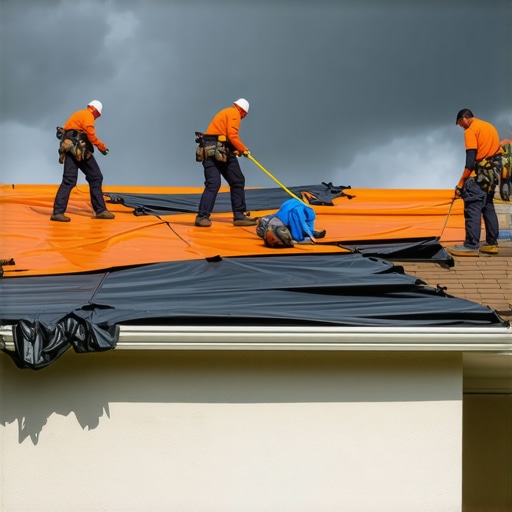
The Anatomy of a Storm Aftermath
My old foreman used to say, ‘Water is patient. It will wait for you to make a mistake.’ He wasn’t talking about the gentle pitter-patter of a spring shower; he was talking about the relentless, wind-driven assault of a Gulf Coast hurricane that finds the one ‘shiner’—that missed nail—hidden under a square of shingles. When the sky turns that bruised shade of purple and the gusts start lifting the tabs on your three-tab asphalt, the clock starts ticking. By the time the rain stops, the vultures are already circling. You’ll hear the ladders of local roofers hitting the gutters before you’ve even finished the insurance claim on your smartphone. But here is the cynical truth from twenty-five years on the roof deck: most emergency tarps installed by the first crew to knock on your door are about as effective as a screen door on a submarine. They aren’t roofing; they are theater.
“The primary purpose of a temporary roof covering is to provide a weather-tight seal to prevent further damage to the building’s interior and structure.” – National Roofing Contractors Association (NRCA)
The Physics of Tarp Failure: Mechanism Zooming
To understand why most tarps fail, you have to understand the Bernoulli effect. As wind speeds increase over the peak of your roof, it creates a zone of low pressure. If a tarp isn’t perfectly sealed, that low pressure acts like a vacuum, sucking the poly-weave material upward. This is ‘uplift.’ Once the tarp starts flapping, it’s not just noisy; it’s a hammer. It beats against the remaining granules of your shingles, stripping the UV protection and creating new leak points. Worse, an improperly secured tarp creates a ‘capillary draw.’ Water doesn’t just fall off the tarp; it gets sucked under the edges by surface tension, traveling uphill against gravity to find the very holes you were trying to cover. I’ve seen 2026 storm victims who thought they were safe because they had a blue tarp, only to find their attic insulation turned into a sodden, mold-growing sponge three days later because of simple physics.
Tip 1: The ‘Wrap-Around’ Ridge Logic
Never, and I mean never, let roofing companies terminate a tarp on the windward slope. Water is a lazy traveler; it follows the path of least resistance. If the tarp ends before the ridge, the water will simply run under the top edge. A forensic-grade tarp job requires ‘peak-wrapping.’ The material must go over the ridge and at least two feet down the opposite slope. This uses the geometry of the house as a natural barrier. Think of it like a saddle on a horse. If the saddle doesn’t clear the spine, it’s going to slide. By wrapping the ridge, you eliminate the highest point of entry where wind-driven rain is most likely to penetrate the secondary water resistance layer. If you see a roofer pulling out a roll of duct tape or trying to nail the top edge into the peak without a cap, fire them on the spot. They are amateurs dressed in neon vests.
Tip 2: The 1×2 Furring Strip Compression Seal
A tarp held down by just nails and washers is a sieve in waiting. Every nail is a new hole. In the forensic world, we look for ‘compression seals.’ This means using 1×2 wood furring strips to sandwich the tarp against the roof deck. You don’t nail the tarp; you nail the wood through the tarp. This distributes the pressure across the entire length of the wood strip rather than at a single point of failure. It prevents the grommets from ripping out when the wind decides to get nasty. We call it ‘lathing the roof.’ If your local roofers aren’t carrying bundles of wood strips up the ladder, they aren’t doing an emergency repair; they are doing a temporary favor that will fail by midnight. You want those strips spaced every two feet to prevent the ‘ballooning’ effect that occurs when air gets trapped underneath.
Tip 3: The 2026 Shift to Self-Adhered Membranes
By 2026, the industry has moved beyond the cheap blue poly-tarp for high-stakes scenarios. We are now seeing the rise of ‘sacrificial membranes.’ These are heavy-duty, self-adhering underlayments that stick directly to the plywood or remaining shingles. No nails, no holes, no flapping. If your contractor is still talking about ‘blue tarps and sandbags,’ they are living in 1998. The forensic advantage of a self-adhered ‘peel-and-stick’ emergency cover is that it creates a true hydrostatic seal. It’s the difference between wearing a raincoat and being vacuum-sealed in plastic. While it costs more per square, it survives 70 mph gusts that would shred a standard tarp in seconds. When you’re dealing with insurance adjusters, showing that you used a high-grade mitigation material can often justify the higher initial cost because it prevents the ‘secondary loss’ of interior drywall and flooring.
“All roof coverings shall be high-wind resistant and installed in accordance with the manufacturer’s instructions and the requirements of this code.” – International Residential Code (IRC)
Tip 4: The ‘Cricket’ and Valley Defense
Valleys are the most dangerous parts of a roof during a storm. They are the highways for water runoff. Most roofing companies just throw a tarp over the valley and call it a day. That creates a ‘bridge’ where water can pool. When that water pools, it gains weight. A single gallon of water weighs about 8.3 pounds. If you have fifty gallons sitting in a tarp-bridge over a valley, you have 400 pounds of pressure pushing down on a compromised structure. You must ‘contour’ the tarp into the valley, securing it with furring strips along the valley’s center line. If there is a chimney involved, you need a ‘cricket’—a small diversion structure—even if it’s just a temporary one made of lumber and tarp. Without a way to divert water around the chimney, the tarp will just act as a funnel, directing every drop of rain straight into the masonry gap.
The Insurance Trap: Functional vs. Cosmetic
Don’t let the ‘storm chasers’ fool you. They will tell you that every bruise on a shingle is a total loss. But insurance adjusters in 2026 are using drone-based AI to differentiate between ‘functional damage’ (leaks) and ‘cosmetic damage’ (granule loss). Your emergency tarp is your primary piece of evidence. If you don’t document the hole before it’s covered, you are giving the insurance company a reason to deny the claim. Take photos of the ‘oatmeal’ plywood, the missed nails, and the cracked rafters before the tarp goes down. A forensic roofer knows that the best claim is the one backed by a gallery of high-resolution photos showing the actual mechanism of failure. Don’t let a fast-talking salesman rush the process just to get his ’emergency fee.’ Protect your deductible by ensuring the mitigation is done right the first time. Waiting for a quality local roofer who understands wind-driven rain physics is better than hiring a ‘trunk slammer’ who will be three counties away by the time the next cloudburst hits.