
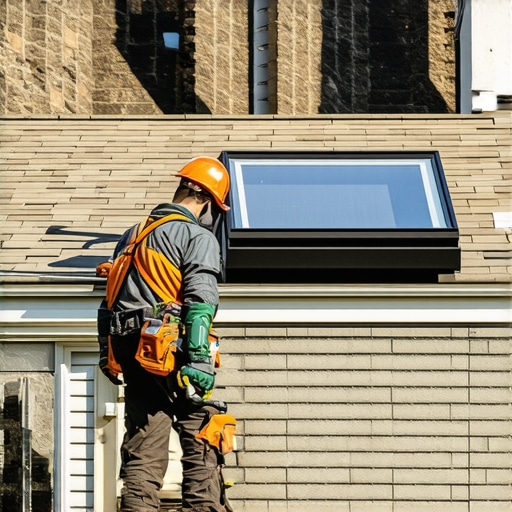
The 2:00 AM Drip: Why Your Skylight Is Failing
Walking on that roof felt like walking on a sponge. I knew exactly what I’d find underneath. The homeowner in the Northeast had called three different roofing companies, and each one just smeared more ‘silver bullet’ silicone around the frame. But the water didn’t care about their caulk. It was bypass air from the bathroom below, hitting the cold glass and raining back down, mimicking a leak while the actual roof deck was rotting from the inside out due to a lack of a proper cricket. That’s the reality of skylights in 2026—everyone wants the light, but nobody wants to do the math on the physics of water and vapor.
The Forensic Autopsy of a Modern Skylight Failure
When you see a stain on the drywall, you aren’t looking at the problem; you’re looking at the finish line. Water is a patient predator. It doesn’t always come through the glass. In cold climates, the primary enemy is the thermal bridge. If your local roofers didn’t wrap that curb in high-temp ice and water shield before the flashing went on, you’ve basically got a giant ice cube tray sitting on your house. As the heat from your home rises, it hits that uninsulated curb, creates condensation, and trickles down into the header. By the time you see it, the OSB is already turning into something that looks like damp shredded wheat.
“A roof is only as good as its flashing.” – Old Roofer’s Adage
We often find shiners—nails that missed the rafter—sticking through the deck right near the skylight. During a deep freeze, these nails grow a coat of frost from the attic humidity. When the sun hits the roof, that frost melts, and you swear the skylight is leaking. It isn’t. It’s a ventilation failure masquerading as a roofing disaster. This is why a forensic approach is the only way to save a roof without a total tear-off.
Fix 1: The Capillary Break and Step Flashing Overhaul
Most roofing companies treat skylight flashing like a suggestion. They try to use one long piece of ‘L’ metal or, heaven forbid, just a heavy bead of roof cement. The real fix for 2026 is the interwoven step flashing system. Each shingle needs its own piece of metal. Why? Because water uses surface tension to ‘climb’ sideways. If you don’t break that tension with individual steps, the water will find a way around the curb and under your underlayment. We see this constantly on 4-pitch roofs where the water slows down enough to pool. You need to ensure the head flashing has a proper hem to prevent wind-driven rain from being pushed uphill—a common physics failure in stormy regions.
Fix 2: Managing the ‘Silent Leak’ (Condensation)
If you’re in a cold zone, your skylight needs more than just shingles; it needs an air-tight seal at the ceiling plane. If warm, moist air from your kitchen or bath reaches the cold underside of the skylight frame, it will condense. You’ll see drips and blame the roofing, but the fix is actually spray foam or rigid insulation around the skylight well.
“The building envelope must be continuous to prevent unintended moisture transport.” – General Axiom of Building Science
Without this, you are just waiting for the wood to rot. Modern local roofers should be checking the R-value of the light well, not just the shingles around it.
Fix 3: The Diverter Cricket for High-Side Water
Any skylight wider than 30 inches acting as a dam on your roof needs a cricket. This is a small peaked structure built behind the high side of the skylight to split the water and send it around the corners. Without it, pine needles, leaves, and ice build up in a stagnant pool. That standing water eventually finds a ‘shiner’ or a small gap in the sealant. Building a proper cricket is a master-level trade skill that separates real roofing professionals from the guys who just learned to use a nail gun last week.
Fix 4: High-Velocity Wind and Secondary Seals
For those in coastal or high-wind areas, the standard deck-mount skylight is a liability if not installed with a secondary water resistance (SWR) layer. We’re talking about a full square of protection that extends 18 inches past the unit in all directions. In 2026, we are seeing more ‘micro-burst’ storms that push water horizontally. If your roofer didn’t use stainless steel fasteners, the salt air or even the chemicals in pressure-treated wood will eat those nails until the flashing literally blows away in a gale. Don’t let a ‘cheap’ quote lead to a $20,000 interior repair bill later.
The Cost of the Quick Fix
If a contractor shows up with a tube of caulk and tells you he can fix a skylight leak for $200, show him the door. Caulk is a maintenance item, not a roofing material. It dries out, cracks under UV radiation, and fails within two seasons of thermal expansion and contraction. A real fix involves pulling shingles, inspecting the deck, and replacing the flashing kits entirely. It’s surgery, not a band-aid. Protecting your home means finding roofing companies that understand the physics of the ‘drip’ and have the patience to track it to its source. Anything less is just pouring money down the gutter.