
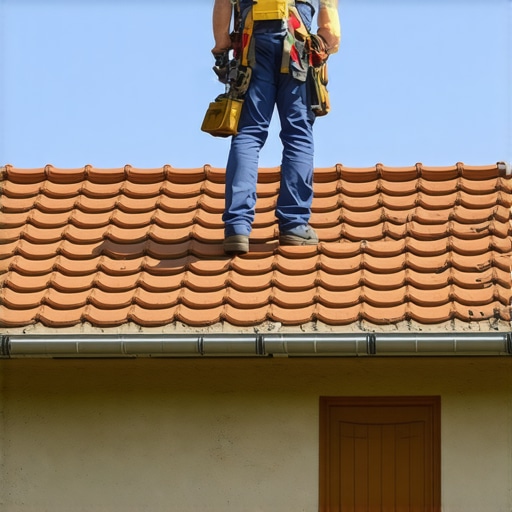
The Scorched Reality of Desert Roofing
I’ve spent the better part of three decades standing on baking clay and concrete tiles when the air temperature is a ‘mild’ 110 degrees, which means the roof surface is screaming at 160. My old foreman used to say, ‘Water is patient. It will wait for you to make a mistake.’ But in the Southwest, the sun is even more patient; it doesn’t wait for a mistake, it creates them. Most roofing companies will tell you that a tile roof is a ‘lifetime’ system. That’s a load of marketing garbage. The tiles might last fifty years, but the system—the fasteners, the battens, and that paper-thin underlayment—is usually gasping for air after fifteen. When I walk a roof and feel the tiles shifting under my boots like loose teeth, I don’t see a simple repair. I see the physics of failure in motion.
The Physics of the ‘Slipped’ Tile
Why do tiles move? It isn’t just gravity. It’s thermal expansion. During the day, that concrete slab absorbs heat and expands. At night, it sheds that heat and shrinks. This constant ‘pumping’ action puts a massive amount of stress on the fasteners. If your local roofers used cheap galvanized nails, those nails are likely rusted or, worse, the hole has wallowed out so much the nail just sits there, doing nothing. We call these ‘shiners’ when they miss the mark, but when they’re loose, they’re just hazards. Once a tile slips even an inch, it exposes the underlayment to direct UV radiation. In our climate, UV turns standard organic felt into potato chips in a matter of months.
‘The roof shall be covered with materials that are compatible with each other and the environment in which they are installed.’ – International Residential Code (IRC) R904.1
Fix 1: The Mechanical Fastener Evolution
The first fix for 2026 isn’t just banging in another nail. If you’re hiring roofing companies that still use standard smooth-shank nails, you’re paying for a temporary fix. The industry is moving toward stainless steel screws or ring-shank nails with specific coating depths. Why? Because the ‘withdrawal resistance’ of a smooth nail in old, dried-out 1×2 battens is practically zero. When we go in for a forensic fix, we look at the batten itself. If that wood is ‘checked’ or split, we have to move the fastening point. A loose tile is often a symptom of a failed substrate. If the wood can’t hold the metal, the tile is going for a ride down the pitch.
Fix 2: High-Velocity Foam Adhesive Systems
In high-wind areas or on steep pitches, mechanical fasteners sometimes aren’t enough. We’re seeing a shift toward polyurethane foam adhesives. This isn’t the stuff you buy in a can at the hardware store. This is a two-component structural foam that bonds the tile to the one below it and the batten. It provides a ‘dual-fix’ system. The beauty here is it eliminates the need to punch holes in your secondary water barrier. Every nail is a potential leak point. By using foam, you maintain the integrity of the underlayment while providing better wind-uplift resistance than any nail could ever offer. It’s about creating a monolithic shell rather than a collection of individual plates.
Fix 3: The Elevated Batten System (EBS)
If you want your roof to actually last, you have to stop the water from damming up behind the wood. Traditional flat battens act like little dams. Dust, bird droppings, and leaf litter get caught behind them, holding moisture against the underlayment. This leads to rot. The 2026 standard for high-end roofing involves elevated battens or ‘counter-battens.’ These allow water and airflow to move underneath the tile. Airflow is your best friend in the desert; it cools the underside of the tile and prevents the ‘thermal shock’ that causes tiles to crack and slip. If your local roofer isn’t talking about drainage planes, they aren’t thinking about the longevity of your home.
Fix 4: Transitioning to Synthetic Underlayment
The old-school 30lb or 40lb organic felt is a relic. It’s made of paper and asphalt. In the heat of the Southwest, the oils in the asphalt evaporate, leaving behind a brittle sheet of paper. For 2026, we are pushing for high-temp synthetic underlayments. These materials are UV-stable for up to 180 days, meaning even if a tile slips and you don’t notice it for a month, your house isn’t going to leak. They don’t tear, they don’t rot, and they don’t act as a food source for mold.
‘A roof is only as good as its flashing and its ability to shed water, not just hold it.’ – Old Roofer’s Adage
The Trap of the ‘Standard’ Warranty
When you call roofing companies, they’ll toss out words like ‘Lifetime Warranty.’ Read the fine print. Those warranties usually cover manufacturing defects in the tile—and as I said, the concrete tile almost never fails. The failure happens in the installation. They won’t cover a slipped tile caused by thermal expansion or ‘improper’ maintenance. You need a contractor who understands the specific micro-climate of your neighborhood. Is your house on a ridge that catches 60mph gusts? Or is it in a valley where heat gets trapped? A real pro looks at those factors before they ever give you a quote. Don’t fall for the ‘trunk slammer’ who offers a five-year labor warranty but changes his phone number every two seasons.
Identifying a Quality Local Roofer
Look for the ‘cricket.’ If a roofer doesn’t know what a cricket is—a small peaked structure behind a chimney to divert water—walk away. Look at how they handle valleys. Are they using ‘closed’ valleys where debris can rot out the metal, or ‘open’ valleys that stay clean? These details are the difference between a roof that lasts thirty years and one that needs a ‘tune-up’ every monsoon season. Tiles are heavy, dangerous, and require a specific skill set to set properly without creating ‘shiners’ or breaking the lugs. Your roof is the only thing protecting your biggest investment; don’t let a low-bidder turn it into a liability.
This article really highlights the importance of investing in quality roofing materials and skilled craftsmanship, especially in extreme climates like the Southwest. I’ve seen firsthand how cheap fasteners and neglecting proper airflow can lead to costly repairs down the line. The shift towards foam adhesives and elevated battens seems like a game-changer, especially for areas prone to high winds and thermal stress. One thing I wonder about is the long-term performance of synthetic underlayment—do you have any insights on how these materials hold up after, say, 10-15 years? I’m considering a roof upgrade for my home and want to ensure I choose the most durable options available. Also, I agree about the importance of a detailed micro-climate analysis; every neighborhood has its quirks, and a good roofing contractor should tailor solutions accordingly. Has anyone had experience with installing these high-end systems in older homes? Would love to hear your thoughts.