
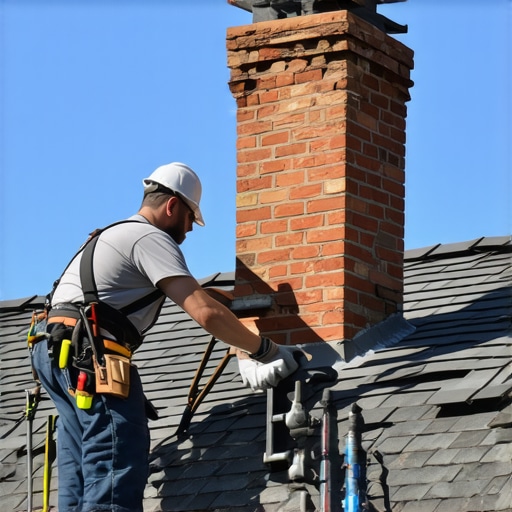
The Anatomy of a Ceiling Stain: Why Your Chimney is Winning the War
You wake up after a three-day Northeaster, walk into the living room, and there it is: a tea-colored ring circling the hearth. Most homeowners call local roofers and ask for a quick smear of caulk, thinking that’ll solve the problem. It won’t. As a forensic roofer who has spent three decades peeling back layers of rotten OSB and sodden fiberglass insulation, I can tell you that a chimney leak is rarely just a ‘hole’ in the roof. It is a systemic failure of physics. In the Northeast, where freeze-thaw cycles turn masonry into a sponge, the chimney acts like a vertical highway for water. When the wind drives rain against those bricks, they don’t just get wet—they saturate. My old foreman used to say, ‘Water is patient. It will wait for you to make a mistake, then it will sit in that gap for five years until your rafters look like Swiss cheese.’ Walking onto a roof in 2026, I see the same ‘trunk slammer’ mistakes being made: excessive use of ‘bull’ (roofing cement) instead of proper metalwork. To truly stop a leak, you have to understand the Mechanism of Failure. Water doesn’t just fall; it moves sideways through capillary action, it gets sucked upward by pressure differentials, and it exploits every ‘shiner’—those missed nails that act as heat sinks and water conduits. If you want your roof to survive the next decade, you need to move beyond basic repairs and look at the forensic fixes that professional roofing companies are finally adopting as standard.
“Flashing shall be installed at wall and roof intersections, at gutters and wherever there is a change in roof slope or direction and around roof openings.” – International Residential Code (IRC) R903.2
Fix 1: The Surgical Replacement of Counter-Flashing
The most common failure I see in 2026 is the ‘over-flash.’ This is where a lazy contractor simply nails a piece of tin over the old lead and slathers it in silicone. Proper counter-flashing requires a reglet cut—a deep groove sliced directly into the mortar joint. We’re talking about a mechanical bond here. By embedding the metal an inch deep into the masonry and securing it with lead wedges, you create a permanent drip edge that sheds water over the step flashing. Without this, water simply runs down the brick, gets behind the metal, and finds its way onto your ceiling. In cold climates, the thermal expansion and contraction of the roof deck compared to the stationary chimney stack will rip cheap caulk apart in a single season. You need the flexibility of a two-piece system. When local roofers ignore this, they are essentially setting a timer for your next leak. I’ve torn off chimneys where the wood underneath was so soft I could put my thumb through it because the counter-flashing was only held on by ‘hope and goop.’
Fix 2: Building a Proper Cricket (The Water Diverter)
If your chimney is wider than 30 inches and sits at the bottom of a slope, it’s acting like a dam. Debris—pine needles, maple helicopters, grit from the shingles—collects behind it, holding moisture against the flashing until the metal corrodes or the water find a way over the top. The fix is a ‘cricket.’ This is a small, peaked roof structure built behind the chimney to divert water to the left and right valleys. In 2026, we are seeing more roofing companies using prefabricated stainless steel crickets rather than site-built wood ones, which can rot if the shingles above them fail. A cricket changes the geometry of the roof. It prevents hydrostatic pressure from building up during heavy downpours. Think of it as a snow plow for your roof. Without it, you’re just waiting for the next big storm to push water under the shingles through sheer volume. I once investigated a mansion where a $50,000 interior paint job was ruined because the roofer saved $200 by not building a cricket. Don’t be that homeowner.
“A chimney is a bridge between the controlled environment of your home and the chaotic environment of the sky; if that bridge isn’t sealed with metal, it will fall.” – Old Roofer’s Axiom
Fix 3: Addressing Masonry Porosity with Silane-Siloxane Sealants
Sometimes, the roof is perfect, the flashing is copper, and the chimney still leaks. This is the ‘Sponge Effect.’ Old bricks, especially those fired decades ago, are incredibly porous. In 2026, the industry is shifting toward high-end Silane-Siloxane breathable sealants. Unlike old-school paints that trap moisture inside the brick (causing it to spall and explode when it freezes), these modern sealants penetrate the surface and change the surface tension of the masonry. Water beads up and rolls off like it’s hitting a freshly waxed car. This is crucial in northern zones where ice dams can sit against a chimney for weeks. If the brick absorbs that melt-water, it will bypass the flashing entirely by traveling through the core of the chimney wall. I’ve seen chimneys that looked solid from the ground but were literally dissolving from the inside out because they hadn’t been sealed in twenty years. If your roofing companies aren’t talking about masonry porosity, they’re only giving you half the story.
Fix 4: The ‘Kick-Out’ Flashing and Step-Flashing Weave
The final line of defense is the step-flashing. This is a series of L-shaped metal pieces woven into every single course of shingles. A common mistake is using one long piece of ‘apron’ flashing along the side of a chimney. This is a death sentence for your roof. Why? Because as the house settles, that long piece of metal will buckle and create gaps. Step-flashing allows for movement. Each piece overlaps the one below it, ensuring that gravity is always on your side. Furthermore, at the very bottom of the chimney where it meets the eaves, you must have a ‘kick-out’ flash. This is a specialized piece of metal that directs the water away from the wall and into the gutter. Without a kick-out, that water gets shoved behind the siding of your house, rotting the corner posts and fascia boards. It’s a $15 piece of metal that saves $15,000 in structural repairs. When I perform a forensic audit of a roof, the first thing I look for is the kick-out. If it’s missing, I know the crew was rushing. In the world of local roofers, the difference between a 30-year roof and a 5-year roof is found in these tiny, boring details. You don’t want a roofer who is fast; you want one who is obsessed with the path of a single raindrop.
Conclusion: The Cost of a ‘Cheap’ Fix
In 2026, the price of materials is only going up, and the cost of labor is following. It’s tempting to go with the lowest bid for a chimney repair, but in the roofing world, you get exactly what you pay for. A cheap repair is just a down payment on a future disaster. When you hire roofing companies, ask them about the ‘reglet,’ the ‘cricket,’ and the ‘kick-out.’ If they look at you like you’re speaking Greek, show them the door. Your home is likely your biggest investment; don’t let a poorly flashed chimney be the reason it rots from the top down. Water is patient, but you shouldn’t be. Fix it right, fix it once, and sleep through the next storm without checking the ceiling for stains.
Reading this detailed breakdown of chimney leak fixes really underscores how critical proper flashing and masonry maintenance are for long-term roof health. Like many homeowners, I initially thought applying some sealant or simple patching would do the trick, but this post highlights the systemic nature of water infiltration—especially in freeze-thaw environments like the Northeast. I appreciated the emphasis on the reglet cut for counter-flashing because I found that many contractors overlook this step, leading to future problems. Also, I was intrigued by the use of stainless steel crickets; in my experience, they’ve been a game changer in preventing water pooling. Has anyone here dealt with re-sealing old brick chimneys using Silane-Siloxane sealants? How effective was it long-term? It seems like a smart investment given the porosity of historic bricks, but I wonder about the maintenance involved.