
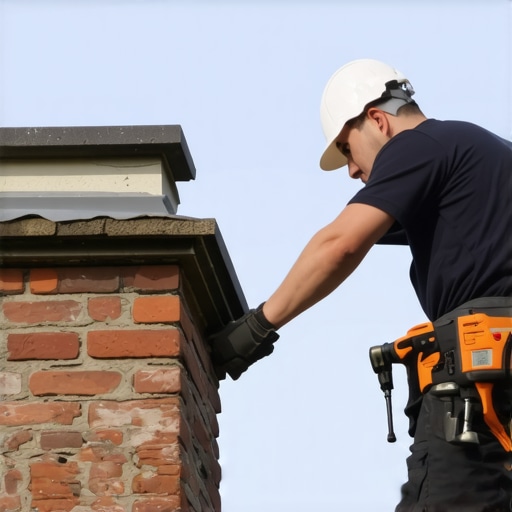
The Forensic Autopsy: Why Your Living Room Ceiling is Currently a Waterfall
You probably didn’t notice the drip until the brown ring appeared on your ceiling, right between the fireplace and the built-ins. Most homeowners think a roof leak is a catastrophic event, a sudden hole ripped open by a branch. But as a forensic roofer who has spent three decades crawling through 140-degree attics and peeling back layers of rotted cedar, I can tell you: water is much more calculated than that. My old foreman used to say, ‘Water is patient. It will wait for you to make a mistake.’ And nowhere is that mistake more common than where the chimney meets the roof deck.
When I walk onto a job site and see a chimney slathered in three inches of black plastic cement—what we call ‘roofing tar’—I know exactly what I’m looking at. I’m looking at a crime scene. That tar is the signature of a ‘trunk-slammer’ who didn’t know how to work with metal. Beneath that sticky mess, the physics of failure are already at work. This isn’t just about ‘roofing’; it is about managing the relentless capillary action that pulls moisture uphill and behind your defenses.
The Physics of the Leak: Why Chimneys Fail
Local roofers often overlook the way a house breathes. In the North, your chimney is a massive thermal bridge. It gets hot when the furnace kicks in, then it hits the freezing air of a January night. This causes the masonry to expand and contract. If your flashing is nailed tight to both the roof and the chimney, it is going to tear. It is inevitable. Once that seal breaks, even by a fraction of a millimeter, surface tension takes over. Rainwater doesn’t just fall; it clings. It rolls down the brick, hits the gap, and is sucked inward by a vacuum-like effect. Once it hits the plywood, it turns that structural wood into something resembling wet oatmeal. I’ve seen rafters so soft you could stick a screwdriver through them with one finger.
“Flashing shall be installed in such a manner as to prevent moisture from entering the wall and roof through joints in copings, through moisture-permeable materials, and at intersections with dissimilar materials.” – International Residential Code (IRC), Section R903.2
Fix 1: The Cricket—Your Roof’s Best Friend
If your chimney is wider than 30 inches and you don’t have a cricket, you have a swimming pool on your roof. A cricket, or saddle, is a small peaked structure built behind the chimney on the upslope side. Its sole job is to divert water around the masonry. Without it, water damming occurs. Leaves, pine needles, and snow pile up in that dead space. As that debris rots, it holds moisture against the flashing until the metal eventually pinholes or the underlayment gives up. In 2026, roofing companies are moving away from simple metal diverters toward fully framed crickets covered in high-temp ice and water shield. If your roofer doesn’t mention a cricket during the estimate for a large chimney, find another contractor. They are setting you up for a ‘shiner’—a missed nail that will weep water every time it thaws.
Fix 2: Reglet-Cut Counter Flashing
The biggest sin in modern roofing is ‘surface-mount’ flashing. This is when a contractor just nails a piece of metal to the brick and runs a bead of caulk along the top. That caulk will fail in 24 months. Period. The sun’s UV rays bake it, the wind pulls at it, and eventually, it peels. The only real fix is a reglet cut. We take a diamond-blade grinder and cut a one-inch-deep groove directly into the mortar joint or the brick itself. The metal flashing is then ‘hemmed’ and tucked into that groove. It’s held in place with lead wedges and then pointed with masonry caulk. This creates a mechanical overlap. Water running down the brick has no choice but to jump onto the metal and shed away. It’s the difference between a band-aid and surgery.
Fix 3: High-Temp Underlayment (The Secondary Defense)
In our climate, standard felt paper is a joke. It’s thin, it tears, and it dries out after five years of thermal cycling. For a 2026-compliant chimney fix, we use a dedicated high-temp ice and water shield. This is a rubberized asphalt membrane that sticks directly to the wood deck. Why high-temp? Because chimneys get hot. Standard membranes can actually melt and ooze out from under the shingles, leaving a black mess on your siding. This membrane acts as a self-healing gasket. Every nail driven through it is wrapped in a bit of ‘gum’ that prevents water from tracking down the shank of the nail. It is your last line of defense when the wind is blowing 60 mph and pushing rain sideways under your shingles.
“The NRCA recommends that flashing systems be designed to accommodate the expected thermal movement of the roof system and the building’s structural components.” – National Roofing Contractors Association (NRCA)
Fix 4: The Kick-out Flashing
If you’ve ever seen rot at the very bottom of a chimney where it meets the gutter line, you’re looking at a missing kick-out. This is a specially shaped piece of metal that ‘kicks’ the water away from the wall and into the gutter. Without it, all the water collected by the chimney flashing is dumped directly into the siding or the fascia board. It’s a five-dollar part that saves a five-thousand-dollar repair. Local roofing companies often skip this because it’s ‘fussy’ to install with siding, but skipping it is negligence. I’ve torn off ‘new’ roofs where the corner post was entirely rotted out because the previous crew didn’t want to spend ten minutes fitting a kick-out.
How to Vet Your Roofing Company
When you start calling roofing companies for quotes, don’t ask for a price per square. Ask them how they handle the counter-flashing. If they say ‘we use a high-grade sealant,’ hang up. You want to hear the words ‘reglet cut,’ ‘step flashing,’ and ‘cricket.’ Look for a crew that carries a metal brake on their truck. If they are buying pre-bent, flimsy aluminum from a big-box store, they aren’t craftsmen; they are installers. You need a craftsman. A chimney is a three-dimensional puzzle of water management. One wrong bend, one ‘shiner’ in the valley, and you’ll be calling me in three years to figure out why your ‘new’ roof is still leaking. Don’t let your chimney be the weak link in your home’s armor. Do it right, or you’ll be doing it twice.