
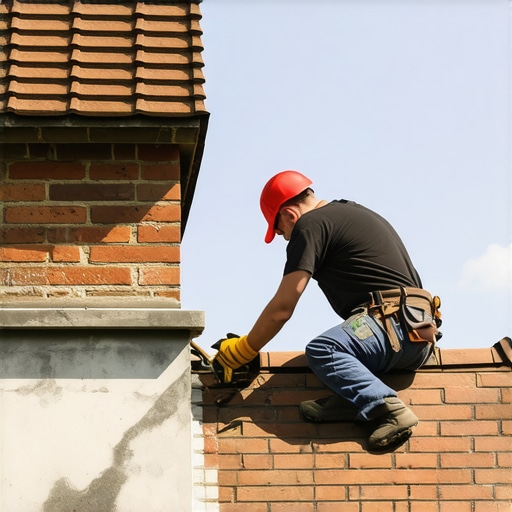
The Midnight Drip: A Forensic Look at Chimney Failure
You hear it before you see it. It is 2:00 AM on a Tuesday, and there is a rhythmic tink-tink-tink against the drywall in your bedroom ceiling. By morning, there is a tea-colored stain spreading across the paint. Most homeowners call local roofers and ask for a quick patch, but after twenty-five years of pulling up shingles, I can tell you that a ‘patch’ is just a slow-motion disaster. When we talk about chimney leaks, we are talking about a failure of physics, not just a hole in a shingle. Water is patient; it does not move in straight lines. It uses capillary action to climb upward, surface tension to cling to the underside of metal, and hydrostatic pressure to find the one ‘shiner’—a missed nail—that a lazy installer left behind in the valley.
My old foreman, a man who had more tar under his fingernails than blood in his veins, used to tell me, ‘Water is patient. It will wait for you to make a mistake, and then it will wait ten years to prove you wrong.’ He was right. Chimneys are the most complex intersection on any roof deck because you are trying to marry two completely different materials: rigid masonry and flexible wood framing. They expand and contract at different rates. If your roofing companies aren’t accounting for that movement, your chimney is a ticking time bomb.
“Flashings shall be installed in a manner that prevents moisture from entering the wall and roof through joints in copings, through moisture-permeable materials and at intersections with parapet walls and other penetrations.” – International Residential Code (IRC), Section R903.2
Fix 1: The Cricket – Solving the ‘Dead Valley’ Problem
If your chimney is wider than 30 inches and sits on the downslope of your roof, it acts like a dam. In the North, where snow piles up, that chimney backer becomes a collection point for slush. As the heat from the fireplace warms the bricks, it melts the bottom layer of snow. This water has nowhere to go because the exit is blocked by the chimney. It pools, finds a seam, and then freezes again, expanding and lifting the shingles. This is the ‘Ice Dam’ effect localized to your masonry. The fix for 2026 isn’t just more tar; it is a properly framed cricket. A cricket is a small, peaked false roof built behind the chimney to divert water to the left and right. Without a cricket, you are relying entirely on the sealant, and in a freeze-thaw cycle, sealant is a temporary prayer. Local roofers who skip the cricket are setting you up for a dry-rot nightmare in your roof deck within five years.
Fix 2: Step Flashing Over ‘L’ Flashing
I see this every week: a ‘trunk slammer’ contractor takes a long, continuous piece of metal and tucks it under the shingles and against the brick. They call it ‘flashing.’ I call it a lawsuit. Continuous flashing cannot handle the house settling. When the roof deck moves even a fraction of an inch, that long piece of metal buckles. Once it buckles, it creates a ‘fish-mouth’ opening that sucks in wind-driven rain. The only real fix is step flashing. This involves individual 7×7 inch pieces of metal bent at a 90-degree angle, woven into every single course of shingles. This way, each shingle has its own independent water shield. If one moves, the system stays intact. It takes three times longer to install, which is why cheap roofing companies hate it. But if you want a dry house in 2026, you don’t compromise on the weave.
Fix 3: The Reglet-Cut Counter Flashing
Most roofing companies just ‘smear and steer.’ They nail the metal to the brick and cover the top edge with a bead of caulk. Give that caulk two years in the sun, and it will shrink, crack, and pull away. Now you have a funnel directing water directly behind your flashing. The forensic fix is a reglet cut. We use a diamond-blade grinder to cut a one-inch deep groove directly into the mortar joint of the chimney. We then hem the top of the metal counter-flashing and tuck it into that groove. We lock it in with lead wedges and seal it with high-performance polyurethane. This creates a mechanical overlap. Even if the sealant fails, the water literally cannot get behind the metal because physics forces it to jump over the ‘lip’ and onto the roof surface. It is the difference between wearing a raincoat and just holding an umbrella in a hurricane.
“A roof is only as good as its flashing; the most expensive shingle in the world is worthless if the transitions are ignored.” – National Roofing Contractors Association (NRCA) Guidelines
Fix 4: Self-Adhering Membrane Transitions
In 2026, we have moved beyond simple felt paper. The area around a chimney should be wrapped in a high-temperature, self-adhering ice and water shield. This membrane needs to be ‘lapped’—meaning the bottom layer goes under the top layer—at least six inches up the masonry wall before the metal ever touches it. Think of this as your secondary line of defense. If a gust of wind drives rain up and under your shingles, this membrane is what keeps the plywood from turning into oatmeal. When I perform an autopsy on a failed roof, I usually find that the installer stopped the underlayment two inches short of the chimney. That two-inch gap is where the rot starts. It eats the fascia boards, then the rafters, and finally, it eats your bank account.
The Cost of the ‘Cheap’ Roofer
You will get three quotes. One will be significantly lower than the others. That guy isn’t ‘efficient’; he’s cutting out the cricket, he’s using ‘shiners’ in the valley, and he’s reusing your old, rusted counter-flashing. When you hire local roofers, ask to see photos of their reglet cuts. Ask how they handle the ‘back-pan’ of the chimney. If they look at you like you’re speaking a foreign language, show them the door. You are paying for a dry home, not just a pile of shingles on your lawn. A chimney fix done right in 2026 should last thirty years. A ‘patch’ will last until the next big thunderstorm. Choose the surgery over the band-aid every single time.