
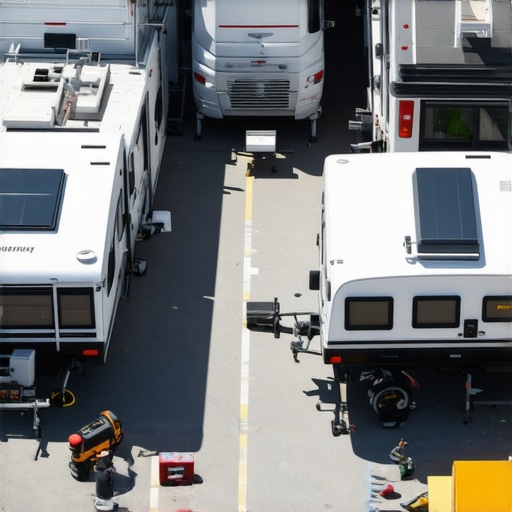
The Truth About RV Roof Coatings: What Your Local Roofers Won’t Tell You
I have spent twenty-five years tearing off roofs that failed far too soon. I have seen it all: the ‘cheap’ fixes that ended up costing more than a total replacement and the ‘pro’ jobs that were anything but professional. When it comes to RV roofs, the stakes are even higher than a standard residential job. You are not just dealing with a stationary structure; you are dealing with a vibrating, shifting, wind-blasted box that experiences an earthquake every time it hits sixty miles per hour on the interstate. My old foreman used to say, ‘Water is patient. It will wait for you to make a mistake.’ On an RV, that mistake usually happens at a seam or a vent flashing because someone thought a five-dollar tube of caulk was a substitute for real engineering.
The Material Truth: Why Most RV Roofs Fail
Most roofing companies will tell you that a roof is a roof, but that is a lie. A residential roof stays still. An RV roof is constantly under stress. Whether you have EPDM (Ethylene Propylene Diene Monomer), TPO (Thermoplastic Polyolefin), or fiberglass, the enemy is the same: UV radiation and thermal expansion. In the Southwest, where the sun feels like a heat lamp, I have seen EPDM membranes turn into a white, chalky mess. This is not just ‘wear’; it is a chemical breakdown. The UV rays literally break the carbon bonds in the rubber, turning your expensive roof into dust that washes down the side of your rig, leaving streaks on your windows and exposing the delicate scrim underneath. Once that scrim is exposed, capillary action takes over. Water hits the fabric-like center of the membrane and is wicked horizontally under the edges of your lap sealant. You won’t see the leak inside for months, but meanwhile, your luan decking is turning into soggy oatmeal.
“A roof is only as good as its flashing.” – Old Roofer’s Adage
The 4 Best 2026 Coatings for RV Roofs: Forensic Analysis
If you are looking at roofing companies to coat your rig, you need to know what materials actually work. We are looking for high elongation, superior UV resistance, and the ability to bond to a variety of substrates without peeling off like a bad sunburn. Here are the top four contenders for the 2026 season.
1. High-Solids Silicone: The Hydrophobic King
Silicone has become the industry standard for a reason. Unlike acrylic, silicone is ‘hydrophobic’—it actually repels water. It does not break down under standing water, which is a common problem on RVs where the roof might have slight depressions. When we talk about Mechanism Zooming, we have to look at the molecular level. Silicone forms a monolithic gasket over your entire roof. It does not just sit on top; it creates a moisture-cured bond that remains flexible down to negative forty degrees. For those of you storing your rigs in the North, this is non-negotiable. You need a material that can handle the freeze-thaw cycle without cracking. However, be warned: nothing sticks to silicone except more silicone. If you go this route, you are committed. You cannot go back to an acrylic or a urethane later without a complete tear-off.
2. Aromatic Polyurethane: The Abrasion Defense
If you are the type of traveler who likes to park under trees or spends time in the brush, polyurethane is your best bet. It is much tougher than silicone. While silicone is soft and can be torn by a low-hanging branch, polyurethane has incredible tensile strength. It is often used as a base coat in two-part systems because it grips the substrate like a vice. In my years as a forensic investigator for roofing companies, I have seen polyurethane coatings survive hail storms that shredded standard asphalt shingles. The downside? It is not as UV-stable as silicone, which is why it usually requires an aliphatic topcoat to prevent yellowing and brittleness.
3. SEBS Thermoplastic: The Extreme Weather Shield
SEBS (Styrene-Ethylene-Butylene-Styrene) is a high-performance synthetic rubber. It is often the choice for local roofers who deal with commercial flat roofs, but it has migrated to the RV market with great success. The advantage here is its ability to handle ‘Thermal Shock.’ In places like Phoenix or Vegas, a roof can hit 160 degrees in the afternoon and drop to 60 at night. That 100-degree swing causes the materials to expand and contract violently. SEBS has a massive elongation percentage—meaning it can stretch and return to its original shape without losing its bond. It acts like a giant rubber band stretched over your roof.
4. Liquid EPDM: The Chemical Restoration
For those with older rubber roofs, liquid EPDM is a unique beast. It is not just a coating; it is a chemical weld. It uses a catalyst to create a cross-link bond with the existing membrane. If you apply this correctly, the new layer becomes part of the old layer. This is the ‘surgery’ approach rather than the ‘band-aid’ approach. I have seen liquid EPDM jobs last fifteen years when the prep work was done right. If you miss a square of cleaning, however, it will bubble. I have seen ‘shiners’—missed nails or screws—under the original membrane that started to rust, and the liquid EPDM actually encapsulated the rust and stopped it from spreading. It is impressive stuff when handled by a pro.
The Warranty Trap: Don’t Be Fooled
When you call local roofers for quotes, they will throw around words like ‘Lifetime Warranty.’ In the roofing world, ‘Lifetime’ is marketing nonsense. Most of these warranties only cover ‘manufacturers’ defects,’ which are almost impossible to prove. They do not cover ‘improper installation’ or ‘lack of maintenance.’ If you don’t keep your lap sealant fresh or check your flashings every six months, the warranty is a piece of paper meant for the trash bin. A real pro will tell you that the coating is only 20% of the job; the other 80% is the prep work. If the roofing companies you are talking to aren’t talking about TSP washes, seam tapes, and mechanical cleaning, keep looking. You cannot put a premium coating over a dirty roof and expect it to stay.
“Buildings are for people, but roofs are for the elements.” – Architectural Axiom
The Physics of the Application: Avoid the DIY Disaster
I once walked onto an RV roof in the middle of summer that felt like walking on a sponge. The owner had tried to save a few bucks by using a hardware store acrylic white paint. Not only did it not bond, but it trapped moisture in the luan underneath. The physics are simple: if the coating can’t ‘breathe’ to some extent or if it doesn’t have a perfect seal, you are creating a greenhouse for rot. Every vent, every AC unit, and every ladder mount is a potential failure point. You need a cricket or a specialized diverter for any area where water might pool. Local roofers who understand the ‘Trade’ know that you have to treat every screw head like a potential leak. We don’t just roll the coating on; we ‘detail’ the penetrations first with a high-viscosity grade of the material. This is where the ‘trunk slammers’ fail—they skip the detailing and go straight to the roller.