
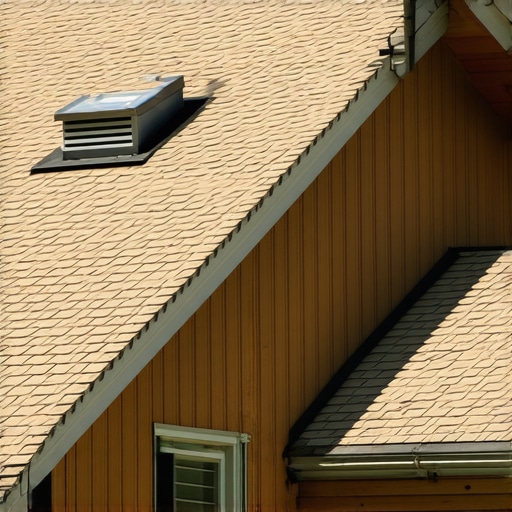
The Invisible Saboteur: Why Your New Roof is Suffocating
My old foreman, a grizzly guy named Miller who’d been on the tools since the late 70s, used to lean over a 12/12 pitch and tell me, ‘Kid, water is patient, but heat is aggressive. Water will wait for you to miss a nail, but heat will eat this whole house from the inside out while you’re sleeping.’ He wasn’t exaggerating. As I look toward the 2026 building standards, roofing companies are facing a crisis of ‘tight’ houses. We are building homes so sealed up that the attic has become a pressure cooker. If you are hiring local roofers to slap a new layer of architectural shingles on a steep-slope deck without addressing the breathability, you aren’t buying a roof; you’re buying a mold farm.
“Ventilation of the attic space shall be provided with an unobstructed chimney effect from the eave to the ridge.” – International Residential Code (IRC) R806.1
When we talk about a ‘Steep Roof’ in the industry—anything over a 6/12 pitch—we are dealing with a massive volume of trapped air. In a cold climate like the Midwest or Northeast, that air is laden with moisture from your dishwasher, your showers, and your breath. It migrates upward through ‘attic bypasses’—those tiny gaps around your recessed lights or pull-down stairs. Once that warm, wet air hits the underside of your cold roof deck, it undergoes a phase change. It turns from invisible gas to liquid water, or worse, ‘frost feathers.’ I’ve walked into attics in January where the plywood was covered in two inches of white fur. When that melts in the spring, homeowners call me screaming about a leak. It’s not a leak. It’s a ventilation failure.
1. The Balanced System: Ridge Vents and Continuous Soffits
The first and most effective way any reputable roofing company will suggest is the balanced intake-and-exhaust system. Think of it as the lungs of the house. You need air coming in at the lowest point (the soffits) and exiting at the highest point (the ridge). This relies on the Bernoulli Principle and the Stack Effect. As wind blows over the peak of your roof, it creates a low-pressure zone that literally sucks the hot air out of the ridge vent. However, this only works if your local roofers aren’t lazy. I can’t tell you how many times I’ve seen a ‘shiner’—a missed nail—holding down a ridge vent that has no hole cut under it. If the roofer didn’t cut the slot in the decking, that plastic vent is just a decoration. You need at least 1 square foot of net free ventilating area for every 300 square feet of attic floor space. Without the intake at the eaves, the ridge vent will actually start pulling air in from the house, wasting your heating dollars.
2. The ‘Vented Nail Base’ for Vaulted Ceilings
By 2026, more homeowners are opting for those beautiful, high-vaulted ‘cathedral’ ceilings. These are a forensic nightmare for roofing. There is no attic. The insulation is packed right against the roof deck. In this scenario, we use what we call a vented nail base or ‘Techno-vent.’ This is a sandwich of polyisocyanurate foam and OSB with a built-in air gap. It allows air to move from the eave to the ridge directly under the shingles but above the insulation. Without this, the shingles reach temperatures of 160°F or higher. This heat causes ‘thermal shock’—the shingles expand and contract so violently that the granules pop off like a cheap scab. If your roofing company doesn’t mention a ‘baffle’ or a ‘vented spacer’ for your vaulted ceiling, fire them immediately.
“A roof is only as good as its flashing and its ability to shed heat.” – NRCA Manual
3. Mechanical Extraction: Solar-Powered Attic Fans
The third way, often necessary for complex rooflines with multiple valleys and hips where a continuous ridge isn’t possible, is mechanical extraction. By 2026, we’ve moved past the old ‘whirlybirds’ that squeak in the wind. We are now using smart, solar-powered fans with integrated humidistats. These don’t just kick on when it’s hot; they kick on when the humidity crosses 60%. This is the ‘Forensic Fix.’ I once investigated a roof in a high-snow-load area where the ‘cricket’—that little peak behind the chimney—was constantly rotting. The problem was a dead air pocket. A properly placed mechanical vent creates a forced-air flow that eliminates these stagnant zones where rot likes to hide.
The ‘Lifetime Warranty’ Trap
Be careful when roofing companies lead with the ‘Lifetime Warranty’ pitch. If you read the fine print on a shingle manufacturer’s warranty, they have a massive ‘Out Clause’: Ventilation. If your attic temperatures exceed a certain threshold due to poor airflow, that 50-year warranty is void on day one. Most ‘trunk slammers’—contractors who work out of their trucks and vanish after the check clears—won’t tell you that. They’ll nail down the shingles over a clogged soffit and leave you to deal with the delaminated plywood five years later. Look for local roofers who carry a moisture meter and a thermal camera. If they aren’t looking at your insulation and your intake vents, they aren’t roofing; they’re just decorating your house with asphalt.