
The 2:00 AM Drip: Why Your Attic is Currently Losing a War Against Physics
I can usually smell a failing vent pipe before I even get my ladder off the rack. It is a specific, cloying scent—halfway between a damp basement and the sour rot of OSB plywood that has been wet for three seasons too many. Most homeowners don’t notice it until the first brown ring appears on the drywall above the master shower, or worse, until a heavy rain causes a rhythmic plink-plink-plink against the insulation. By then, the forensic evidence is clear: the roof didn’t fail, the penetration did. As we approach 2026, we are hitting the ‘expiry wall’ for the millions of cheap, rubberized boots installed during the housing booms of the last decade. My old mentor, a man who had replaced more squares of shingle than I’ve had hot meals, used to tell me, ‘Kid, a roof isn’t a shield; it’s a series of managed failures. The vent pipe is where the failure happens first because that’s where you’ve dared to poke a hole in the armor.’ He was right. Water is patient. It doesn’t need a gash; it just needs a microscopic crack and the laws of capillary action to turn your attic into a swamp.
Sign 1: The Molecular Breakdown of the Neoprene Collar
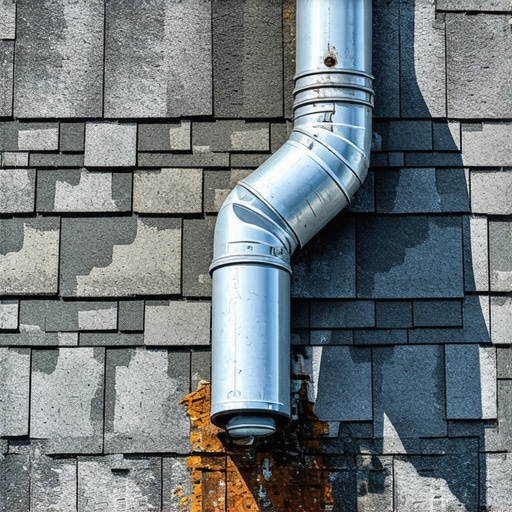
The first sign of the 2026 failure cycle is what I call ‘alligatoring’ of the pipe boot. Most roofing companies use standard EPDM or neoprene collars because they are fast to install. But physics is a brutal landlord. In a cold climate, that rubber collar spends the winter shrinking in sub-zero winds and the summer expanding in 140°F attic heat. By the time it hits its tenth year, the plasticizers have leached out. The rubber becomes brittle. If you look closely, you’ll see tiny fissures that look like lizard skin. This is where local roofers often miss the mark—they see a boot that looks ‘okay’ from the ground, but up close, those cracks are wide enough to draw water in through hydrostatic pressure. When rain hits that pipe, it doesn’t just run off; it clings to the PVC, and the cracks act like a straw, sucking moisture under the shingle line where it hits the ‘shiner’—that missed nail the original crew left behind—and starts the rot process.
“All roof penetrations shall be flashed in accordance with the manufacturer’s instructions and shall be weather-tight.” – International Residential Code (IRC), R903.2
Sign 2: The ‘Ghost Leak’ and Thermal Bridging Condensation
Not every leak is actually rain. In the forensic roofing world, we deal with ‘ghost leaks.’ You see water on the floor, but it hasn’t rained in a week. This is a classic sign of vent pipe failure related to thermal bridging. The vent pipe is a direct straw of warm, moist air from your bathroom or kitchen leading through a freezing attic. If the flashing has pulled away even a fraction of an inch, or if the roofing material around the base wasn’t properly integrated with an ice and water shield, that cold air hits the warm pipe and creates heavy condensation. I’ve seen attics where the underside of the plywood was covered in frost because the pipe boot wasn’t air-sealed. When that frost melts, it mimics a roof leak perfectly. Most roofing companies will try to sell you a whole new roof, but a forensic investigator knows it’s an air-sealing and flashing issue at the penetration point. You are looking for ‘rust rings’ around the base of the pipe or water tracks that start at the very top of the insulation and work their way down.
Sign 3: The Flange Lift and Capillary Creep
The third sign is the mechanical lifting of the metal flange. Because of the extreme temperature swings we’re seeing, the different expansion rates between the plastic PVC pipe, the aluminum or lead flange, and the asphalt shingles create a ‘pumping’ action. Over time, this pumps the nails loose. Once that flange lifts even an eighth of an inch, you are at the mercy of capillary action. This is the physics of water moving sideways or even upward through tight spaces. Surface tension pulls the water under the flange, where it bypasses the shingles entirely. If your local roofers didn’t install a ‘cricket’ or a proper diverter on a wide chimney-style vent, or if they relied solely on a bead of caulk, you’re in trouble. Caulk is a five-year solution for a thirty-year roof. If you see ‘puckering’ around the base of the pipe where the shingles seem to be pushing upward, the flange is already failing. That is the moment for ‘surgery’—tearing back the surrounding squares, replacing the boot with a high-grade silicone or lead alternative, and properly weaving the new shingles back into the pattern.
“A roof is only as good as its flashing; the shingle is merely the aesthetic skin over the functional skeleton.” – Old Roofer’s Adage
The Forensic Verdict: Surgery vs. The Band-Aid
When you call roofing companies to look at these signs, watch their hands. If they reach for a tube of ‘goop’ (roofing cement or caulk), they are giving you a band-aid that will bake off in two summers. Real roofing repair involves removing the surrounding shingles to expose the deck. We look for ‘oatmeal’ plywood—wood so saturated it has lost its structural integrity. If the deck is soft, the pipe boot won’t hold a nail, and the cycle of failure repeats. The 2026 failure trend is avoidable, but it requires moving beyond the ‘trunk slammer’ mentality of just slapping a new collar over an old one. It requires understanding that the vent pipe is a high-stress transition zone that demands the best materials, not the cheapest rubber. If you ignore these three signs, the cost won’t just be a new pipe boot; it will be a full-scale mold remediation project in your attic. Don’t wait for the ceiling to fall in; the physics of failure are already at work.